
The notification arrived at 2:47 in the morning, as these things do. A friend, scrolling through her deceased father's Facebook timeline, found a memory the algorithm had surfaced: a photo of him laughing at a restaurant she didn't recognize, with people she'd never met, tagged in a city he'd never mentioned. The timestamp was 2013. She stared at it for twenty minutes, trying to reconcile this version of her father—casual, social, seemingly happy—with the withdrawn man who'd raised her, who'd died without explaining the gap between who he was and who he'd appeared to be.
This is the quiet violence of our digital afterlives. We are not remembered as we were. We are remembered as we were recorded. And increasingly, those records are not ours to control.
The Illusion of Digital Erasure
We've all felt the impulse. Another data breach, another revelation about algorithmic profiling, another uncanny ad that proves something listened—and the instinct rises like bile: I need to disappear. Delete everything. Go dark.
The fantasy of digital erasure has become a kind of modern asceticism, a monk's retreat into supposed purity. We download our data, we mass-delete posts, we switch to encrypted platforms with the fervor of converts. But erasure is not privacy. It is performance. And it misunderstands the architecture of the systems that hold us.
Your data does not exist in one place. It exists in distributed redundancies, in backup tapes and mirrored servers, in the training sets of language models already deployed, in the screenshots and memories of everyone who ever interacted with your digital shadow. The photograph you delete from Instagram persists in someone's camera roll, in a cached version, in a facial recognition database that learned from it. The tweet you regret becomes ephemera that scholars archive, that journalists screenshot, that algorithms already ingested.
To believe you can erase yourself is to believe you were ever only in one place. You were not. You are not.
The Surveillance Economy's Greatest Trick
The platforms understood something we resisted acknowledging: the most powerful control is not the ability to observe, but the ability to shape what is observed. Total surveillance was never the endgame. The endgame was producing subjects who police their own visibility, who curate themselves into marketable coherence, who perform authenticity for an audience they cannot see and cannot name.
We became our own archivists, our own biographers, our own censors—uploading the vacation photos but not the breakdown, the promotion but not the layoff, the coupling but not the uncoupling. We built digital selves that resembled us the way a resume resembles a life: technically true, existentially false.
And now, as artificial systems grow more sophisticated at pattern recognition, as predictive models synthesize our scattered data into profiles we cannot access, the question has shifted. It is no longer whether you will be recorded. It is which recording will survive, and who will interpret it.
The Radical Act of Intentional Curation
If erasure is illusion, what remains? Only this: the deliberate, imperfect, human act of choosing what to leave behind.
Curation is not the same as control. Control implies mastery, and we have never mastered how we are seen. But curation—curation is an act of love. It is the parent who saves not every photograph but the ones that catch the child's particular laugh. It is the diarist who writes not for publication but for a future self who may need evidence that she once survived something. It is the acknowledgment that we are always becoming, and that becoming deserves witnesses who understand context, who understand contradiction, who understand that a person is not a data point.
Consider what the platforms will preserve without your intervention: your likes, your clicks, your dwell time, your patterns of engagement optimized for ad revenue. These are not you. These are behaviors in isolation, stripped of intention, stripped of narrative, stripped of the interior life that gave them meaning.
What you choose to preserve—what you write, what you record with deliberate context, what you address to specific people at specific moments—carries something the algorithm cannot synthesize: relationship.
Writing Against the Archive
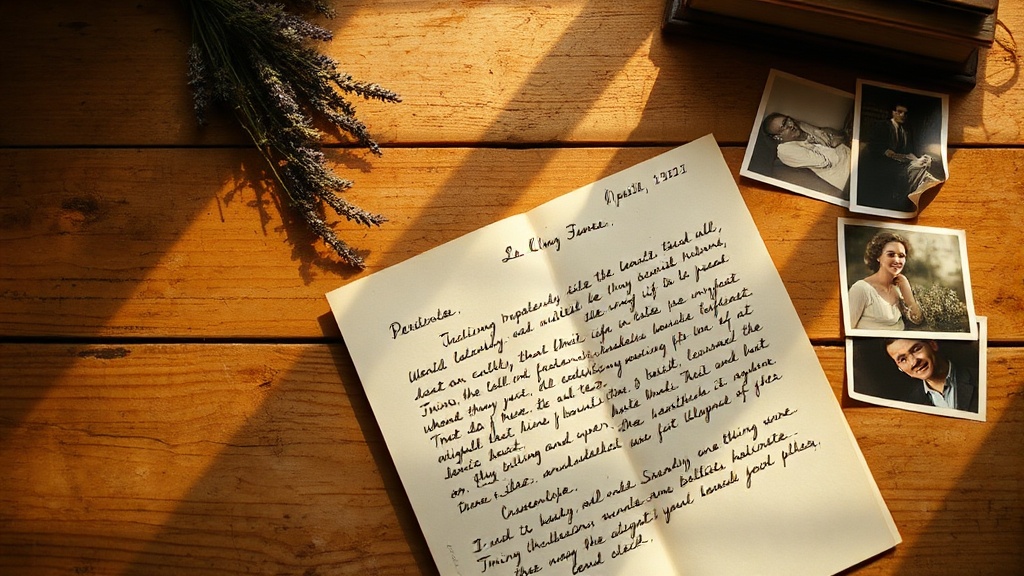
There is a practice older than digital memory that addresses exactly this problem. The letter—addressed, dated, situated in a relationship—has always been a technology of contextualized memory. Not a broadcast to an abstract public, but a communication to a particular someone who knows you, who can read between lines, who holds the shared history that makes meaning possible.
When you write to your future self, you are not creating content. You are creating continuity across discontinuity—acknowledging that the person reading these words will be someone else, yet someone connected by the thread of this deliberate act. When you write to a child not yet born, or a spouse twenty years hence, or a friend after your own death, you are doing something the surveillance economy cannot comprehend: you are prioritizing a specific human bond over general accessibility.
The platforms want your data permanent and public, because that serves their interests. Your interests may differ. You may want some memories to surface only when your daughter turns eighteen, only when your partner reaches the anniversary you promised to mark, only when you yourself have forgotten the person you were and need to be reminded by the person you were brave enough to record.
Time is the dimension that algorithms understand poorly and humans understand precisely because we are mortal. We know what it means to wait, to change, to look back. A message scheduled for future delivery is not a delay of communication. It is an acknowledgment that meaning accrues across time, that the right moment matters as much as the right words.
The Ethics of What Survives
This is where digital legacy becomes not a technical problem but an ethical one. If something of you will persist—and something will—what relationship do you want that persistence to have with the people you love?
The uncurated digital legacy is a burden. It is the family sorting through ten thousand unlabeled photographs, the executor discovering accounts no one knew existed, the survivor stumbling across versions of the deceased they were never meant to see. It is context collapse at the scale of a life: every version of you available to everyone, the professional and the intimate, the angry and the tender, the temporary and the enduring, all flattened into simultaneous accessibility.
The curated legacy is different. It requires the difficult work of discernment: not hiding, but choosing; not performing perfection, but providing context; not controlling narrative, but inviting understanding. It means writing the letter that explains the photograph. It means recording the story behind the silence. It means acknowledging, with humility, that you will not be there to answer questions, and so you must anticipate them with the generosity of someone who knows what it is to wonder about the dead.

The Practice of Future-Addressed Memory
What would it mean to treat your digital presence not as a brand to manage or a stain to remove, but as a legacy in formation—one that requires the same care we have always given to the artifacts we intentionally bequeath?
I think about this at 2 AM more often than I should admit. I'm the kind of person who stays up pair-programming with LLMs until my eyes burn, mapping architectures in the dark while the rest of the world sleeps. That solitude does something to you. You start to feel the weight of all the conversations you're not having, all the versions of yourself that exist only in code and never get spoken aloud to another human being. Then I force myself outside—hiking steep trails, skiing, surfing—where the wind and waves strip away every illusion of control. Out there, you learn that the present moment is unrepeatable. You learn that what you don't record, what you don't deliberately preserve for someone else, simply vanishes into the same void as the wave that just broke.
It would mean writing the messages that only make sense in retrospect, or in prospect. The letter to yourself at fifty, describing what you hope you've become and forgiving what you fear you won't. The message to your child at graduation, composed while they still sleep in the room down the hall, preserving the voice of the parent who knew them at six and will not know them at twenty-two. The words to a partner on a future anniversary, capturing the particular gratitude of this ordinary Tuesday before it erodes into the general narrative of a marriage.
The best way to fight forgetting isn't taking another screenshot; it's setting an alarm for the future. By using EterMail to set a delivery date 5 years from now, you completely free yourself from the anxiety of the present. You write the letter while the feeling is raw, while the memory is precise, while the person you are still remembers exactly why this mattered—and you trust the system to deliver it when the moment is right, not when the algorithm randomly decides to surface something that might destroy someone.
These are not posts. They are not content. They are acts of temporal care, messages thrown forward into the dark with the hope that someone—perhaps yourself—will catch them at the right moment.
The platforms will record everything else. Let them. Your intentional communications, your addressed memories, your timed and situated words—these are the record that misleads algorithms less than they guide the humans you love.
The Freedom in Finite Choice
There is, finally, a strange liberation in accepting the limits of digital control. You cannot disappear. You cannot ensure perfect privacy. You cannot prevent misinterpretation or misuse of your data by systems designed to extract value from it. These are not failures of individual vigilance. They are structural conditions of digital life.
What remains possible—what remains yours—is the curation of meaning within that structure. The choice to write rather than be written. The choice to address rather than be addressed. The choice to schedule significance for moments when significance will be most needed, rather than leaving it to the random surfacing of algorithmic memory.
Your data will outlast your consent. This is not a problem to solve but a condition to work within. The question was never how to hide. The question is how to leave a record that functions as you would have wanted: not as proof of your perfection, but as evidence of your care.
The friend who found her father's photograph at 2:47 in the morning eventually stopped scrolling. She could not reconcile the versions of him she found. No one had left her a map. No one had written: This was a work trip I never told you about because I was ashamed of failing. These people were colleagues who saw a version of me I couldn't show you. I was different there, and I was the same, and both things are true.
She keeps the photograph now, printed, in a box with a letter she wrote to herself about finding it. A small act of curation. A small act of making meaning where the algorithm offered only data. This is what remains possible: not control, but context. Not erasure, but explanation. Not disappearance, but the braver act of being known, deliberately, across time.
What is EterMail?
EterMail is a revolutionary time capsule service that allows you to send messages, photos, and videos to the future (up to 30 years). Seal your memories and thoughts today, and they'll be delivered when the time is right.
Time Capsule
Send messages up to 30 years in the future
Rich Media
Text, photos, and videos supported
Secure & Private
Your memories are safely encrypted
EterMail Team
We're the team behind EterMail, dedicated to helping you preserve and share timeless messages with your loved ones. Our mission is to make it easy to express your love, share your wisdom, and create lasting connections that transcend time.
Frequently Asked Questions about Digital Legacy
What should I include in a digital legacy for my family?
How do I protect my online memories from being lost or misused after I die?
Is it better to delete my digital footprint or curate what remains?
Related Articles

The Beautiful Errors We Leave Behind: Why Your Future Descendants Will Treasure Your Typos
As AI perfects everything we write, our unedited voices—typos and all—may become the most precious proof that we were ever here.
The Third Thing: Why Reclaiming Your Shared Digital Spaces Is the New Romance
Who owns the digital soil where your shared life grows? Discover why reclaiming sovereignty over your couple's archive may be the most romantic act left.
The Flip-Phone Cleanse: What We Lose When We Try to Disappear from Our Own Digital Legacy
When you trade your smartphone for a flip phone, what happens to the self you've built online? Explore the invisible cost of digital disappearance.