
The announcement arrived like a letter you knew was coming but refused to open. Boeing would stop building the 747. The Queen of the Skies, that impossible humpbacked monument to human ambition, would finish her final orders and fade into the same twilight that already claimed the Concorde, the ocean liner, the telegram. Fourteen hours to cross the Atlantic. No Wi-Fi. No streaming. Just the drone of engines and the slow, earned compression of distance into something you could feel in your body, something that changed you between departure and arrival.
We have made distance disappear. We have made time collapse. And in that miraculous violence, we have forgotten what it meant to be away, to be waiting, to be becoming someone who could only be reached through patience and paper.
This is not nostalgia. This is digital mindfulness—the deliberate recovery of technologies that demand slowness, that preserve the self who remembers how to travel meaningfully rather than scroll infinitely. The 747 took fourteen hours because physics demanded it. Your next message to your future self deserves no less reverence for the physics of becoming.
The Architecture of Patience
The 747 was designed in an era when engineers still spoke of "graceful degradation"—systems that failed slowly, visibly, giving you time to respond. The upper deck. The spiral staircase. The lounge where passengers in 1970 smoked and drank while the Atlantic passed beneath them at 550 miles per hour. These were not conveniences. They were admissions that the journey itself mattered, that the time between here and there was not waste to be optimized but experience to be inhabited.
Our digital lives have inverted this architecture. The notification arrives before the thought completes itself. The reply precedes the reflection. We have built systems of graceless acceleration, where the only metric is elimination of friction, of pause, of the fertile void between impulse and expression.

Digital mindfulness asks a different question: not how fast can this message travel, but what kind of self can only emerge when a message travels slowly? The letter you write today and schedule to arrive in five years is not a delayed text. It is a different species of communication entirely—one that requires you to imagine a reader you do not yet know, a self you have not yet become, a relationship to time that contradicts everything your phone was designed to teach you.
The Correspondence of Arrival
There is a particular grief in the 747's retirement that transcends aviation. It marks the end of an era when crossing an ocean still meant something. When you departed as one person and arrived as another, changed by the hours of suspension, the meals you did not choose, the strangers whose stories you learned in fragments, the sleep you stole in unfamiliar positions. Arrival was earned. It had weight.
We have replaced this with the weightlessness of perpetual presence. The Zoom call that collapses time zones. The Instagram story that evaporates in twenty-four hours. The Slack notification that finds you in any room, any country, any supposed sanctuary. We are never fully anywhere because we are always partially everywhere, and in that diffusion, we have lost the self who could be found.
The scheduled letter—written now, arriving later—restores this architecture of arrival. When you compose a message to your future self, you are not merely "sending an email." You are constructing a bridge across time that only you will cross, and only when the far shore has become visible. The person who reads your words in 2029 is not the person writing them in 2024. They have survived what you have not yet endured. They have disappointed or exceeded your predictions. They have become, through the ordinary violence of living, someone you must now address with the humility of distance.
This is the correspondence of arrival: not the confirmation that your package has been delivered, but the recognition that you yourself have been delivered, transformed, made available to your own future witness.
The Recovery of Slowness as Resistance
The 747 did not fail because it was imperfect. It was, by many measures, the most successful commercial aircraft in history. It was retired because the market demanded something else: twin-engine efficiency, point-to-point routes, the elimination of hubs and waits and the grand, collective experience of departure. The A380, its only rival in scale, suffered the same fate. We have voted with our bookings for smaller, faster, more frequent. We have chosen to make distance disappear.
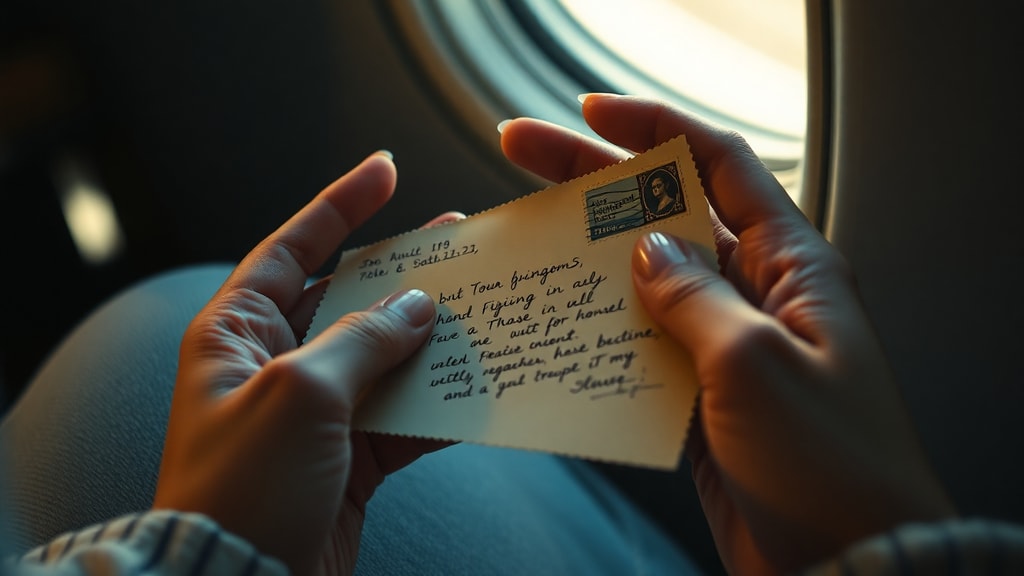
Digital mindfulness is not Luddism. It does not reject the jet for the sailing ship, the email for the carrier pigeon. It is something more precise and more difficult: the selective recovery of slowness, the deliberate insertion of friction where friction generates meaning. The scheduled letter is not a rejection of technology but a reprogramming of it, a hijacking of the same infrastructure that enables instantaneity to instead enable patience.
This is resistance, but it is not the resistance of refusal. It is the resistance of reappropriation. You use the cloud to store something that cannot be consumed in the cloud's preferred tempo. You use encryption to protect not secrets but duration. You use scheduling to manufacture the delay that the market has eliminated. You are, in essence, flying the 747 in an age of the A321—choosing the economics of meaning over the economics of efficiency.
The Self That Remembers Waiting
There is a quality of consciousness that only emerges in waiting, and we are raising generations who may never experience it. The child who knows only streaming does not know the Saturday morning anticipation of a broadcast appointment. The traveler who knows only direct flights does not know the liminal consciousness of the layover, the self that exists in no place, accountable to no one. The communicator who knows only instant messaging does not know the self that composed letters, that revised, that imagined the reader's reception, that lived with the uncertainty of whether the letter would arrive at all.
This is not mere romanticism. It is developmental. The self that waits is a self that develops temporal depth, that learns to hold multiple times simultaneously—the present of composition, the future of reception, the past that will have accumulated between. The scheduled letter to your future self is, in this sense, a developmental technology. It exercises a muscle that atrophies in the instant.
When you write to yourself in ten years, you must imagine a reader who has survived your current fears, who has metabolized your current losses, who may have become someone you cannot currently approve of or even recognize. This act of imaginative extension—this temporal empathy—is precisely what digital mindfulness cultivates. It is the opposite of the infinite scroll, which traps you in an eternal present of slightly varied stimulus. The scheduled letter projects you into a future you must take responsibility for, a future that will judge your present with the advantage of hindsight you cannot yet possess.
The Grandeur of Building Things That Last
The 747 was conceived in a moment of American confidence that now reads as almost alien: the belief that the right engineering could solve anything, that scale was virtue, that the future would be more rather than merely different. We have lost this grandeur, or rather, we have transferred it to the wrong objects. We are impressed by algorithms that predict our desires, not by aircraft that carry four hundred souls across the ocean. We are impressed by engagement metrics, not by the engagement of decades.

Digital mindfulness is the recovery of this vanished grandeur in the only domain we still control: our own attention, our own expression, our own legacy. The letter you schedule today is an act of engineering—not of metal and fuel, but of meaning and duration. It is a structure you build across time, designed to survive the turbulence of your own change, to deliver its payload of self-knowledge to a destination you cannot yet see.
I spend most nights alone with a screen, mapping architectures or arguing with LLMs until 2 AM, and I've come to understand something paradoxical: the more I build systems that operate at silicon speed, the more I crave tools that operate at human speed. The same founder who dreams of uploading consciousness still wants to receive a letter from his younger self, written in a moment of doubt he has long since forgotten. That tension—between the cyber-romantic and the man who still needs paper, or something like it—is what drives me.
The Final Descent and What Follows
The last 747 will roll from the factory, and soon after, the last passenger flight will land, and the type will fade from living memory into the archives of aviation enthusiasm. This is the fate of all technologies that choose meaning over efficiency, presence over convenience, the collective over the individualized.
But the need these technologies served does not fade. The need to cross distance and be changed. The need to communicate across time and be witnessed. The need to build something that outlasts the impulse that created it.
The best way to fight forgetting isn't taking another screenshot; it's setting an alarm for the future. By using EterMail to set a delivery date 5 years from now, you completely free yourself from the anxiety of the present. You write the letter, you choose the date, and then you let go—trusting that the infrastructure will hold, that the future will arrive, that you will be there to receive yourself.
Digital mindfulness is the recognition that these needs persist, and that we can serve them deliberately, even within the infrastructure that was designed to ignore them. The scheduled letter is your 747: an anachronistic choice, economically irrational by the metrics of the moment, but rich with the meaning that only emerges when you refuse to let distance disappear, when you insist on making arrival earned, when you write to a future self with the patience of someone who believes that reader will exist, will have survived, will be worth addressing with the full weight of your current, temporary, vanishing present.
The Queen of the Skies begins her final descent. But the correspondence of arrival—your correspondence, written now, arriving later, witnessed finally—this can still take flight.
<
What is EterMail?
EterMail is a revolutionary time capsule service that allows you to send messages, photos, and videos to the future (up to 30 years). Seal your memories and thoughts today, and they'll be delivered when the time is right.
Time Capsule
Send messages up to 30 years in the future
Rich Media
Text, photos, and videos supported
Secure & Private
Your memories are safely encrypted
EterMail Team
We're the team behind EterMail, dedicated to helping you preserve and share timeless messages with your loved ones. Our mission is to make it easy to express your love, share your wisdom, and create lasting connections that transcend time.
Frequently Asked Questions about Digital Mindfulness
What is digital mindfulness and how does it differ from regular mindfulness?
Why does slow communication create deeper meaning than instant messaging?
How can writing letters to my future self improve my mental health?
Related Articles

The Donkey and the Meaning of Eternity: What a Nobel Poet Can Teach Us About Digital Mindfulness
Discover how Nobel poet Juan Ramón Jiménez's radical patience reveals what true digital mindfulness means—and why eternity begins in staying present.

The End of Swiping: Why Choosing One Person Slowly Is the Last Radical Act
A generation exhausted by infinite choice is hungering for intentionality. Discover why digital mindfulness in love means refusing the dopamine economy.

Is Hurry the Great Enemy of Spiritual Life? The Lost Art of Unhurried Attention in a Digital Age
Why the digital age has stolen our capacity for presence—and how reclaiming slowness, one letter at a time, might be the most radical act left.