The Garden That Outlived the Gardener
Donald Hall, the poet who spent decades writing about his life with Jane Kenyon at their farmhouse in New Hampshire, understood something about love that most of us spend years misunderstanding. It isn't the gaze, the touch, or even the words whispered in darkness that sustains two people across decades. It is the third thing they build together.
For Hall and Kenyon, it was the literal garden they tended, the poems they critiqued over morning coffee, the particular silence of their New England rooms. "We did not spend our days gazing into each other's eyes," Hall wrote. "We did a third thing." This third thing—shared, cultivated, jointly owned—became the vessel that held them when language failed, when bodies aged, when death finally separated them.
But here is the question that Hall, who died in 2018, never had to fully confront: What happens when your third thing lives on someone else's servers?

The Silent Third Partner in Every Relationship
Consider the modern couple's archive. The seven-year thread of text messages that maps your relationship's geography: the first awkward "good morning," the fight at the airport, the ultrasound photo, the 2 AM confession of fear about becoming parents, the grocery lists and the pet names and the thousand tiny negotiations of a shared life. Consider the cloud album where your child's first steps live, the shared notes app where you planned your wedding, the voice messages you saved because her laughter in the background still undoes something in your chest.
These are not merely data. They are the digital soil of your third thing.
And they are not yours.
Not really. Not in any way that would hold up if the platform changed its terms, if the service shut down, if an algorithm decided your content violated some policy you never read, if a breach exposed your most vulnerable moments to strangers, if the company holding your memories was acquired by another company with different values, different servers, different ideas about what you are entitled to keep.
We have accepted, with remarkably little resistance, a strange arrangement. We pour the raw material of our most intimate collaborations—our third things—into platforms designed for engagement, not preservation. We trade sovereignty for convenience. We let our love letters live in rented rooms.
The Architecture of Digital Vulnerability
The vulnerability is not abstract. It is structural.
When you send a message through most commercial platforms, you are not handing a sealed letter to a trusted courier. You are depositing it in a facility where it may be scanned for advertising potential, where it may be subpoenaed in legal proceedings, where it may be retained indefinitely after you believed you deleted it, where it almost certainly exists in forms and locations you do not control and cannot fully audit.
The couple who documented their fertility struggles in a shared app. The widow who discovers her late husband's account was memorialized without her input, his voice messages inaccessible. The divorced partners locked in dispute over who owns the digital record of their children's early years. These are not edge cases. They are the predictable consequences of building third things on foundations we do not own.

Reclaiming Sovereignty as an Act of Love
There is something quietly radical about choosing to preserve your third thing yourself. Not because you have something to hide, but because you have something to protect.
This is where the language of digital privacy often goes wrong. It gets framed as paranoia, as technophobic withdrawal, as the province of people with something shameful to conceal. But for couples, for families, for anyone building something they hope will outlast the present moment, privacy is not about secrecy. It is about stewardship.
To steward something is to care for it across time. To make choices about where it lives, who can access it, how it will be passed along. The garden Hall and Kenyon tended was not hidden—it was simply theirs. They decided what to plant, what to let go to seed, what to cut back. No terms of service governed their tomatoes. No algorithm determined which of their poems would surface in what order. No acquisition by a larger gardening conglomerate threatened to restructure their access to their own soil.
The digital equivalent requires more intention than most of us have exercised. It means asking uncomfortable questions about the platforms we use by default. It means accepting some friction in exchange for control. And it means recognizing that the work of preservation—of choosing where and how your third thing will endure—is itself part of the collaboration.
The Romance of Future-Proofing
There is a particular tenderness to the act of writing to the future. Hall, after Kenyon's death, continued to write to her, about her, in the space their third thing had carved out in time. The garden remained. The poems remained. The particular silence.
For those of us whose third things are increasingly digital, the question becomes: Will what we built still be readable? Still be findable? Still be ours?
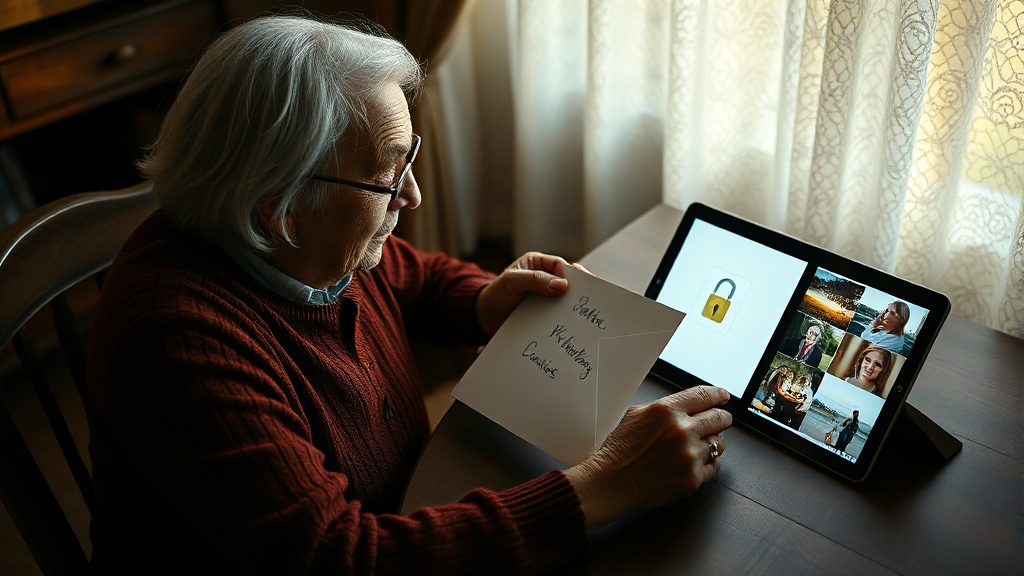
This is not merely a technical concern. It is an emotional one. The couple who wants to read their early messages on their fiftieth anniversary. The parent who hopes their child will one day understand not just what was said, but the texture of how they loved each other. The person facing mortality who wants to leave something unmediated, unfiltered by platform interests, something that arrives as intended, when intended, to whom it was intended.
I think about this often in the small hours, when I'm still at my desk after midnight, running tests on server clusters or refining encryption protocols while the rest of the world sleeps. There's a strange loneliness to building infrastructure for intimacy—coding the architecture that will carry someone else's confession of love years into the future, long after I've moved on to the next problem. But that same solitude teaches me something: the bridge between two people, across time, is worth the obsessive care. I spend my weekends shredding powder on mountain slopes or fighting ocean currents on a board precisely because I need to feel what cannot be controlled—to remember that the most real things in life happen in unrepeatable moments, not in the infinite scroll. The code I write is my attempt to honor that fragility, to build something that respects how precious and perishable genuine connection is.
Building Your Third Thing on Ground You Hold
The alternative to platform dependency is not isolation. It is intentional architecture.
End-to-end encryption ensures that only your intended recipient can read what you send. Time-scheduled delivery allows you to compose for a future moment—a child's eighteenth birthday, a twentieth anniversary, a morning you know will be difficult—and trust that your words will arrive precisely then. Decentralized or user-controlled storage means your archive persists according to your wishes, not a corporation's business model.
This is exactly why I obsessed over end-to-end encryption and extreme server redundancy when building EterMail. Because I know that a letter written to the future needs to be guarded even more fiercely than a bank password. The same focus that keeps me debugging at 2 AM, the same reverence I feel standing on a ridgeline above the clouds—those go into every line of code. EterMail exists because I wanted a space where the third thing you build with someone you love isn't subject to quarterly earnings reports or opaque moderation policies. Where you can write to your future self, to your child, to your partner decades from now, and know the message will wait faithfully, unread by anyone else, until the exact moment you chose.
These are not features in the abstract. They are the digital equivalent of choosing your own soil, of planting your own garden, of deciding what kind of third thing you want to build and on what terms it will survive you.
Donald Hall wrote that he and Kenyon "did not spend our days gazing into each other's eyes." They had work to do. They had a world to make between them. The making was the love, and the made thing—the third thing—was what outlasted the making.
What we make now, we make in digital spaces. The question is whether we will make them deliberately, with the same care we would bring to any shared endeavor, or whether we will continue to outsource the foundations of our most intimate collaborations to entities that cannot love what we love, that cannot grieve what we grieve, that cannot steward what we need to endure.
The most romantic act available to us may not be the grand gesture, the perfect gift, the well-timed "I love you." It may be the quieter, more persistent work of reclaiming the ground where your shared life grows—and choosing, together, to hold it yourselves.
What is EterMail?
EterMail is a revolutionary time capsule service that allows you to send messages, photos, and videos to the future (up to 30 years). Seal your memories and thoughts today, and they'll be delivered when the time is right.
Time Capsule
Send messages up to 30 years in the future
Rich Media
Text, photos, and videos supported
Secure & Private
Your memories are safely encrypted
EterMail Team
We're the team behind EterMail, dedicated to helping you preserve and share timeless messages with your loved ones. Our mission is to make it easy to express your love, share your wisdom, and create lasting connections that transcend time.
Frequently Asked Questions about Digital Privacy & Security
What should couples consider when choosing how to store their shared digital memories?
How can families protect their digital photos and messages from being lost or inaccessible?
What are the emotional risks of relying on social media platforms to preserve relationship history?
Related Articles
The Beautiful Errors We Leave Behind: Why Your Future Descendants Will Treasure Your Typos
As AI perfects everything we write, our unedited voices—typos and all—may become the most precious proof that we were ever here.

The Recorded Self: Why Erasure Is a Losing Battle and Curation Is the Only Freedom Left
Your data will outlive you. The radical act isn't deleting your digital footprint—it's curating what remains for the people who matter most.
The Flip-Phone Cleanse: What We Lose When We Try to Disappear from Our Own Digital Legacy
When you trade your smartphone for a flip phone, what happens to the self you've built online? Explore the invisible cost of digital disappearance.