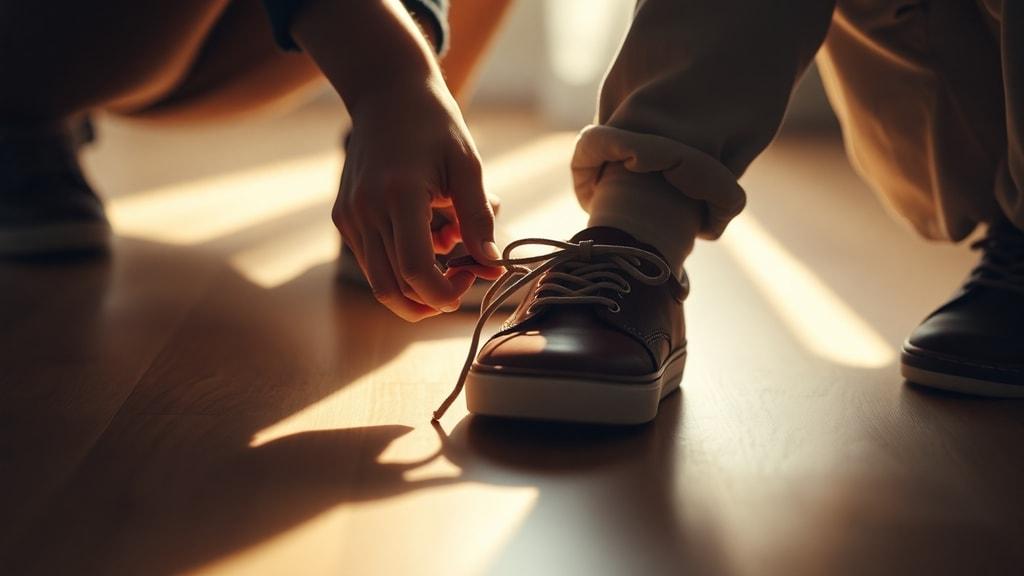
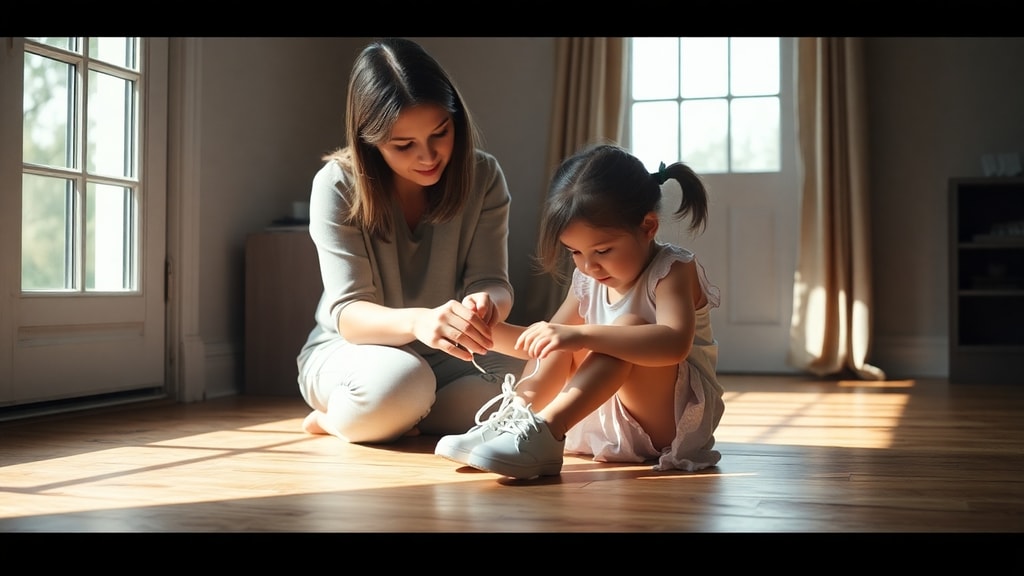
There comes a morning, sudden as a slammed door, when your child sees your hands tremble at a knot you've tied ten thousand times. You are crouched on the kindergarten carpet, late for work, and the shoelace has become an impossible thing—a snake, a puzzle, a test you are suddenly failing. You feel their eyes on you: patient, confused, waiting. And in that waiting, you understand something you cannot yet name. You are not failing. You are performing a failure. You are learning to forget so they can learn to remember.
This is the secret curriculum of parenthood, the coursework no one assigns. We become cartographers of our own erasure, redrawing the maps of our competence until the territories we once commanded dissolve into generous confusion. We forget the route to the grocery store so they learn to read street signs. We cannot recall the capital of Paraguay so they discover atlases. We stand helpless before the microwave's clock, blinking 12:00, so they press the buttons themselves and feel the small godhood of fixing something for us.
But what happens to the mapmaker when the maps are gone? What happens when the performance becomes the reality, when the neighborhoods we once knew by heart become places we genuinely cannot find, and the children who learned to rescue us have already learned something else—that rescue is a habit, and habits can be broken?
The Manufactured Incompetence of Love
My father could navigate any city without a map. He had driven trucks across three countries before I was born, had memorized the truck stops and weigh stations and the particular bend of every mountain highway. But when I was seven, he got lost driving to my grandmother's house—a route we had taken monthly since my birth. He pulled over, hands on the wheel, and asked me to read the map spread across my lap.
I felt chosen. I felt necessary. I directed us through streets I did not know, and when we arrived, my grandmother praised my cleverness while my father winked at me over her shoulder. It was years before I understood: he had never been lost. The map in the glove compartment had been a prop. The wrong turn had been choreography. He had manufactured his own incompetence so I could manufacture my first competence, and in the exchange, something was built between us that felt like love because it was.
This is the economy of parenting, and it runs on a currency of deliberate diminishment. We shrink so they might expand. We forget phone numbers so they must write them in address books they will keep for decades. We struggle with the new television so they teach us, becoming experts in our presence, feeling the particular pride of knowing something the giants do not. Each performance is a gift wrapped in vulnerability, a way of saying: I need you. Therefore you exist.
But economies have consequences. Inflation is real. The parent who pretends not to understand technology may find themselves genuinely excluded from digital spaces their children inhabit. The mother who feigned helplessness with household repairs may live in a house where small degradations accumulate because the performance became habit, because the children left before the lessons were complete, because she taught them too well that she was someone who needed saving.
The Geography of Dependence
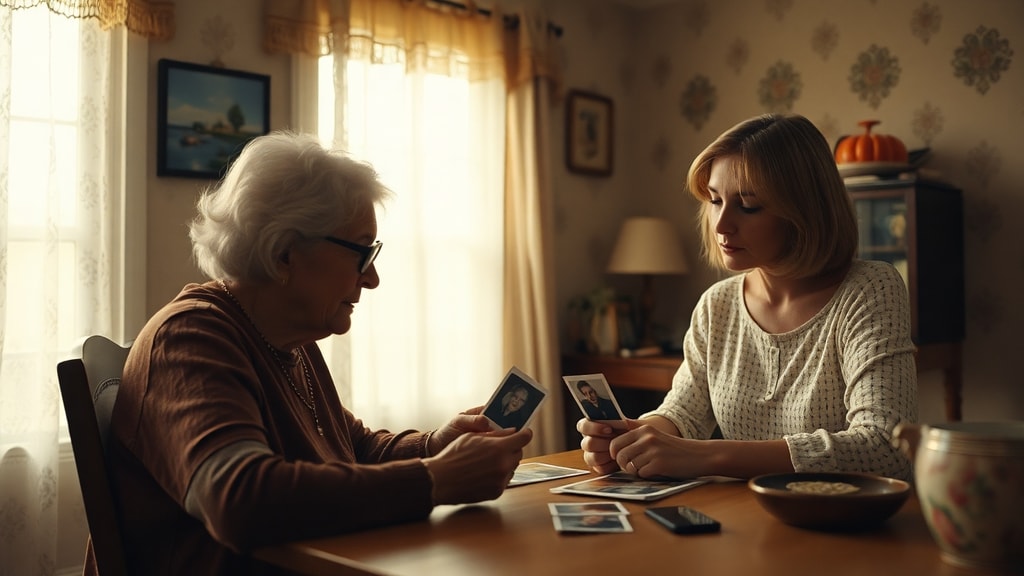
I think often of a friend whose mother developed early dementia. The disease was real, biological, unchosen. But my friend described something that haunts me: her mother's confusion felt, at first, like an extension of the performance she had maintained throughout my friend's childhood. The mother who had always asked for help with the crossword, who had never learned to pump her own gas, who called weekly for computer assistance—these small dependencies had been love's language. How do you distinguish the performed forgetting from the genuine decline? How do you know when to keep rescuing and when the rescue itself has become the cage?
Her mother lived in the diminished world she had partially built, a geography of dependence that her daughter had learned to navigate with resentment and devotion in equal measure. The daughter had left, as children do. She had learned that leaving was possible because her mother had taught her—through countless small abandonments of competence—that the world could be managed without her, that the child was the competent one, that the parent's need was the child's reason for being.
But need, performed too long, becomes need in truth. The muscles of competence atrophy like any others. The parent who stops driving at night finds night driving genuinely terrifying. The parent who never learned the new software finds the digital world impenetrable. We become the characters we played, trapped in sets we constructed for productions that closed years ago.
The Revelation of the Performance
The cruelest moment is not when they leave. It is when they see through you.
My neighbor told me of the afternoon her twelve-year-old son found her crying over a tax form she had completed annually for two decades. "You don't need my help," he said, not unkindly. "You never did." She could not explain. The words would have required admitting the architecture of her love, the way she had built her house with deliberate missing stairs so he would learn to climb. His recognition of the performance felt like accusation. He was not grateful for the lessons. He was suspicious of the teacher. What else had she pretended? What other competencies had she hidden, and to what end?
Children who see through the performance face a particular disillusionment. The parent who was always lost becomes the parent who was always lying. The vulnerability that invited connection reveals itself as strategy, and strategy feels like manipulation to the young. They do not yet understand that all love contains strategy, that authenticity and performance are not opposites but collaborators in the work of attachment.
Some children never see through it. This is its own tragedy. They carry the parent through life like a perpetual rescue mission, unable to distinguish genuine need from performed need, trapped in a dynamic where their competence is the parent's only proof of their love. These children learn to leave by degrees—first emotionally, then geographically—because the alternative is permanent captivity in a relationship where they are always the strong one, always the finder of lost things, always the adult before their time.
What We Leave in the Archive of Ourselves
I am trying now to imagine a different model. Not the parent who forgets, but the parent who remembers aloud. The parent who ties the shoelace slowly, narrating each loop, each cross, each pull tight. The parent who says: I know this city well. Let me show you how I know it. Let me teach you to know it differently. The parent who admits competence and invites partnership rather than reversal.
But I am also honest enough to recognize the seduction of the performance. There is something exquisite in being needed. In a world that offers so few guarantees of our necessity, the child's dependence is a renewable resource, a well we can return to when other sources of meaning run dry. The parent who never performs need may find themselves genuinely alone in their competence, capable of everything and required for nothing.
This is the paradox at the heart of the cartography of learned forgetfulness. We unlearn to teach, but we also unlearn to be taught. We forget to be remembered, but we also forget ourselves. The maps we destroy are maps we may need, and the children who learn to navigate without us may navigate away forever, leaving us in territories we chose to make strange.

The Letter to the Child Who Will Eventually Leave
I have started writing letters I will not send immediately. Not because I am hiding my competence or performing my confusion, but because some understandings require distance to become legible. I write to my future child, or perhaps to the adult they will become, explaining the architecture of my love. I name the performances. I admit the strategy. I ask for forgiveness where the performance became habit, where the feigned confusion crossed into genuine loss, where my need to be needed may have delayed their departure in ways that served me more than them.
These letters are my attempt at honest cartography—not the maps I destroyed, but maps of the destruction itself. Here is where I chose to be lost. Here is where I genuinely became so. Here is where I hope you will find me, not to rescue me, but to recognize that love sometimes wears the costume of incompetence, and that the costume was never the whole truth.
I find myself writing these at odd hours, often after midnight, when the house is quiet and I can finally think clearly about what I want to say versus what I want them to believe. There's a particular loneliness to these sessions—me, the screen, and the imagined future reader who may not exist yet, or who exists now but won't understand for decades. It reminds me of those nights I spend coding until 2 or 3 AM, "pair programming" with an AI that has no memory of our conversation the next day, yet somehow keeps me company in the dark. Both practices share this quality: building something alone that hopes to reach across time and find another person.
The best way to fight forgetting isn't taking another screenshot; it's setting an alarm for the future. By using EterMail to schedule these letters for moments I cannot predict—their first apartment, their first failure I will not witness, the morning they become parents themselves and suddenly understand the economy of deliberate diminishment—I completely free myself from the anxiety of the present. I can write in the fullness of my present knowing and deliver in their future uncertainty, when my voice might reach them across the distance they have earned the right to claim.
The Final Geography
What I am learning, slowly, is that the goal is not to remain competent in everything, nor to perform incompetence in anything. The goal is to be honest about the exchange. To say: I can tie this knot. I will show you how. Then you will tie it, and I will watch, and my watching is my gift to you—the gift of being seen in your competence, not required for mine.
The neighborhoods I once knew by heart are changing anyway. New construction, new traffic patterns, new ways of moving through the world that I will not master. I do not need to pretend confusion to invite my child's guidance. I can be genuinely uncertain and genuinely grateful, without having manufactured either state.
And if they leave me somewhere I cannot find my way home from, let it be because they are moving toward their own geography, not because I taught them that leaving me behind was the natural order of things. Let my diminishment be honest, the erosion of time rather than the strategy of love. Let them return, if they return, to a parent who is still learning, still remembering, still mapping the world as it changes rather than as I performed it.
The shoelace waits on the floor. I will tie it slowly, narrating each movement. Then I will untie it, and hand them the laces, and watch them fail and fail and finally succeed. My hands remember. I do not need to prove my forgetting. I need only prove my presence, my attention, my willingness to witness their becoming without requiring my own disappearance.
This is the harder performance. This is the one worth learning.
What is EterMail?
EterMail is a revolutionary time capsule service that allows you to send messages, photos, and videos to the future (up to 30 years). Seal your memories and thoughts today, and they'll be delivered when the time is right.
Time Capsule
Send messages up to 30 years in the future
Rich Media
Text, photos, and videos supported
Secure & Private
Your memories are safely encrypted
EterMail Team
We're the team behind EterMail, dedicated to helping you preserve and share timeless messages with your loved ones. Our mission is to make it easy to express your love, share your wisdom, and create lasting connections that transcend time.
Frequently Asked Questions about For Our Children
How do I write a letter to my child explaining my parenting choices without sounding defensive?
What should parents consider when deciding what competencies to deliberately teach versus let children discover independently?
How can parents preserve their authentic voice and memories for children who are too young to understand them now?
Related Articles
For Our Children: The Cartography of Inherited Light and the Lighthouses We Become in Darkness
What do we leave our children when they finally see our chipped paint? Explore the quiet sacrifices and unspoken love that shape generational legacy.
The Cartography of Deferred Touch: Mapping the Borders We Draw Around Our Children
Why do parents retreat from their children's bodies as they age? Explore the quiet geography of physical distance—and how to reclaim the intimacy we never meant to lose.

The Cartography of Inherited Friction: On the Small Resistances We Engineer for Our Children
We calibrate difficulty like a dosage for our children—tangled shoelaces, heavy bags, wrong turns. But what happens when hardship arrives unscripted?