The Notification That Never Arrives
You check your phone again. Not because you heard it vibrate. Because you expected to feel something—anything—and found nothing waiting. This is the peculiar grief of our era: the loneliness of being perpetually reachable yet rarely touched.
Zadie Smith, in her meditation on digital life, described what happens when "two lonelinesses collide without real contact." The phrase cuts clean through our collective delusion. We have engineered a world of infinite connection and manufactured a poverty of genuine relation. The scroll offers everything except what we actually need: the sense that another consciousness has paused, chosen us, and remained long enough to be changed by the encounter.
This is the crisis of digital mindfulness—not the wellness industry's sanitized version of meditation apps and screen-time limits, but something far more radical. It is the practice of refusing to treat others as instruments for our own distraction, entertainment, or validation. It is the discipline of allowing another person to exist in your awareness as a full presence, not as content to be consumed.

The Colonization of Consciousness
Smith's diagnosis of "instrumentalism"—the habit of treating people as means rather than presences—has completed its colonization of daily life. Consider the architecture of our most intimate digital spaces. The direct message arrives with urgency, demanding immediate response. The story disappears in twenty-four hours, training us to consume before we consider. The algorithm serves us faces we once loved alongside strangers who resemble them, flattening distinction into engagement metrics.
We have learned to instrumentalize ourselves in turn. The selfie is not self-portraiture but self-commodification. The status update anticipates reaction before it articulates meaning. Even our grief has become performative, measured in flowers left on virtual memorials, timed for maximum visibility.
The cost is measured in attention—the scarcest resource we possess. Each swipe donates fragments of consciousness to platforms designed to harvest and resell them. What remains is too scattered for the sustained encounter that human beings require. We become, in philosopher Byung-Chul Han's formulation, "achievement subjects" optimized for productivity even in our most private moments, incapable of the idleness from which genuine relationship emerges.
The rebellion, then, cannot be merely subtractive. Digital detoxes and notification bans treat symptoms while the disease—our learned impatience with presence—metastasizes. True resistance requires affirmative action: the deliberate construction of spaces where instrumentalism cannot operate, where time moves at human speed, where another person must be encountered in their irreducible complexity.
The Letter as Insurrection
There is a reason totalitarian regimes historically targeted the post. Letters create what surveillance cannot penetrate: the private sphere where consciousness meets consciousness without mediation. The digital letter, properly composed, recovers this space.
To write a letter is to perform an act of faith. You address someone who does not yet exist in the moment of reading—your future self, grown strange; your child, still unborn; your partner, aged into someone you cannot yet imagine. You write without guarantee of reception, without the immediate dopamine of reply. You write because the writing itself constitutes the relationship.
This is digital mindfulness in its most radical form: not the management of attention but the sacrifice of it. The letter demands what the scroll forbids—temporal extension, the willingness to remain with a single consciousness long enough to be altered by the encounter.
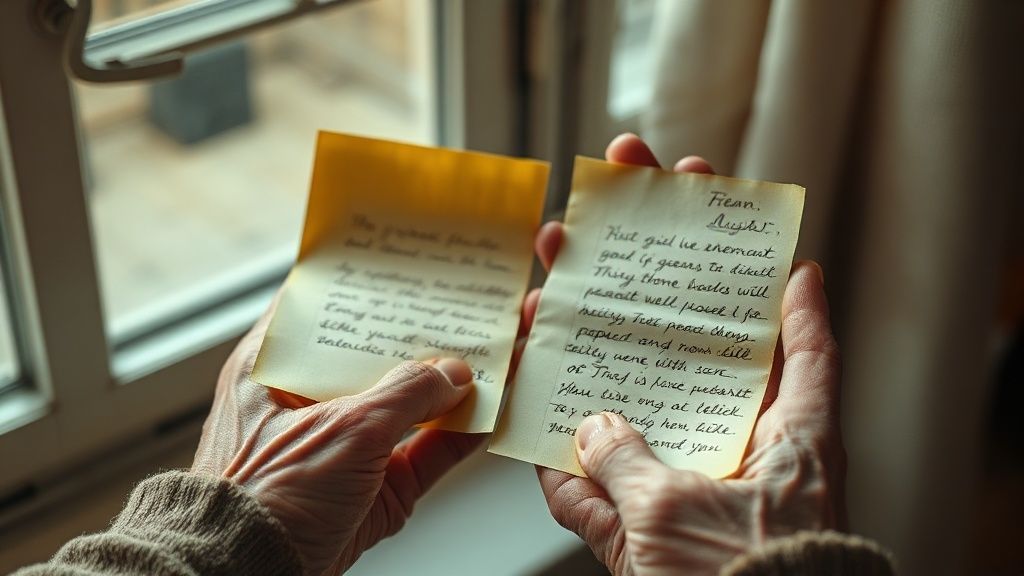
Consider what happens when you compose for a future reader. You cannot rely on shared context, on the assumptions that lubricate daily exchange. You must build a world from words alone, anticipating questions, correcting misunderstandings before they form, choosing details that will survive the erosion of memory. The act forces you to imagine another mind in its fullness—to practice, in the construction of the letter, the recognition of consciousness that instrumentalism has trained us to abandon.
The recipient, when they finally open what you have sent, encounters something increasingly rare: evidence that they were held in mind across time. Not the algorithm's simulation of care—content selected by prediction models—but the genuine article: another human being who paused, who chose, who remained.
The Architecture of Patience
Our technologies are not neutral. They encode specific temporalities, specific relationships to presence and absence. The instant message compresses time to immediacy; the letter expands it to duration. Each shapes the self that uses it.
The scroll teaches us that satisfaction is always one more swipe away. The letter teaches that meaning accumulates slowly, that the best thoughts arrive only after the obvious ones have been exhausted, that relationship deepens through the accumulation of shared time rather than the intensity of single encounters.
Digital mindfulness requires us to become architects of our own attentional environments. This does not mean rejecting technology but selecting technologies that support the temporalities we wish to inhabit. The scheduled message, the time capsule, the letter set to arrive years hence—these are not nostalgic retreats but strategic deployments. They carve out spaces where instrumentalism cannot reach, where the platform's demand for engagement is answered with deliberate delay.

I spend most nights alone with a screen, "pair programming" with LLMs until 2 or 3 AM, chasing the edge of what's possible in human-machine collaboration. That extreme digital solitude taught me something: the most profound dialogues happen across time, not in real-time. When I step away—hiking steep trails, skiing, surfing—I feel the opposite of control. Wind and waves strip away every illusion. Those moments of raw reality made me desperate to build something that could preserve unrepeatable presence, that could outlast my own memory.
The practice extends beyond correspondence. It infects how we read, how we listen, how we move through the world. Having learned what it costs to compose for a future self, we become less willing to surrender our present selves to the scroll's endless now. We recognize, in our own patience, the possibility of patience in others. We begin to seek, in our digital encounters, the signs of similar resistance—the message that took time, the response that arrived without demand.
The Recovery of Touch
There is a paradox at the heart of digital mindfulness. The more we distribute ourselves across time—writing to futures we cannot see, preserving voices for ears not yet born—the more fully we inhabit the present. The letter to your future self requires you to know your present self. The message to your grown child demands that you articulate, now, what you value enough to transmit.
This is the opposite of the scroll's dissociative time, where present and past and future collapse into an eternal now of content consumption. The letter creates temporal depth. It locates us in a narrative that extends beyond our own death, connecting us to the human project of meaning-making across generations.
The touch we recover is not physical but intentional. It is the touch of having been chosen, having been held in mind, having mattered enough to interrupt the flow of days. In an age of ubiquitous connection, this is the only touch that still counts.
The rebellion is quieter than we might wish. It will not trend. It cannot be optimized. It happens in private, at odd hours, when someone decides that another consciousness deserves more than the scroll can give. It happens when we write slowly enough to let another person actually exist on the page—not as content to consume, but as consciousness to meet.
I built EterMail because I was tired of watching my own thoughts disappear into the void of ephemeral feeds. When I set a letter to arrive five years from now, I'm not just scheduling a message—I'm building a bridge between who I am and who I'll become, between the physical world I hike through and the digital world I code in until dawn. The best way to fight forgetting isn't taking another screenshot; it's setting an alarm for the future. By using EterMail to set a delivery date years from now, you completely free yourself from the anxiety of the present.
This is digital mindfulness: not the absence of technology but its redemption, the recovery of presence through the deliberate construction of absence, the creation of spaces where two lonelinesses might finally collide into something that resembles contact.
What is EterMail?
EterMail is a revolutionary time capsule service that allows you to send messages, photos, and videos to the future (up to 30 years). Seal your memories and thoughts today, and they'll be delivered when the time is right.
Time Capsule
Send messages up to 30 years in the future
Rich Media
Text, photos, and videos supported
Secure & Private
Your memories are safely encrypted
EterMail Team
We're the team behind EterMail, dedicated to helping you preserve and share timeless messages with your loved ones. Our mission is to make it easy to express your love, share your wisdom, and create lasting connections that transcend time.
Frequently Asked Questions about Digital Mindfulness
How does writing letters improve mental health compared to digital messaging?
What makes digital communication feel less meaningful than handwritten correspondence?
How can I practice digital mindfulness without completely disconnecting from technology?
Related Articles

The Donkey and the Meaning of Eternity: What a Nobel Poet Can Teach Us About Digital Mindfulness
Discover how Nobel poet Juan Ramón Jiménez's radical patience reveals what true digital mindfulness means—and why eternity begins in staying present.

The End of Swiping: Why Choosing One Person Slowly Is the Last Radical Act
A generation exhausted by infinite choice is hungering for intentionality. Discover why digital mindfulness in love means refusing the dopamine economy.

Is Hurry the Great Enemy of Spiritual Life? The Lost Art of Unhurried Attention in a Digital Age
Why the digital age has stolen our capacity for presence—and how reclaiming slowness, one letter at a time, might be the most radical act left.