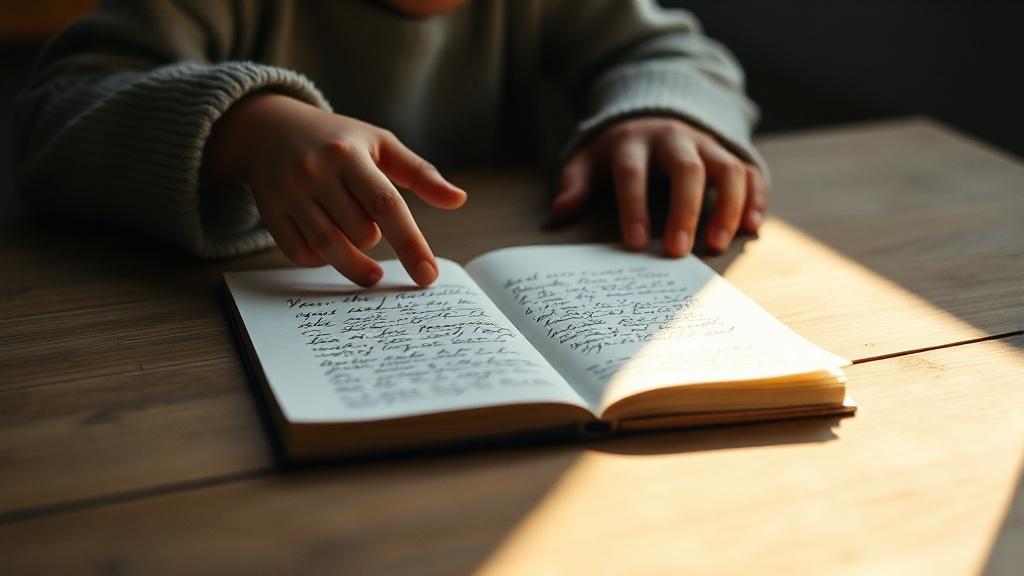
The hamster died on a Tuesday. You found it in the cedar shavings, already stiff, and felt the familiar compression in your chest—not for the hamster, exactly, but for the conversation that now stood between your daughter's breakfast cereal and her school bus. You had forty minutes. You chose the rainbow. You chose the bridge. You chose a sentence about running wheels in some other meadow, and you watched her face carefully for the exact moment when confusion dissolved into something she could carry.
This is the work we do as parents. We are not merely guardians of bodies and bedtimes. We are simultaneous interpreters, stationed at the border between what the world delivers and what our children can metabolize. We translate the sharp edges of existence into softer tongues, believing we are building resilience through gradual exposure. But somewhere in this cartography of translated grief, we may be drawing maps to places that don't exist—and leaving our children without coordinates for the territories they will eventually have to walk alone.
The Grammar of Protection
Every family develops its own dialect of loss. The pet doesn't die; it crosses a rainbow. The grandmother isn't gone forever; she became a star, took a long trip, sleeps now in a garden. The divorce isn't a fracture; it's an abundance of love so overflowing it required two houses to contain it. We construct these sentences with genuine care, following some inherited intuition that childhood must be insulated, that innocence is a resource to be conserved rather than a temporary station through which all humans pass.

The motivations are not trivial. Developmental psychology confirms that children process concrete information differently than adults; abstract concepts like permanent absence require cognitive scaffolding we believe we're providing. We fear trauma the way we fear fevers—something to be reduced, managed, kept below threshold. But protection and preparation are not synonyms, and the grammar we teach them shapes not just what they understand, but how they will eventually understand their own suffering.
The Archive of Euphemism
Consider what accumulates across a childhood. The dog that went to live on a farm. The parent who works so much because they love you so much. The illness described as "tiredness," the financial strain as "being careful right now," the marital tension as "grown-up stuff." Each translation is a small kindness, perhaps. But kindnesses compound into architectures, and children become fluent in a language that has no words for the actual weather of human experience.
They learn that loss is always beautiful, that change is always elective, that pain is always temporary and externally resolved. They become, in essence, tourists in their own emotional lives—able to read the menu but not order the meal, familiar with the vocabulary of grief but strangers to its grammar.
And then adolescence arrives, or young adulthood, or that ordinary Wednesday when the translation fails entirely. A friend dies by suicide with no rainbow mythology prepared. A partner leaves without the explanatory framework of excessive love. They encounter the untranslatable weight of the real thing, and discover that their parents' dialect has left them without the syntax for despair.
The Moment of Untranslation
There is a specific ache in recognizing that your childhood was narrated to you. It arrives differently for each person—sometimes as anger, sometimes as grief for grief itself, sometimes as the vertigo of realizing that foundational memories rest on revised editions. The parent who "took a long trip" was actually institutionalized. The "special sleep" was death. The "two houses of love" were the shrapnel of two people who could no longer bear each other.
This untranslation is not merely intellectual. It is somatic, a recalibration of the nervous system around truths that retroactively alter the meaning of bodily sensations. The child who learned to associate loss with rainbows must now learn to associate it with absence that has no color, no destination, no return. The work of unlearning protective fictions is itself a form of labor we rarely acknowledge—a second grief layered atop the first, the grief of discovering that your grief was managed before you knew to have it.

What Honesty Might Look Like
This is not an argument for cruelty. No child needs the unfiltered torrent of adult despair, the granular details of marital collapse, the clinical specifics of terminal diagnosis. But there exist territories between euphemism and exposure, between the rainbow bridge and the necropsy report. Honesty with children is not a binary; it is a practice of calibration, of matching the truth to the developmental capacity without replacing it with something fundamentally false.
The hamster died. It will not run again, not here, not elsewhere. This is sad. This is how bodies work. The grandmother died. She loved you, and she is not coming back, and love that continues is carried by the living, not by the dead. The divorce is painful. Two people tried, and it was not enough, and you are not the reason, and your feelings about it are allowed to be complicated.
These sentences are harder to speak. They do not resolve. They sit with the child in the discomfort of irreversibility, which is exactly where they will eventually have to sit as adults. Our job is not to prevent them from ever sitting there. Our job is to ensure they have practiced the posture.
The Letters We Cannot Translate
Some griefs arrive with advance notice. Others do not. But all parents carry the awareness that their children will outlive them, that there will be days when they are not present to offer even the softest translation. This is where the practice of direct communication becomes not just ethical but practical—a legacy of honesty that survives the speaker.

I know something about building systems that outlast their creators. I've spent too many nights alone until 3 AM, "pair programming" with LLMs, mapping architectures for platforms I hope will matter after I've moved on to the next thing. There's a particular loneliness to that glow—the screen, the silence, the sense that you're constructing a bridge to someone you may never meet. I started EterMail because I kept imagining my own daughter, decades from now, sorting through digital debris and finding nothing but passwords and notifications. I wanted to build something that could carry voice across that gap, that could hold the weight of things I won't be around to say in person.
The platform allows parents to compose letters to their future children—messages scheduled for delivery years or decades hence, when the child has crossed into adulthood and the parent may no longer be present to speak. These are not translations. They are the original text, preserved in the author's voice, available when the recipient has developed the capacity to receive it.
A mother writes to her daughter at thirty-five, explaining the depression that shadowed the daughter's early childhood—not as "tiredness" but as the clinical and emotional reality it was. A father schedules a letter for his son's wedding day, acknowledging the divorce that reshaped their family—not as "two houses of love" but as the painful necessary choice it was, with regret and growth held in the same sentence. These letters are acts of temporal honesty, circumventing the erosion of euphemism by speaking directly across time.
This is exactly why I obsessed over end-to-end encryption and extreme server redundancy when building EterMail. Because I know that a letter written to the future needs to be guarded even more fiercely than a bank password. The encryption and scheduling mechanisms ensure that these messages arrive only when intended, preserved against the fragility of memory and the chaos of digital inheritance. They represent a different model of parental protection—not the protection of insulation, but the protection of preparation, of leaving behind not revised editions but source documents.
The Dialect of the Real
Our children do not need us to make the world painless. They need us to make it legible. They need to know that loss is real, that love persists through loss rather than negating it, that the sharpness of existence is not a defect in the design but the condition of its vividness. The parent who never permits their child to experience sadness does not raise a happy adult; they raise a person unprepared for the happiness that coexists with sorrow.
The rainbow bridge is not evil. It is insufficient. It prepares children for a universe of continuous color, and they will live instead in one of contrast, of light that requires shadow to be visible at all. Our translations must eventually include the original vocabulary, or we risk raising generations fluent in consolation but mute in the presence of actual pain.
We become, if we are careful, not interpreters who replace the text but annotators who make it accessible—providing footnotes, context, the occasional simplified phrasing, but never denying that the original exists, that it is difficult, that difficulty is not synonymous with damage.
The hamster died. Start there. The rest is commentary.
What translations have you inherited? What have you chosen to revise? The letters we write to our future selves and our future children are opportunities to speak in our own voice, unmediated by the dialects we were taught. EterMail preserves these voices against the erosion of time and memory, ensuring that honesty survives its speaker.
What is EterMail?
EterMail is a revolutionary time capsule service that allows you to send messages, photos, and videos to the future (up to 30 years). Seal your memories and thoughts today, and they'll be delivered when the time is right.
Time Capsule
Send messages up to 30 years in the future
Rich Media
Text, photos, and videos supported
Secure & Private
Your memories are safely encrypted
EterMail Team
We're the team behind EterMail, dedicated to helping you preserve and share timeless messages with your loved ones. Our mission is to make it easy to express your love, share your wisdom, and create lasting connections that transcend time.
Frequently Asked Questions about For Our Children
How do I explain death to a child without using euphemisms?
What should I include in a letter to my future adult child?
How can parents balance protecting children with preparing them for life's difficulties?
Related Articles
The Cartography of Mirrored Damage: What We Show Our Children, What We Hide, and What Breaks When They Bring Us Their Own Fractures
How do we teach children that healing isn't never breaking? Explore the art of showing our fractures to help them recognize their own—and what happens when they finally do.
The Cartography of Inherited Scent: How We Become Perfumers of Love for Our Children, and What We Lose in the Translation
We curate our very chemistry for our children—until they outgrow the fragrance of our love. What remains when they no longer recognize us as home?
The Cartography of Swallowed Sound: On the Silence We Cultivate for Our Children
What happens when the quiet we built for our children becomes the only language they know us by? A reflection on lost voice and intentional sound.