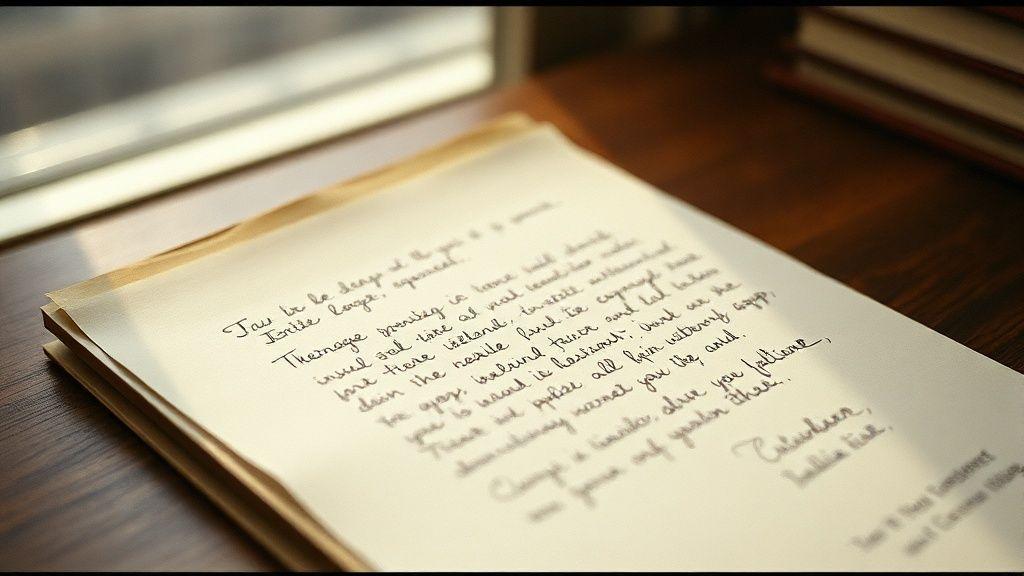
The Thursday Afternoon That Doesn't Exist in Your Performance Review
You won't find it in any HR file. No quarterly review captured the moment your colleague—Sarah, was it? Or maybe David?—pulled you aside after you bombed the presentation and said something that rearranged your understanding of your own potential. The words themselves have probably dissolved. What remains is the feeling: the sudden, vertiginous sense that someone saw something in you that you had not yet earned the right to see in yourself.
This is the architecture of a working life. Not the promotions, which LinkedIn will preserve with embarrassing thoroughness. Not the salary figures, which your bank statements will remember longer than your emotional relationship to them. The real wealth milestones—the moments that compounded into whoever you are becoming—live in the gaps between official records. And they are disappearing faster than you think.
Memory, it turns out, is a terrible archivist of professional transformation. It preserves humiliation with photographic clarity and dissolves mentorship into vague gratitude. It remembers the job you didn't get, the reorganization that flattened you, the year you worked through pneumonia. The good stuff? The moments of genuine growth? Those require intentional excavation.

The Inheritance of Your Working Self
Consider what your future self actually inherits from your professional life. Not the 401(k), though that matters. Not the title, which will sound quaint or incomprehensible in twenty years. What you really pass forward is a story about what work meant to you, what you believed you were building, who you were willing to become in the service of something that mattered—or didn't.
The salary you negotiated at 31 carries emotional residue that the number itself cannot convey. Was it the first time you recognized your own market value? The moment you stopped apologizing for wanting more? The conversation where you learned that preparation and worthiness are different currencies? These are the questions your 55-year-old self might need answered, especially if that future self is navigating a career transition, a professional reinvention, or simply the quiet crisis of wondering whether any of it meant anything.
We treat career narratives as if they assemble themselves. They do not. They are constructed through reflection, and reflection requires material—the raw sensory data of who you were when you were becoming. Without that material, your future self is left with LinkedIn's version of your history: a vertical scroll of job titles that suggests a linear progression you know was nothing of the sort.
The Three Archives We Fail to Keep
Most professionals maintain three incomplete records of their working lives. First, the financial archive: tax returns, pay stubs, investment statements. These preserve what you earned, not what you learned. Second, the network archive: contacts, recommendations, the accumulated social capital of professional relationships. These preserve who you knew, not how knowing them changed you. Third, the artifact archive: projects, portfolios, the occasional award or press mention. These preserve what you made, not why making it mattered.
What is missing from all three is the phenomenological archive: the felt experience of your professional development. The terror before the pitch that worked. The strange hollowness after the promotion that was supposed to satisfy you. The colleague whose belief in you arrived at exactly the moment your own belief was collapsing. These experiences do not leave material traces. They must be captured deliberately, or they are lost to the revisionism of retrospective coherence—the mind's tendency to smooth the past into a story that makes sense of the present, which is almost never the story that actually happened.

Writing to the Professional You Haven't Met Yet
There is a particular loneliness to career milestones that no one warns you about. The promotion celebrated alone in a hotel room. The resignation submitted with trembling hands and no one to witness. The realization, sudden and devastating, that you have built exactly the life you thought you wanted and it does not fit. These moments crave witness. Future-you is the only witness guaranteed to survive them.
I know this loneliness intimately. There are nights when I'm still at my desk at 2 AM, debugging some stubborn API integration or sketching out architectures with an LLM as my silent pair programmer. The screen glows, the house is dark, and I'm acutely aware that no one else will ever see these particular hours—the false starts, the small breakthroughs, the conversations with code that slowly become conversations with myself. That digital solitude taught me something: the moments that shape us most often happen without an audience. The letter becomes the witness we never had.
Writing to your future self about your professional life is not journaling. It is time-traveling testimony. You are establishing facts under oath before memory has a chance to distort them. What did you actually believe about success at 34? What were you pretending not to know about your own limitations? What did you hope your work would make possible for people you had not yet met, including the person you were trying to become?
The practice requires specific techniques. Date your letters to specific future moments: not "someday" but "your first day as a director," "the morning you turn 50," "the month you consider leaving this industry." These temporal anchors give your future self permission to read when the wisdom will actually land. Include sensory details that performance reviews never capture: the quality of light in the office where you did your best work, the particular fatigue of the commute that taught you something about your own limits, the physical sensation of realizing you had finally mastered something that once defeated you.
Most importantly, write the questions your future self will need answered. Not "am I happy?"—too abstract, too easily answered with whatever narrative serves the present. Instead: "What am I pretending not to know about why I took this role?" "Who am I afraid of becoming if I keep succeeding at this particular thing?" "What would I do for the next two years if I genuinely believed I could fail without disappearing?"
The Wealth That Compounds in Secret
We misunderstand professional wealth. We measure it in compensation and title progression, in the external validation of markets and hierarchies. But the wealth that actually compounds across a working life is internal and largely invisible: the accumulation of judgment, the refinement of taste, the slow construction of a self that knows its own values well enough to recognize when they are being violated.
This is why the Thursday afternoon matters. The colleague who believed in you before you believed in yourself was making a deposit in an account you would not learn to access for years. The salary negotiation was practice for a more important conversation you could not yet imagine having. The project that failed taught you something about your own resilience that no success could have revealed.
Your future self deserves to inherit this archaeology. Not the polished LinkedIn narrative, but the stratified truth: the layers of hope and disappointment, the false starts that turned out to be preparation, the moments of genuine connection that occurred in the margins of professional obligation. These are the materials from which a meaningful working life is reconstructed, and they do not preserve themselves.

The Letter as Professional Practice
There is something fitting about using a time-delayed letter to capture career milestones. The practice itself embodies what professional development actually requires: delayed gratification, trust in a future self you cannot fully imagine, the willingness to work without immediate feedback. The letter you write today and schedule for delivery in five, ten, or twenty years is a bet on your own continuity. It assumes that the person who opens it will recognize the person who wrote it as a legitimate ancestor, worthy of attention and compassion.
This is not sentimentality. It is strategic self-regard. The research on future self-continuity is clear: people who feel connected to their future selves make better long-term decisions, save more, invest in relationships, avoid the short-term temptations that derail larger purposes. Writing to that future self is not just preservation. It is construction—building the bridge across time that makes continuity feel possible.
Your career milestones deserve this treatment. Not because they are more important than other life events, but because they are more vulnerable to misremembering. Work consumes so many of our waking hours, yet we preserve its meaning so poorly. We let institutions tell us what our professional lives meant. We let the logic of optimization flatten the complexity of vocation. We arrive at future moments of decision—pivot or persist, settle or risk, stay or go—without the accumulated wisdom of our own experience because we never bothered to record it in a form our future selves could access.
What Your Future Self Needs to Know
The best way to fight forgetting isn't taking another screenshot or drafting another note that sinks into your digital swamp. It's setting an alarm for the future—an actual mechanism that guarantees your words survive. I built EterMail because I needed this myself: a way to send letters across time without worrying whether the platform, or my own discipline, would survive the interval. The best way to fight forgetting isn't taking another screenshot; it's setting an alarm for the future. By using EterMail to set a delivery date 5 years from now, you completely free yourself from the anxiety of the present.
The person you will become in fifteen years is already forming judgments about the person you are now. They are constructing explanations for your choices, attributing motives you may not have felt, smoothing the jagged edges of your actual experience into a coherent narrative of professional development. You can influence this process. You can leave evidence.
Write about the specific conversation that changed your trajectory. Write about the fear you could not admit when you took the big opportunity. Write about the ordinary Tuesday when you realized your definition of success had quietly shifted. Write about the person you were trying to become and whether you are becoming them. Write with the understanding that your future self will read these words in a context you cannot predict, needing wisdom you cannot currently possess, and that your only gift to that person is honesty about who you were when you were still becoming.
The salary you negotiated at 31. The colleague who believed in you. The Thursday afternoon you realized you'd built something that would outlast your tenure. These are the wealth milestones that matter. Your future self is waiting to receive them.
What is EterMail?
EterMail is a revolutionary time capsule service that allows you to send messages, photos, and videos to the future (up to 30 years). Seal your memories and thoughts today, and they'll be delivered when the time is right.
Time Capsule
Send messages up to 30 years in the future
Rich Media
Text, photos, and videos supported
Secure & Private
Your memories are safely encrypted
EterMail Team
We're the team behind EterMail, dedicated to helping you preserve and share timeless messages with your loved ones. Our mission is to make it easy to express your love, share your wisdom, and create lasting connections that transcend time.
Frequently Asked Questions about Career & Wealth Milestones
What should I write in a letter to my future self about my career?
How do I preserve my professional legacy beyond job titles and salaries?
Why do we misremember our professional achievements and setbacks?
Related Articles

Why I Built EterMail: A Time Capsule for the People I Love Most
I’m a Product Manager who spends all week optimizing for the "immediate now." But getting lost off the grid on a mountain ridge made me realize I had zero infrastructure for the "forever." Here’s why I stopped worrying about conversion rates for a moment and built EterMail—a secure, tamper-proof digital time capsule for the people I love most.

The Most Radical Letter to Your Future Self Is a Promise to Stay Unfinished
The best letter to your future self isn't a memory—it's a mandate. Learn how writing to the version of you still working with love changes everything.

The Ice Tray at Midnight: On Grief, Domestic Minutiae, and the Quiet Work of Becoming Yourself Again
Why do the smallest habits hurt most after someone leaves? A reflection on grief, domestic minutiae, and the quiet moment healing finally begins.