
You remember the number, don't you? The salary figure you finally said out loud in that conference room, the one that made your throat tight and your palms damp at 31. You remember the silence after you spoke it, and the way your manager's pen stopped moving. What you may not remember—what you almost certainly won't, unless you force the record—is the colleague who rehearsed that number with you in a parking garage at 7 p.m. the night before. The one who said, "You're not asking for enough," when you were still negotiating against yourself. The one who saw your worth before your confidence had learned to match it.
This is the architecture of a career: not the LinkedIn headline, not the stock vesting schedule, but the accumulated weight of moments where someone chose to believe in you, where you chose to believe in yourself, where the work felt like it might matter beyond the quarter.
And it is almost entirely unrecorded.
The Inheritance Problem of Professional Memory
We treat career milestones as transactional. Promotion. Raise. Title change. New company. We document these in spreadsheets and tax returns and vesting calendars. But the meaning of these milestones—the emotional geology of how we became who we are professionally—lives in a far more fragile archive. Text threads with mentors. The voice memo you recorded walking out of a terrible interview, laughing with disbelief. The email from a client saying your work changed how they thought about their own business. The afternoon you realized, with a strange calm, that you had built something that would function without you.
These are the wealth milestones. Not the net worth figure. The net meaning figure. And they are dissolving faster than we build them.
Research on autobiographical memory suggests that we reconstruct our past selves through the narratives we actively maintain. Without deliberate documentation, the brain prioritizes survival-relevant details over subtle emotional textures. The fear of the layoff stays. The gratitude for the colleague who helped you pivot does not. The humiliation of a failed project calcifies. The Thursday afternoon of unexpected creative flow evaporates.
Your future self—the one at 55, at 70, at whatever age you finally have enough distance to assess what your working life actually meant—will inherit only what you preserve. And right now, you are almost certainly preserving the wrong things.

The Three Categories of Invisible Career Wealth
The Belief Milestones
These are the moments when someone external validated your potential before you could see it yourself. The manager who pulled you into a room and said, "I want you on this, not because you're ready, but because you'll be ready by the time it matters." The peer who recommended you for a role you would never have applied for. The client who became a reference before you thought to ask.
These milestones are easy to dismiss in the moment. They feel like luck, like timing, like someone else's generosity rather than your own earned trajectory. But they are, in retrospect, the pivot points. The career is a series of doors that opened because someone else held the handle. Without recording who these people were, what they said, and what it cost you to walk through, you lose the causal chain of your own becoming.
The Competence Milestones
These are the moments when you felt the shift—from performing competence to inhabiting it. The first time you walked into a negotiation and knew, bodily, that you would not leave with less than you deserved. The afternoon you debugged a system failure and realized your intuition had outpaced your conscious analysis. The presentation where you stopped reading the room and started leading it.
These milestones rarely announce themselves. There is no certificate. The promotion that follows may feel anticlimactic because the internal transformation already happened. Recording these moments requires a different kind of documentation: not the outcome, but the sensation of capability arriving. The specific thought, the physical location, the weather outside the window. These sensory anchors are what allow future you to reconstruct not just what you did, but who you were when you became capable of doing it.
The Contribution Milestones
These are the moments when your work connected to something larger than your own trajectory. The project that outlasted your tenure. The team member you trained who went on to build something you never could have. The policy change you advocated for that affected people you would never meet. The product that solved a problem you had personally experienced, and therefore understood with an intimacy no market research could replicate.
These milestones are the most vulnerable to retrospective editing. In the absence of documentation, we tend to attribute collective achievements to collective effort, minimizing our own catalytic role. Or we inflate our contribution in the opposite distortion, manufacturing a hero narrative that the record cannot support. The honest documentation—the specific email, the dated note, the contemporaneous reflection—preserves a truth that memory cannot be trusted to maintain.

The Architecture of Preservation
The problem with conventional career documentation is that it is written for an audience: recruiters, investors, performance reviewers. It is optimized for forward momentum, not backward understanding. The resume does not ask: What did you fear in this role? What did you learn about your own limitations? Who saw you clearly when you could not see yourself?
A different practice is needed. One that borrows from the tradition of letter writing—the deliberate construction of a message for a specific future reader, who happens to be yourself.
I came to this obsession honestly. For fifteen years I've been the person staring at a glowing screen until 2 or 3 AM, pair-programming with LLMs or mapping architectures in the dead silence of a house that has long since gone to sleep. That extreme digital solitude taught me something about loneliness and about the strange intimacy of writing to someone who isn't there yet. When I step away from the keyboard, I throw myself into steep mountain trails or ocean swells—places where the raw reality of wind and water strips away every illusion of control. Those moments taught me to value what cannot be repeated: the unrepeatable present, witnessed only by yourself, unless you force the record.
Consider writing to your future self at defined career intervals: the five-year mark, the ten-year mark, the moment you anticipate a significant transition. Not a goals list. A state document. Where are you right now, in the architecture of your own confidence? What do you know about your work that you did not know last year? What are you currently unable to see, and who is helping you see it?
The specificity is the preservation. "I am scared that the new role will expose that my previous success was luck" is a document that future you can use. "Excited for new challenges!" is not.
This practice also creates a counterweight to the narrative compression that time enforces. The career, viewed from its end, becomes a story of outcomes. The preserved letters restore the uncertainty, the contingency, the process of becoming. They remind future you that the current moment of professional confusion is not aberrant but normative. That you have been here before, and the evidence of navigation exists.
The Wealth You Cannot Liquidate
There is a particular loneliness to professional success that arrives without witnesses. The founder who sells a company and realizes no one who knew her at the beginning is still in her life. The executive who cannot explain to his children what he actually did all those years, because the work was abstract and the documentation was financial rather than narrative. The retiree who discovers that her memories of thirty years have condensed into three anecdotes, repeated until they feel like performance rather than memory.
The wealth milestones are the antidote to this loneliness. They are the preserved evidence that your work was witnessed, that your growth was real, that your contributions left traces in other lives. They are not liquidable. They cannot be converted to retirement income or bequeathed in a will. But they can be inherited by your own future self, and they can be shared—deliberately, with intention—with the people who will outlast your working years.
Imagine receiving, at a significant career juncture, a letter from your past self. Not advice—you are not qualified to advise your future self, who lives in conditions you cannot predict—but testimony. This is who I was. This is what I could not yet see. This is who believed in me when I needed it. The letter does not instruct. It accompanies. It says: you were not alone in this, even when you felt alone. The evidence is here, dated, preserved.

The Practice of Excavation
The work of preserving career wealth is not nostalgic. It is archaeological. You are excavating a site you currently inhabit, knowing that the terrain will change, that the buildings will be demolished, that the view from this window will not exist in five years. The documentation is a form of respect for the present moment's reality—a recognition that you are, right now, in the middle of a becoming that future you will want to understand.
Don't wait for the perfect moment to start writing. Open EterMail, skip the complex formatting, type the very first sentence that comes to mind, set the date, and leave the rest to us. The best way to fight forgetting isn't taking another screenshot; it's setting an alarm for the future. By using EterMail to set a delivery date 5 years from now, you completely free yourself from the anxiety of the present. That parking garage conversation, that 2 a.m. doubt, that Thursday afternoon of unexpected flow—future you deserves to receive them exactly as they were, not as memory will have edited them.
Start with one specific moment. Not the promotion. The conversation that preceded it. Not the product launch. The 2 a.m. doubt that almost prevented it. Not the successful negotiation. The rehearsal in the parking garage with the colleague who saw your worth first.
Write it as a letter. Date it. Preserve it with the same care you would apply to a financial instrument, because it is, in the only currency that ultimately matters, exactly that.
Your future self is the only audience who will ever fully understand what this cost. Write accordingly.
What is EterMail?
EterMail is a revolutionary time capsule service that allows you to send messages, photos, and videos to the future (up to 30 years). Seal your memories and thoughts today, and they'll be delivered when the time is right.
Time Capsule
Send messages up to 30 years in the future
Rich Media
Text, photos, and videos supported
Secure & Private
Your memories are safely encrypted
EterMail Team
We're the team behind EterMail, dedicated to helping you preserve and share timeless messages with your loved ones. Our mission is to make it easy to express your love, share your wisdom, and create lasting connections that transcend time.
Frequently Asked Questions about Career & Wealth Milestones
How do I identify the invisible milestones in my career that are worth preserving?
What should I include in a letter to my future self about my career?
Why do we remember career failures more vividly than moments of growth and support?
Related Articles

The Invisible Architecture of Your Working Life: What Your Future Self Deserves to Remember
Before memory rewrites your professional story, capture the salary you fought for, the belief others had in you, and the quiet triumphs no spreadsheet holds.

The Salary You Negotiated at 31: Why Your Future Self Needs the Whole Story of Your Working Life
The promotions, failures, and quiet triumphs that shaped your professional life deserve to be remembered. Here's how to preserve them.
Why I Built EterMail: A Time Capsule for the People I Love Most
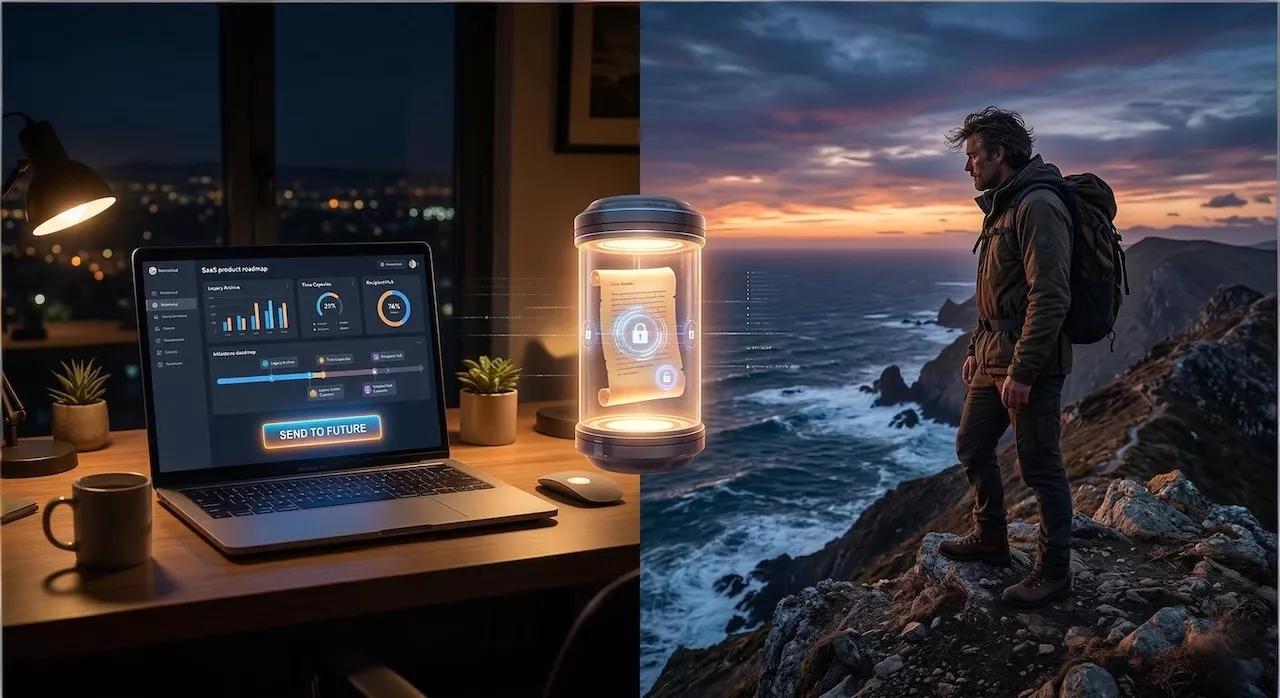
I’m a Product Manager who spends all week optimizing for the "immediate now." But getting lost off the grid on a mountain ridge made me realize I had zero infrastructure for the "forever." Here’s why I stopped worrying about conversion rates for a moment and built EterMail—a secure, tamper-proof digital time capsule for the people I love most.