
The Fluorescent Light That Changed Everything
Thursday afternoon, 2019. A colleague you barely knew stopped you in the hallway. You remember the lighting—harsh, institutional, the kind that makes everyone look slightly unwell. You do not remember their name.
What they said, though: "Your presentation changed how I think about my own work."
You mumbled thanks. Checked your phone. Moved toward the elevator. Within a week, the moment had compressed into something like "someone said something nice once." Within a year, it had vanished entirely, replaced by performance reviews and promotion timelines and the ambient anxiety of whether you were "on track."
This is how professional memory works. It is not a curator. It is a demolition crew with a bias for the measurable.

The Invisible Architecture of Working Life
We are trained to document our careers in the language of LinkedIn optimization: metrics, titles, skills acquired, teams led. This is not false. It is merely thin—a single coat of paint over load-bearing walls we never learned to see.
Consider the salary negotiation at 31. You asked for 15% more because someone once told you that was "the rule." You got it. You spent the raise on therapy and a coat that still hangs in your closet, unworn but somehow essential. The negotiation taught you that asking is a skill separate from deserving. The therapy taught you that relief and grief can arrive simultaneously. The coat taught you that some purchases are talismans, not utilities.
None of this appears on your CV.
Or the resignation letter drafted at 2 AM, saved but never sent. It became the invisible pivot point between who you were willing to become and who you refused to stay. You did not quit that month. But something in you did quit—quietly, internally, the way a river changes course without announcing itself. The letter was the first evidence that you could imagine a different life. That capacity, once exercised, does not disappear. It waits.
These are the emotional coordinates of a working life. They resist spreadsheet logic. They matter precisely because they cannot be optimized.
The Salary You Forgot to Feel
We remember our starting numbers with strange precision: $42,000, $67,500, $89,000 with the signing bonus. We forget what those numbers meant—the studio apartment with the broken radiator, the first dinner where you didn't check prices, the particular shame of realizing you earned more than your parents ever had and still felt empty.
Money is a language we learn to speak without understanding our own accent.
The colleague who explained 401(k) matching over sad desk salads. The mentor who admitted, at a bar you couldn't afford, that they had no idea what they were doing either. The first time you calculated your hourly rate against a project and understood, mathematically, that your time was being stolen.
These lessons compound silently. They shape every subsequent decision—who you trust, what you tolerate, how you define "enough." Yet we leave them unrecorded, assuming our future selves will somehow remember what it felt like to be learning rather than having learned.

The Tuesday That Made Years Worthwhile
Career narratives favor inflection points: promotions, departures, the dramatic email sent at midnight. But satisfaction lives in Tuesdays—the ordinary days when work felt like contribution, when a stranger's gratitude arrived without request, when you solved something alone at your desk and no one would ever know.
The client who cried in your conference room because you had actually listened. The intern you taught to advocate for themselves, watching your younger self in their hesitation. The project that failed completely but taught you that your value exceeds your output.
These moments do not trend. They do not generate notifications. They are, in the language of platform capitalism, unengaging—too specific, too slow, too resistant to universalization.
This is precisely why they must be preserved.
Writing Before Memory Rewrites You
Neuroscience confirms what we intuit: memory is reconstruction, not retrieval. Each time we recall an event, we alter it slightly—incorporating what we have since learned, what we wish had happened, who we have become in the interim. The colleague in the hallway grows kinder or more anonymous. The 2 AM resignation letter becomes braver or more foolish. The coat becomes symbol or mistake.
Without intervention, our professional past becomes overwritten so many times that the original text becomes illegible.
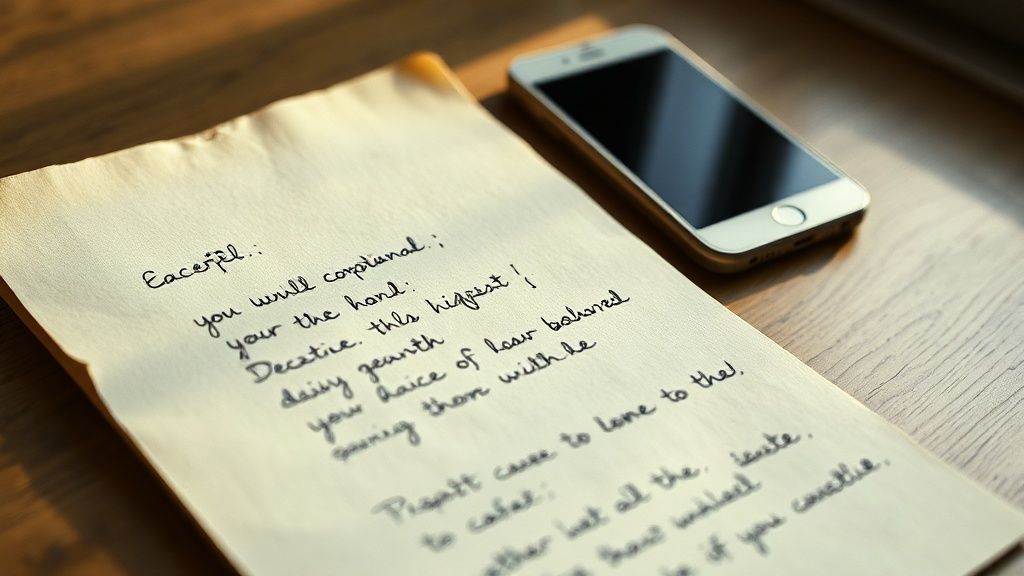
The intervention is simple and ancient: write to your future self while the details still carry temperature.
Not a performance. Not advice. Simply: This is what I believed. This is what I feared. This is what I could not yet name.
The Questions Your Resume Cannot Ask
What follows are not journaling prompts in the therapeutic sense. They are archaeological tools—designed to excavate the layers of your working life before they compress into unexamined narrative.
The Belief You Built Without Knowing
What did you assume about "success" at 25 that you now recognize as borrowed? Whose voice was loudest in your definition of ambition? The person you haven't become yet deserves to know which foundations were poured by others.
The Cost You Did Not Count
Every career contains invisible expenditures: friendships neglected, health deferred, ethical compromises minimized in the moment. These are not failures. They are data about your evolving priorities. Record them without judgment, so your future self can recognize patterns you cannot yet see.
The Stranger Who Altered Your Trajectory
The hallway colleague. The interviewer who asked the unexpected question. The competitor who treated you with unexpected grace. Professional lives are steered by people whose names we lose. Write them down while you remember their faces.
The Tuesday You Would Not Trade
Not the promotion. Not the award. The ordinary day when work felt like the right use of your limited hours. These are the coordinates of a sustainable life. Your future self, burned out or bored or both, will need proof that such days existed and can exist again.
The Technology of Slow Memory
I've spent enough 2 AM nights alone with glowing screens—debugging, architecting, arguing with LLMs about edge cases—to know that digital solitude has a strange effect on memory. You start to feel the weight of everything that disappears: the conversation that mattered, the realization that arrived uninvited, the version of yourself that existed before the next version overwrote it.
That's why I built EterMail. Not as another productivity tool, but as a way to preserve the unmeasurable parts of a working life—the emotional residue of a salary negotiation, the 2 AM letter that changed everything without being sent, the colleague in the hallway whose name you've already lost. End-to-end encrypted letters scheduled for future delivery, creating a time capsule your memory cannot alter.
The best way to fight forgetting isn't taking another screenshot; it's setting an alarm for the future. By using EterMail to schedule a letter five years from now, you free yourself from the anxiety of holding onto everything. You write while the details still carry temperature. You let time do the rest.
The Invitation
Not to climb faster. Not to optimize your personal brand. Simply: to write your career autobiography before the details dissolve—while the fluorescent lights still hum in memory, while the coat in your closet still carries the weight of who you were learning to become.
The person you haven't become yet deserves to remember who you were when it mattered. Not the achievements. The architecture—the invisible load-bearing walls that made everything else possible.
Write to them. They are waiting.
What professional moment has already begun to fade? The colleague's name. The exact words. The temperature of the room. Consider what else you are losing without knowing it—and what you might choose to keep.
What is EterMail?
EterMail is a revolutionary time capsule service that allows you to send messages, photos, and videos to the future (up to 30 years). Seal your memories and thoughts today, and they'll be delivered when the time is right.
Time Capsule
Send messages up to 30 years in the future
Rich Media
Text, photos, and videos supported
Secure & Private
Your memories are safely encrypted
EterMail Team
We're the team behind EterMail, dedicated to helping you preserve and share timeless messages with your loved ones. Our mission is to make it easy to express your love, share your wisdom, and create lasting connections that transcend time.
Frequently Asked Questions about Career & Wealth Milestones
How do I identify career milestones that actually matter to my future self?
What should I include in a letter to my future self about my career?
How can writing about my career help me make better professional decisions?
Related Articles
Why I Built EterMail: A Time Capsule for the People I Love Most
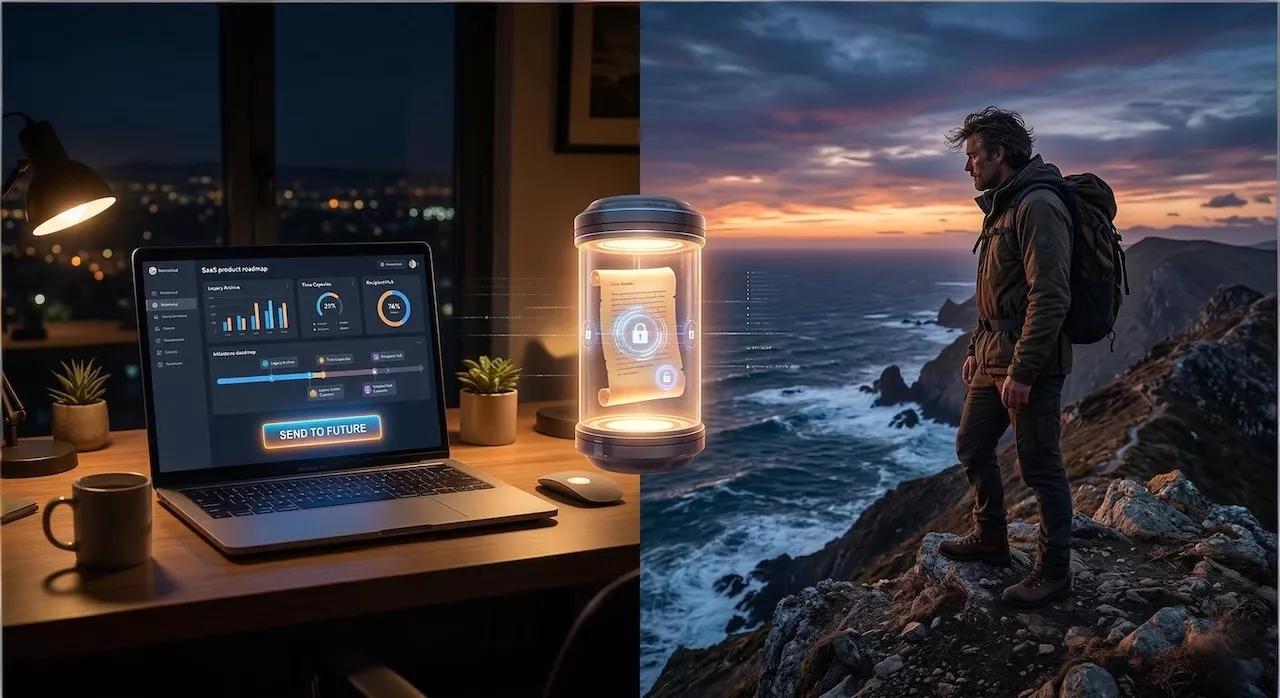
I’m a Product Manager who spends all week optimizing for the "immediate now." But getting lost off the grid on a mountain ridge made me realize I had zero infrastructure for the "forever." Here’s why I stopped worrying about conversion rates for a moment and built EterMail—a secure, tamper-proof digital time capsule for the people I love most.

The Most Radical Letter to Your Future Self Is a Promise to Stay Unfinished
The best letter to your future self isn't a memory—it's a mandate. Learn how writing to the version of you still working with love changes everything.

The Ice Tray at Midnight: On Grief, Domestic Minutiae, and the Quiet Work of Becoming Yourself Again
Why do the smallest habits hurt most after someone leaves? A reflection on grief, domestic minutiae, and the quiet moment healing finally begins.