The salary you negotiated at 31. The colleague who believed in you before you believed in yourself. The Thursday afternoon you realized you'd built something that would outlast your tenure. These are the wealth milestones no spreadsheet captures—yet they form the only professional narrative your future self will inherit.
Memory is not a faithful archivist of work. It preserves the humiliations with crystalline clarity and lets the victories dissolve into vague impressions of having been busy. The corner office, if it ever came, becomes a footnote. The project that nearly broke you becomes the story. This is an invitation to excavate the invisible architecture of your working life before memory rewrites it, and to ask what the person you haven't become yet deserves to remember about who you were when it mattered.
The Two Ledgers: What We Track vs. What We Live
Most professionals maintain two parallel records of their careers. The first is public and quantified: titles, salaries, equity stakes, performance ratings, LinkedIn endorsements. The second is private and largely unspoken: the first time you spoke up in a room that had intimidated you for years, the client you defended when it would have been easier to stay silent, the risk you took that paid nothing for eighteen months and then changed everything.
The problem is that only the first ledger gets preserved. We update our resumes. We file our tax returns. We track our net worth with apps that send us monthly summaries. But the second ledger—the one that actually explains how we became who we are—exists only in the unstable medium of memory, subject to the same distortions as any other autobiography.
Research on autobiographical memory suggests that we do not remember events so much as we remember our last retelling of them. Each time you narrate your career to yourself or others, you edit. The failures grow more instructive or more unfair. The successes shrink or inflate depending on whether you need humility or confidence in the present moment. Without an external record, your professional past becomes a servant of your present mood.

The Milestones That Matter in Hindsight
Ask someone twenty years into their career what they wish they had documented, and the answers rarely involve compensation. They mention the texture of specific seasons: the loneliness of their first management role, the exhilaration of their first independent client, the slow dawning realization that they had developed a genuine expertise that could not be easily transferred or faked.
These are the milestones worth preserving:
The Belief Milestones
The moments when someone saw capacity in you that you could not yet see in yourself. The mentor who recommended you for a role you would not have applied for. The peer who defended your work when you were not in the room. These external votes of confidence often precede our own by years, and their full significance only becomes visible in retrospect.
The Integrity Milestones
The times you chose the harder path because it was the right one. The budget you refused to inflate. The credit you redirected to a teammate. The departure you made because the organization's values had diverged too far from your own. These decisions rarely feel heroic in the moment. They often feel expensive. But they form the spine of whatever professional self-respect you will carry forward.
The Craft Milestones
The invisible hours of repetition that preceded competence. The first time a complex problem felt intuitive. The project where you finally understood not just what you were doing but why it mattered to the people it served. These are the moments when work transcends employment and becomes something closer to a practice.
The Transition Milestones
The departures, pivots, and reinventions that looked like failure to everyone except the version of you that would eventually emerge. The sabbatical. The demotion you accepted to change industries. The business you closed. These transitions are poorly documented because they resist the linear narrative that careers are supposed to follow.
Why Future You Needs This Archive
There is a peculiar loneliness to mid-career and late-career success. You have accumulated enough evidence of competence that fewer people challenge you, which means fewer people remind you of how you earned it. The stakes of your decisions grow higher, but the feedback grows quieter and more politicized. In this phase, many professionals experience a kind of impostor syndrome in reverse: a forgetting of the struggle that made their current position possible.
A letter to your future self, written at the height of a difficult but formative period, serves as an anchor. It reminds you that you have been uncertain before and acted anyway. It preserves the specific fears you overcame, not as generic inspiration but as evidence that your current confidence was constructed, not inherited.
There is also the question of what you will want to pass on. Whether to children, to mentees, or simply to the record of your own life, most people eventually want to offer more than a list of positions held. They want to explain how they learned what they learned, what they would do differently, and which principles held up across decades of change. Without documentation, this wisdom remains trapped in the generalities of age.

The Practice of Professional Preservation
Preserving career milestones does not require a memoir. It requires a habit of capturing specific moments in their specificity, before they collapse into summary.
Write the scene, not the summary. Instead of "Q3 was challenging," describe the conference room, the objection you raised, the silence that followed, and what you did with your hands while you waited for a response. These sensory details are what will transport your future self back to the person you were.
Capture the questions, not just the answers. The professional dilemmas that most shaped you were probably those you did not resolve cleanly. Preserve the uncertainty. Your future self will learn more from your honest framing of a problem than from your polished conclusion.
Name the people. Careers are collaborative fictions. The individuals who shaped yours deserve to be named, and your future self deserves to remember them. The manager who gave you feedback that stung for a week and then improved your work for a decade. The rival who made you raise your standard. The friend who listened to every iteration of a problem until you found your own way through it.
Include the numbers that carry emotional weight. Not your net worth, necessarily, but the specific figures that marked transitions: the freelance rate you first charged without apologizing, the salary that finally let you stop calculating every grocery purchase, the investment you made in yourself that felt reckless and turned out to be essential.
What We Owe to the People We Haven't Become
The person you will be in ten or twenty years is not a stranger. They are you, with the accumulated weight of experiences you cannot yet imagine and the accumulated loss of memories you currently take for granted. They will make better decisions if they can access not just your outcomes but your process. They will be kinder to themselves if they can read your account of uncertainty rather than relying on the polished narrative that memory will eventually construct.
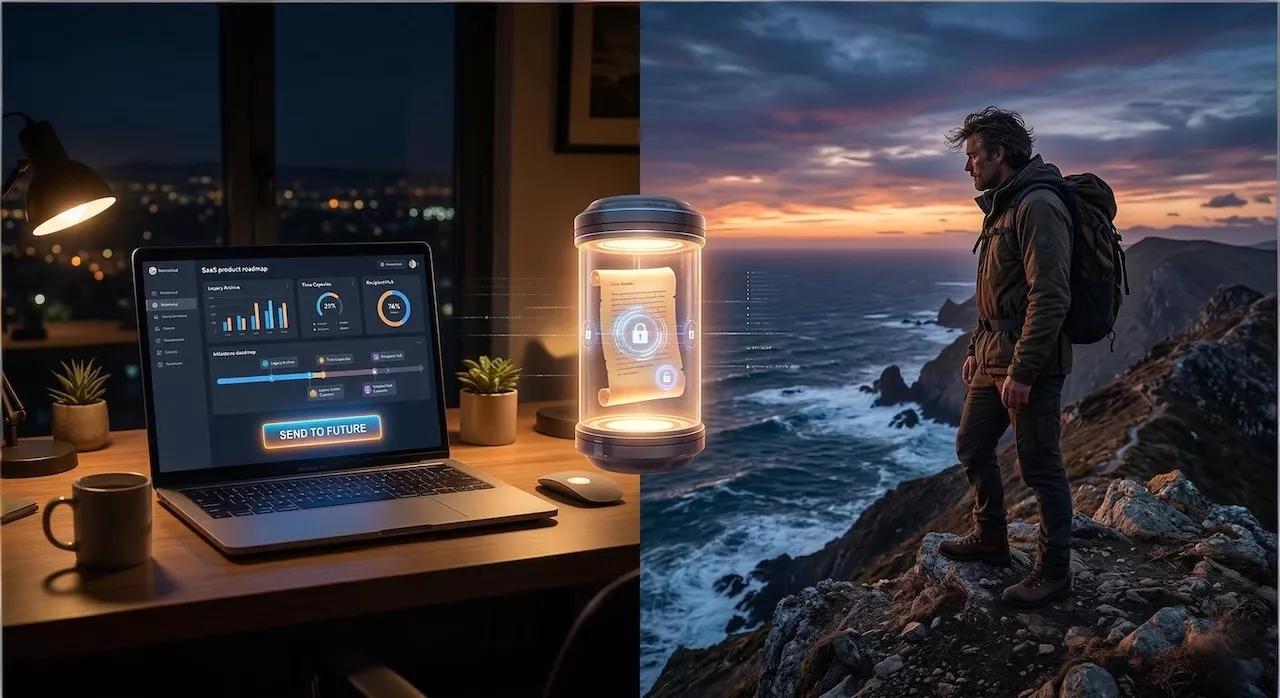
I know this because I've lived it from both sides. As a founder, I spend too many nights alone until 2 or 3 AM, pair-programming with an LLM, mapping out architectures in the blue glow of a monitor. That extreme digital solitude creates a strange intimacy with loneliness—and with the idea of speaking across time to someone who isn't there yet. When I finally step away from the keyboard, I head straight for the steepest mountain trail I can find, or the harshest wind I can ski through. The raw reality of nature strips away every illusion. It reminds me that the present moment is unrepeatable, and that the version of me standing on a ridge next weekend will already have forgotten details that matter to the me typing this now.
This is why I built EterMail. The best way to fight forgetting isn't taking another screenshot or adding another note to an app you'll never open; it's setting an alarm for the future. By using EterMail to set a delivery date 5 years from now, you completely free yourself from the anxiety of the present. You write the letter. You seal it. And you trust that it will reach the person who needs it most—your future self, delivered at exactly the right moment.
The career milestones that matter most are rarely the ones that appear on your annual review. They are the moments of private transformation, the relationships that altered your trajectory, and the quiet decisions that aligned your work with something you could respect. These deserve to be preserved with the same care you apply to your financial portfolio—because in the end, they are the only assets that explain who you became.
Your future self is already forming. They will inherit whatever record you choose to leave. Make it something they can use.
Frequently Asked Questions
What should I write in a letter to my future self about my career?
Focus on specific moments of uncertainty, growth, or decision rather than broad summaries. Describe the people who influenced you, the risks you took, the mistakes that taught you something, and the values you want to remember holding—your future self will learn more from your process than from your outcomes.
How do I document career milestones that don't show up on a resume?
Keep a private record of "invisible" milestones: the feedback that changed your approach, the project where you first felt like an expert, the transition that looked like failure from the outside, and the moments when you chose integrity over convenience. These form the real narrative of your professional development.
Why is it important to preserve memories of my working life?
Memory distorts professional experience, usually preserving failures more vividly than successes. An external record helps you maintain perspective during future challenges, pass on meaningful guidance to others, and avoid the late-career loneliness of forgetting how you earned your current position.
What is EterMail?
EterMail is a revolutionary time capsule service that allows you to send messages, photos, and videos to the future (up to 30 years). Seal your memories and thoughts today, and they'll be delivered when the time is right.
Time Capsule
Send messages up to 30 years in the future
Rich Media
Text, photos, and videos supported
Secure & Private
Your memories are safely encrypted
EterMail Team
We're the team behind EterMail, dedicated to helping you preserve and share timeless messages with your loved ones. Our mission is to make it easy to express your love, share your wisdom, and create lasting connections that transcend time.
Frequently Asked Questions about Career & Wealth Milestones
What should I write in a letter to my future self about my career?
How do I document career milestones that don't show up on a resume?
Why is it important to preserve memories of my working life?
Related Articles
Why I Built EterMail: A Time Capsule for the People I Love Most
I’m a Product Manager who spends all week optimizing for the "immediate now." But getting lost off the grid on a mountain ridge made me realize I had zero infrastructure for the "forever." Here’s why I stopped worrying about conversion rates for a moment and built EterMail—a secure, tamper-proof digital time capsule for the people I love most.

The Most Radical Letter to Your Future Self Is a Promise to Stay Unfinished
The best letter to your future self isn't a memory—it's a mandate. Learn how writing to the version of you still working with love changes everything.

The Ice Tray at Midnight: On Grief, Domestic Minutiae, and the Quiet Work of Becoming Yourself Again
Why do the smallest habits hurt most after someone leaves? A reflection on grief, domestic minutiae, and the quiet moment healing finally begins.