The 2 AM Email That Still Haunts You
You remember the cursor blinking. Three hours past midnight, your apartment dark except for the screen's blue glow. You had rewritten the same paragraph eleven times. The client needed an answer by morning. Your finger hovered over delete. Instead, you sent something flawed—something alive.
That typo in the second sentence. The sentence fragment in the fourth paragraph. The admission, buried near the end, that you weren't entirely sure of the path forward but were committed to finding it together.
You woke to a response you didn't expect. Not correction. Not dismissal. "This is the first time someone from your firm has sounded like a person."
We have built entire productivity religions around the elimination of such moments. Inbox zero. Second brain systems. The polished personal brand. The seamless workflow. We have been taught that professional advancement is a process of sanding down—of removing the friction, the hesitation, the human texture that might snag on someone else's expectations.
But something is shifting beneath our feet. The tools of seamlessness have become so capable that perfection itself is becoming commodified. AI can now generate the cover letter you spent hours crafting. It can smooth your prose into something indistinguishable from competence. It can simulate the voice you spent years developing, and in doing so, it threatens to render that voice—your voice—invisible.
The question is no longer how to become perfect. It is how to remain recognizable as yourself.
What Productivity Systems Cannot Catalog
Consider what your calendar remembers. The quarterly review. The promotion. The closed deal. These are the milestones we are trained to celebrate, the data points that populate LinkedIn updates and performance reviews.
But what about the moments that shaped you in the spaces between?
The handwritten note from a client who thanked you for admitting you were wrong. The project you launched before it was ready, because waiting meant missing a window that would never reopen. The colleague you defended when it cost you political capital. The time you chose transparency over strategy, and somehow strategy followed anyway.
These are the unpolished milestones—the human fingerprints no productivity system values because they resist quantification. They do not fit neatly into OKRs or quarterly planning documents. They are messy, contextual, often invisible even to the people who lived them.
And they are becoming harder to preserve.
Our digital workspaces are designed for ephemerality. Slack threads disappear into paid tiers. Email inboxes become unsearchable archives we never revisit. The documents we draft and discard leave no trace. Even our "sent" folders become graveyards of context—we can read what we wrote, but not what we felt, not what we risked, not what we almost chose differently.
The wealth of a career, measured in its full human dimension, is leaking away.
The Algorithmic Mirror and the Crisis of Recognition
There is a particular loneliness that arrives when you cannot distinguish your own work from what a machine might have produced. You read back something you wrote six months ago and find yourself wondering: Would I have written this differently if I had used the assistant? Would it have been better? And if so, what does "better" mean when the standard is frictionless competence?
This is the algorithmic mirror—the moment when the tools designed to amplify your capabilities begin to reshape your sense of what your capabilities were. You start to doubt the value of your hesitation, your particular rhythm of thought, your instinct to push against conventional phrasing. You begin to outsource not just the execution but the judgment of what sounds like you.
The danger is not that AI will replace you. The danger is that you will replace yourself—gradually, invisibly, by accepting a definition of professional quality that has no room for your particular texture of mind.
Consider what future you deserves to know. Not the polished narrative of advancement you might construct for a performance review. The real story. The fear you felt before the risk that paid off. The arrogance you displayed before the failure that humbled you. The moment you recognized that your definition of success had quietly changed, and you weren't sure when or how.
These are the materials of becoming. They are the only inheritance that cannot be generated, because they are the record of choices made under uncertainty by someone who existed at a specific moment and will never exist in exactly that form again.

Cataloging the Unpolished: A Practice of Resistance
What would it mean to deliberately preserve the imperfect record of your professional life?
Not the portfolio pieces. Not the metrics that impressed. The other things. The email you sent in anger and later regretted, which taught you something about your own triggers. The proposal that was rejected because it was too honest, which clarified what you were and weren't willing to compromise. The mentorship conversation where you admitted you didn't have answers, and discovered that your uncertainty was itself a form of guidance.
This is not nostalgia. It is archaeology of the self—the disciplined practice of maintaining evidence that you were here, that you struggled, that you changed.
The value is not merely personal. As AI-generated content proliferates, the ability to recognize human authorship becomes itself a skill—a form of literacy that future colleagues, clients, and collaborators will need to develop. Your preserved imperfections become reference points in a landscape increasingly populated by seamless simulation. They are proof of concept that another way of working was possible, that the friction you experienced was not failure but feature.
What Future You Needs to Witness
There will come a moment, perhaps decades from now, when you will want to remember who you were when you still had to choose between perfect and present. When the tools of seamlessness were available but you had not yet surrendered to them completely. When your career still felt like a series of gambles rather than optimizations.
Future you deserves to see the raw material. The draft with the embarrassing confession. The message sent without the safety of revision. The project launched with known flaws because the alternative was silence.
These are not mistakes to be forgiven. They are choices to be understood—by the person you will become, who may have forgotten what it cost to make them.
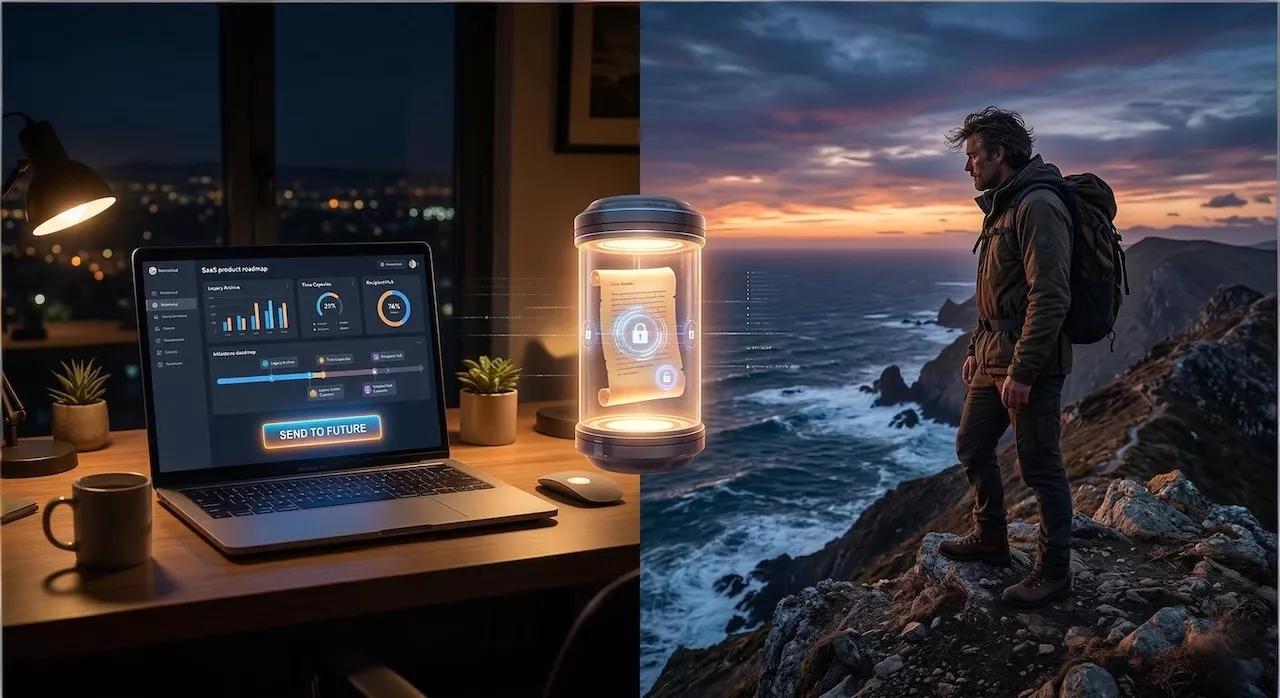
I know this feeling intimately. I spend too many nights alone with a glowing screen, "pair programming" with LLMs until 2 or 3 AM, chasing architectures through the dark. That extreme solitude—just me and the machine, building in silence—has given me a strange kinship with loneliness, and with the idea of sending messages across time to someone who isn't there yet. When I finally step away, I head straight for the mountains or the ocean, desperate for wind and waves that don't care about my code, that strip away every illusion of control. The contrast teaches me something I keep having to relearn: the unrepeatable moment matters more than the polished output.
The deeper wealth is the accumulated evidence of your presence in your own life. The record of moments when you could have been smoother, safer, more algorithmic—and chose not to be. The documentation of your becoming, preserved not for public consumption but for private recognition.
The best way to fight forgetting isn't taking another screenshot; it's setting an alarm for the future. I built EterMail because I kept losing the threads of who I was—the raw drafts, the late-night confessions, the versions of myself I needed future me to meet again. By using EterMail to set a delivery date 5 years from now, you completely free yourself from the anxiety of the present. The letter waits. Time becomes something you can speak to, not just something that erases you.
The Invitation
You will not remember the polished presentations. You will remember the 2 AM email. The risk. The human error that connected you to another person in a way that competence never could.
The invitation is to preserve these moments deliberately. To resist the ephemerality of digital workspaces that erase the texture of your thinking. To create a record that future you can excavate—not for pride, but for recognition. For the essential human need to know that you were real, that you struggled visibly, that you left fingerprints no algorithm could have predicted.
Your career's most enduring wealth is not what you optimized. It is what you dared to send imperfectly into the world—and what the world, impossibly, sent back.
What is EterMail?
EterMail is a revolutionary time capsule service that allows you to send messages, photos, and videos to the future (up to 30 years). Seal your memories and thoughts today, and they'll be delivered when the time is right.
Time Capsule
Send messages up to 30 years in the future
Rich Media
Text, photos, and videos supported
Secure & Private
Your memories are safely encrypted
EterMail Team
We're the team behind EterMail, dedicated to helping you preserve and share timeless messages with your loved ones. Our mission is to make it easy to express your love, share your wisdom, and create lasting connections that transcend time.
Frequently Asked Questions about Career & Wealth Milestones
What career milestones should I document beyond promotions and salary increases?
How can I preserve my professional story in an age of ephemeral digital communication?
Why do imperfections in my work history matter for my future self?
Related Articles
Why I Built EterMail: A Time Capsule for the People I Love Most
I’m a Product Manager who spends all week optimizing for the "immediate now." But getting lost off the grid on a mountain ridge made me realize I had zero infrastructure for the "forever." Here’s why I stopped worrying about conversion rates for a moment and built EterMail—a secure, tamper-proof digital time capsule for the people I love most.

The Most Radical Letter to Your Future Self Is a Promise to Stay Unfinished
The best letter to your future self isn't a memory—it's a mandate. Learn how writing to the version of you still working with love changes everything.
The Ice Tray at Midnight: On Grief, Domestic Minutiae, and the Quiet Work of Becoming Yourself Again
Why do the smallest habits hurt most after someone leaves? A reflection on grief, domestic minutiae, and the quiet moment healing finally begins.