
The Document That Doesn't Exist in Your Files
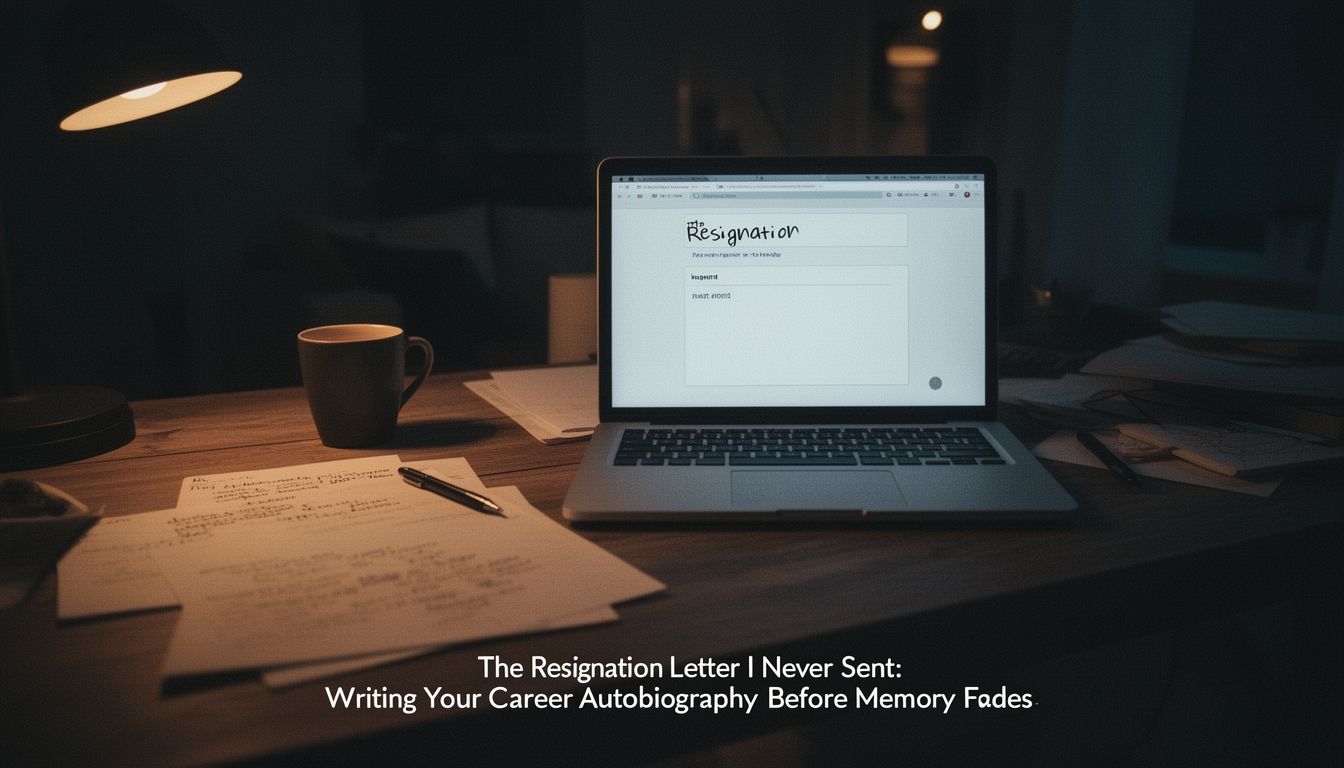
Somewhere in your digital history—buried in a drafts folder, perhaps, or scrawled in a notebook you haven't opened since 2019—lives a version of yourself you never became. The resignation letter composed at 2 AM after a brutal quarter. The email accepting a dream position you ultimately declined because the timing felt wrong. The unsent message to a mentor whose advice you ignored, then spent years wishing you'd taken.
These are the invisible milestones of a working life. No LinkedIn notification celebrates them. No performance review captures their weight. Yet they compose the true architecture of your professional identity—the choices that bent your trajectory in directions you couldn't yet see.
What would it mean to write directly to the person standing at those crossroads? More urgently: what do you owe the professional you haven't met yet?
The Wealth That Can't Be Deposited
We are trained to measure career success in increments that fit spreadsheets. Salary bands. Equity stakes. Titles with progressively more syllables. But ask someone two decades into their working life what they actually remember, and the accounting shifts dramatically.
They recall the specific afternoon when a junior colleague's gratitude made the years of invisible mentorship feel worthwhile. The project that failed spectacularly yet taught them everything about their own resilience. The moment they realized their ambition had been borrowed from someone else's definition of success—and the subsequent, terrifying work of building their own.
These are wealth milestones in the truest sense: deposits into a self-knowledge account that compounds over time. The tragedy is how quickly they degrade. Memory is not retrieval but reconstruction—each access slightly altering the original. The emotional texture of your first major professional failure softens into anecdote. The specific doubt that haunted your decision to pivot careers dissolves into "I just knew it was time."
Your future self deserves better documentation than this.
The Three Letters Every Professional Should Write
To the Version of You Who Just Endured Something
Not the polished retrospective you'll deliver at dinner parties. The raw, unprocessed account written while the experience still has teeth.
What did you actually believe about yourself in that moment? What did you fear would be permanently true? What did you hope for with an intensity that now embarrasses you?
This letter serves two purposes. First, it preserves emotional accuracy against the smoothing work of time. Second, it creates a bridge of compassion for your future self, who will inevitably face something that rhymes with this experience. Reading your own unvarnished account of survival—written in real-time, not retrospect—provides a form of mentorship no external source can replicate.
To the Ambition You Haven't Yet Outgrown
Every professional carries multiple versions of their future. The one where you become indispensable to your organization. The one where you walk away entirely. The one where your work and your values finally align without daily negotiation.
Write to the specific ambition currently dominating your imagination. Not to commit to it—to interrogate it. What need does this version of success promise to satisfy? Whose recognition does it require? What would actually change in your daily experience of being alive if you achieved it?
Schedule this letter to arrive in five years. The person reading it will possess information you cannot access now. They will know which ambitions aged poorly, which transformed into something unrecognizable, and which quietly died without the funeral you expected. Their perspective on your current striving—delivered in your own voice—constitutes a unique form of wisdom.

To the Professional Identity You're Still Constructing
Perhaps most difficult: a letter to the self who will eventually look back on your current chapter as "early career." This requires the radical act of naming what you cannot yet see—the patterns, limitations, and possibilities invisible from your present vantage.
What are you currently pretending not to know about your own working style? What feedback have you received consistently enough that its truth is becoming undeniable? What capacity do you sense developing that you cannot yet fully articulate?
This letter resists the performance of certainty that professional culture demands. It models the vulnerability of being in-process, which your future self—likely occupying some new threshold of development—will need to remember is survivable.
The Architecture of Scheduled Self-Conversation
The practical challenge is not writing these letters but ensuring they survive to reach their intended recipients. Digital files corrupt. Cloud accounts lapse. Physical notebooks migrate to storage units and garage sales.
More subtly: the self who composed these letters may not want them found. The impulse to delete, to curate, to protect one's narrative from contradiction is powerful. Future-you may prefer the simplified story to the documented complexity.
This is why time-locked digital correspondence matters—not as mere storage, but as commitment device. The act of scheduling a letter for future delivery creates a small rupture in the continuity of self. It acknowledges that you are not the final arbiter of your own story. The person who receives this message will have earned the right to interpret it differently than you intend.
I spend most nights alone with a screen, "pair programming" with AI systems until 2 or 3 AM, chasing the edge of what's technically possible. That extreme digital solitude has taught me something about loneliness and about conversations that stretch across time. When I'm not at the keyboard, I'm on steep mountain trails or in ocean waves—places where control dissolves and raw reality demands attention. The contrast keeps me honest. Code is just a bridge between physical and digital worlds, and I've always been obsessed with that boundary. The Matrix wasn't just entertainment for me; it was a blueprint. Building tools that let humans preserve and transmit their consciousness across time—that's the work that actually matters.
Consider what it means to write knowing your reader possesses knowledge you cannot imagine. The colleague who will betray you. The unexpected opportunity that will arrive disguised as inconvenience. The slow accumulation of evidence that will finally clarify what you actually value.
This orientation—writing toward a wiser, more experienced self—paradoxically produces greater honesty in the present. You cannot perform for an audience who already knows how the story goes.
The Questions Worth Preserving
The most valuable letters to your future self may not contain answers at all. They might simply preserve the precise formulation of questions that currently structure your professional life.
- What would I create if no one else's opinion mattered?
- Is my current definition of success making me more or less available to the people I love?
- What am I currently optimizing for that I won't remember caring about in ten years?
- What would I attempt if I knew my next professional chapter was my last?
These questions have shelf lives. The person you become will have settled some, abandoned others, and discovered that several were malformed from the start. But receiving your own earnest engagement with them—written in the specific vocabulary of your current concerns—creates a continuity of self that professional identity often disrupts.
We are not, despite LinkedIn's implications, continuous narratives of upward progression. We are serial selves, each version partially unrecognizable to the others, connected by memory and story. The letters we write across time are the stitching that holds these selves in conversation.

What Your Future Colleague Needs From You
The professional you will become is not your enemy, though they may feel like it. They may have made choices that puzzle you, abandoned commitments you consider sacred, succeeded by metrics you find suspect. They are, nonetheless, the only person who fully inherits the consequences of your current decisions.
What do you owe them?
Honesty about the trade-offs you're currently making. The specific costs of your ambition, documented while you're still paying them. The rationalizations you're currently employing, preserved without judgment for later examination.
Gratitude for the foundations they're building on. The mentors who shaped you. The failures that equipped you. The luck you didn't earn but benefited from nonetheless.
Permission to have become someone you didn't plan. The acknowledgment that your current vision of success is provisional, that your future self's deviations from it may constitute growth rather than betrayal.
These are the contents of a career autobiography worth preserving—not the accomplishments that fit a resume, but the interior movements that determined which accomplishments would matter to you. The promotions you chased and the ones you declined. The resignation letters composed and unsent. The quiet Tuesdays when a stranger's gratitude made the years feel worthwhile.
The best way to fight forgetting isn't taking another screenshot; it's setting an alarm for the future. By using EterMail to set a delivery date 5 years from now, you completely free yourself from the anxiety of the present. No more wondering if you'll remember to revisit these questions. No more trusting corrupted files or abandoned cloud accounts. Just your own voice, preserved exactly as you spoke it, arriving when you most need to hear it.
What is EterMail?
EterMail is a revolutionary time capsule service that allows you to send messages, photos, and videos to the future (up to 30 years). Seal your memories and thoughts today, and they'll be delivered when the time is right.
Time Capsule
Send messages up to 30 years in the future
Rich Media
Text, photos, and videos supported
Secure & Private
Your memories are safely encrypted
EterMail Team
We're the team behind EterMail, dedicated to helping you preserve and share timeless messages with your loved ones. Our mission is to make it easy to express your love, share your wisdom, and create lasting connections that transcend time.
Frequently Asked Questions about Career & Wealth Milestones
What should I write in a letter to my future self about my career?
How do career milestones affect long-term professional satisfaction?
Why is writing to my future self valuable for career planning?
Related Articles

Why I Built EterMail: A Time Capsule for the People I Love Most
I’m a Product Manager who spends all week optimizing for the "immediate now." But getting lost off the grid on a mountain ridge made me realize I had zero infrastructure for the "forever." Here’s why I stopped worrying about conversion rates for a moment and built EterMail—a secure, tamper-proof digital time capsule for the people I love most.

The Most Radical Letter to Your Future Self Is a Promise to Stay Unfinished
The best letter to your future self isn't a memory—it's a mandate. Learn how writing to the version of you still working with love changes everything.

The Ice Tray at Midnight: On Grief, Domestic Minutiae, and the Quiet Work of Becoming Yourself Again
Why do the smallest habits hurt most after someone leaves? A reflection on grief, domestic minutiae, and the quiet moment healing finally begins.