The 2 AM Email That Changed Everything
You were exhausted. The client proposal had to go out before sunrise, and your eyes burned from staring at spreadsheets no human was meant to parse at that hour. You hit send. Then you saw it—the typo. Not a catastrophic one, not the kind that sinks careers, but something small and human. "Best retards" instead of "best regards." Your stomach dropped through the floor.
You drafted the correction immediately. The apology. The careful re-establishment of professionalism. But something unexpected happened: the client wrote back laughing. They'd been there too, they said. The typo became a door. Six months later, that same client recommended you for the largest contract of your career—not despite the mistake, but because of what it revealed. You were not a bot. You were not polished into nonexistence. You were present, fallible, and awake at an ungodly hour trying to solve something that mattered to you.
I know this hour intimately. There are nights building EterMail when I'm still at my desk at 2 AM, "pair programming" with an LLM, mapping out encryption architectures while the rest of the world sleeps. That digital solitude has a strange texture—your mind raw, your defenses down, the screen's glow the only witness to your stumbling toward something real. Those hours teach you that the most human work happens precisely when you're too tired to perform.
We do not have productivity systems for this. No quarterly review captures the weight of that moment. Yet these are the wealth milestones that compound in directions no spreadsheet tracks.
The Margin Note That Saved a Partnership
Consider the contract you almost didn't read. The one that arrived during your daughter's birthday party, that you skimmed while pretending to listen to her describe her cake. Something caught your eye—a clause buried on page seventeen, phrased with the careful ambiguity that only lawyers who have never built anything can achieve. You grabbed the nearest pen, a purple marker meant for gift tags, and scribbled in the margin: "This kills us in year three. Need cap on liability or we walk."
The partnership almost dissolved over that note. The other party's counsel called it "unprofessional." But your counterparty, the founder who had also built something from nothing, saw something else. She saw someone who still read the fine print with their hands, who still thought with ink rather than tracked changes. The renegotiation took eight weeks. The partnership lasted eight years.
Wealth, in its truest form, is not the accumulation of optimized outcomes. It is the accumulation of moments where you chose presence over polish, where you risked looking unprofessional to protect something that mattered. These moments do not appear in your LinkedIn timeline. They exist in margins, in voicemails, in the spaces between the versions of yourself that algorithms would prefer you present.
When You Abandoned the Script
There was the presentation, too. The one you'd rehearsed until your own voice sounded like a stranger's. The slides were beautiful—designer-blessed, data-rich, utterly dead. You stood before the room and felt the familiar dissociation: who is this person speaking? Then something broke. A question from the audience, unexpected and sharp, about something the deck didn't cover. Something real.
You closed the laptop. The room inhaled. And you spoke—not from the script, but from the accumulated weight of every 2 AM typo, every margin note, every moment you'd chosen to stay present in a process designed to automate you away. The presentation became a conversation. The conversation became a relationship. The relationship became the foundation of work you still believe in.

The Algorithmic Polish That Erases Us
We are living through what might be called the Great Smoothing. The tools of seamlessness—AI-generated correspondence, automated scheduling, predictive text that finishes your sentences before you know your own thoughts—are not merely convenient. They are rewriting the texture of professional memory. The email you didn't quite send, the one that existed in the space between intention and execution, is disappearing. What remains is the perfectly calibrated output, indistinguishable from a million other perfectly calibrated outputs.
This is not a Luddite's lament. The tools are extraordinary. They extend our capacity in ways that would have seemed magical a decade ago. But capacity without texture is volume without weight. When future you attempts to reconstruct who you were during the years of your becoming, what record will remain? The polished outputs tell a story of competence, perhaps. They do not tell the story of becoming.
The wealth milestones that matter—the ones that shape not just what you accumulated but who you became—are increasingly invisible to the systems that archive our lives. The CRM doesn't capture the courage of the unscripted moment. The portfolio doesn't include the partnership that nearly failed. The résumé cannot hold the weight of the 2 AM typo that became a door.
Cataloging the Unpolished: A Practice for Future You
What would it mean to intentionally preserve these moments? Not as performance, not as content to be shared, but as evidence of your human presence in the years when you were still becoming?
Consider the practice of recording what you might call "process memories"—the unguarded artifacts of professional life that reveal who you were when you still had to choose between perfect and present. The screenshot of the typo, saved before the correction. The photograph of the margin note, purple ink bleeding slightly into expensive paper. The voice memo recorded in your car after the abandoned presentation, still vibrating with the adrenaline of having chosen real over rehearsed.
These are not nostalgia. They are data points in the longitudinal study of your own becoming. Future you—sitting in whatever success or failure or strange middle space awaits—deserves access to this evidence. Deserves to remember that you were not always the person you will become, that the competence you may eventually wear like armor was once uncertain, chosen, earned in moments of visible imperfection.
The Time Capsule of Your Becoming
There is a particular loneliness to professional memory in the digital age. We archive everything and preserve nothing. The cloud holds infinite versions of polished outputs, yet the process of our becoming—the stumbles, the recoveries, the moments where we chose humanity over optimization—exists only in the fragile medium of biological memory, subject to the same smoothing as our tools.
What if you could send these moments forward? Not as social media performance, not as content calibrated for engagement, but as private correspondence with the person you are still becoming. A letter to your future self that includes not just the achievements the world can see, but the invisible milestones that actually shaped you. The typo that taught you vulnerability could be a door. The margin note that reminded you why you started. The abandoned script that proved you could still choose presence over polish.
This is where EterMail lives. I built it because I know what it's like to lose the thread of who you were—to wake up years later and wonder if the person who made those messy, brave choices was really you. The best way to fight forgetting isn't taking another screenshot; it's setting an alarm for the future. By using EterMail to set a delivery date 5 years from now, you completely free yourself from the anxiety of the present. You write the unpolished truth now, seal it, and let time carry it to the person you're becoming. Because I know that a letter written to the future needs to be guarded even more fiercely than a bank password—that's why I obsessed over end-to-end encryption and extreme server redundancy when building this.
This is the practice that no productivity system values, yet it may be the most important wealth you accumulate. The ability to remember who you were when you were still becoming—to recognize the continuity between the exhausted person who made the typo and the accomplished person who eventually emerged—is the antidote to the imposter syndrome that afflicts even the most successful.
What Future You Deserves to Remember
The question is not whether you will change. You will. The question is whether you will recognize yourself across that change, whether you will be able to trace the thread of your becoming from who you were to who you become.
Future you deserves to remember the courage of imperfection. The partnerships that survived because someone saw humanity in your margin notes. The presentations that mattered because you closed the laptop. The 2 AM emails that remind you that you cared enough to be exhausted, enough to make mistakes, enough to be present in a process that would have preferred your automation.
These are the wealth milestones that compound in directions no spreadsheet tracks. They are the proof that you were here, that you chose, that you became something through the accumulated weight of unpolished moments. Before the tools of seamlessness erase the record of your becoming, catalog them. Send them forward. Let future you recognize the person who made the typo, who scribbled in purple ink, who closed the laptop and spoke from whatever truth was available in the moment.
That person is still becoming. That person deserves to be remembered.
The tools we build to optimize our outputs cannot preserve the texture of our becoming. Only we can choose to send that evidence forward—to the person we are still in the process of becoming, who will one day need to remember that we were here, that we tried, that we were human in the years when humanity was still a choice.
What is EterMail?
EterMail is a revolutionary time capsule service that allows you to send messages, photos, and videos to the future (up to 30 years). Seal your memories and thoughts today, and they'll be delivered when the time is right.
Time Capsule
Send messages up to 30 years in the future
Rich Media
Text, photos, and videos supported
Secure & Private
Your memories are safely encrypted
EterMail Team
We're the team behind EterMail, dedicated to helping you preserve and share timeless messages with your loved ones. Our mission is to make it easy to express your love, share your wisdom, and create lasting connections that transcend time.
Frequently Asked Questions about Career & Wealth Milestones
How do I document my career journey beyond just achievements and promotions?
Why do unpolished professional moments matter for long-term growth?
How can I preserve professional memories that aren't captured by work systems?
Related Articles
Why I Built EterMail: A Time Capsule for the People I Love Most
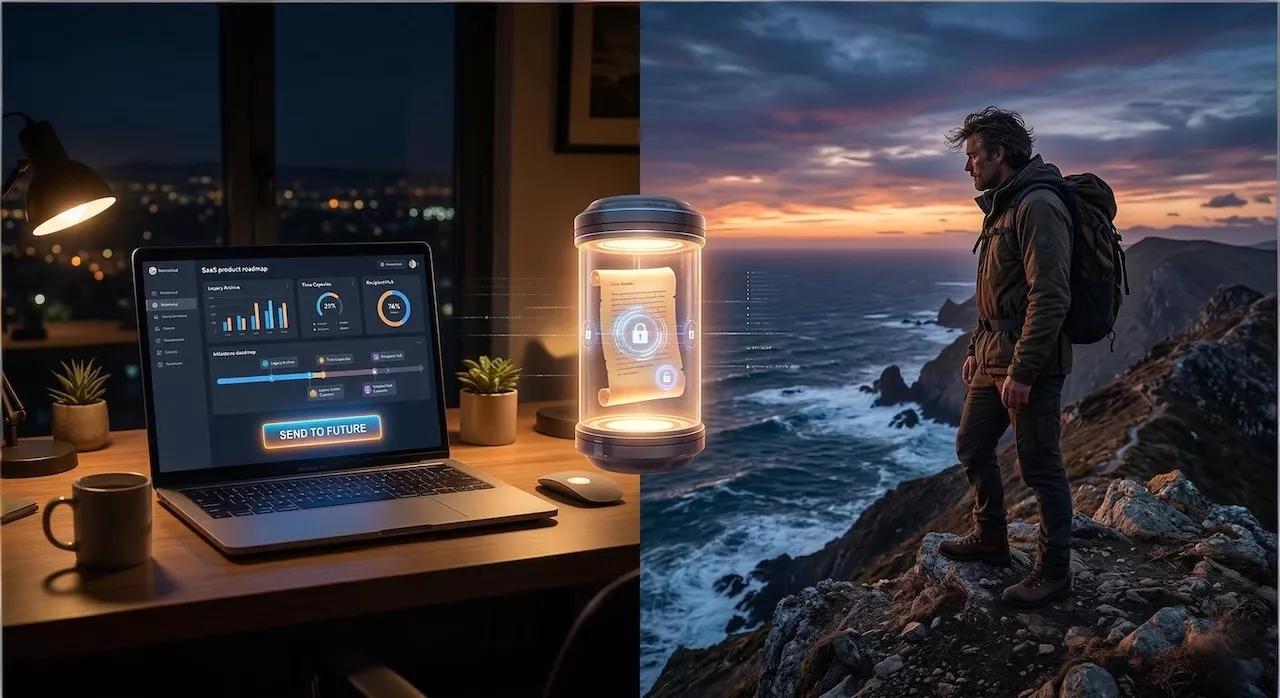
I’m a Product Manager who spends all week optimizing for the "immediate now." But getting lost off the grid on a mountain ridge made me realize I had zero infrastructure for the "forever." Here’s why I stopped worrying about conversion rates for a moment and built EterMail—a secure, tamper-proof digital time capsule for the people I love most.

The Most Radical Letter to Your Future Self Is a Promise to Stay Unfinished
The best letter to your future self isn't a memory—it's a mandate. Learn how writing to the version of you still working with love changes everything.

The Ice Tray at Midnight: On Grief, Domestic Minutiae, and the Quiet Work of Becoming Yourself Again
Why do the smallest habits hurt most after someone leaves? A reflection on grief, domestic minutiae, and the quiet moment healing finally begins.