Nobody Remembers Every Version of You: The Ghosts We Leave in the Cloud
You found an old laptop in a drawer last spring. The battery had swelled like a bruise, but when you plugged it in, the machine wheezed to life. Your younger self stared back from the desktop wallpaper—someone with different hair, different fears, a relationship you had trained yourself not to think about. The browser history loaded like a confession you never meant to record. Draft emails to people who had since died or disappeared. A folder of photographs so poorly composed they felt stolen from someone else's life.
You sat with this stranger for an hour, then closed the laptop and returned it to the dark. You have not opened it since.
This is the unspoken crisis of our era: we are the first humans to leave behind not one legacy, but dozens—fragmented, contradictory, often involuntary. Our ancestors buried a single set of letters, perhaps a diary, maybe a handful of photographs carefully selected for posterity. We scatter ourselves across servers and devices without ceremony, without curation, without consent. And the versions we leave behind are rarely the ones we would have chosen to be remembered by.
The Accidental Archive
Consider what survives when you do not actively choose. Your first email account, still accumulating spam after fifteen years. The cloud backup from a phone you destroyed in anger. Social media platforms you abandoned but never deleted, their algorithms still surfacing your face in strangers' memories. Each of these repositories preserves a version of you that you have outgrown, outlasted, or outright rejected.
The psychological weight of this is rarely discussed. We speak of digital legacy as if it were a marketing problem—how to manage your "personal brand" for future employers, how to curate an Instagram that ages gracefully. But the deeper disturbance is existential. You are not the same person who typed those 3 AM messages, who photographed that particular sunset, who searched for those symptoms you were too frightened to speak aloud. Yet that person persists, stored in climate-controlled server farms, waiting to be encountered by someone who lacks the context to understand that you changed.
Dr. Elaine Kasket, psychologist and author on digital death, has observed that our online remnants often create what she calls "posthumous continuity"—the illusion that the dead (or in this case, the transformed) remain accessible, unchanged, forever present. But for the living, this continuity can feel more like haunting. The past self that survives in digital form does not know what you have learned. It cannot apologize, cannot contextualize, cannot grow. It simply waits, preserved in amber, ready to be misread by future partners, children, or strangers with administrative access to your accounts.
The Inheritance of Unfinished Becoming
Perhaps the most unsettling aspect of accidental digital legacy is how it captures the selves we were becoming without knowing we would become something else. The graduate school application essays from the career you abandoned. The fertility tracking app from the pregnancy that ended differently than hoped. The tentative messages to a therapist you never followed through with seeing. These fragments do not tell the story of who you became. They tell the story of who you were afraid you might be, or who you desperately wanted to become, or who you were too exhausted to sustain.
This matters because inheritance is not merely about property. It is about narrative. When your loved ones eventually sort through your digital remains—because someone will, whether in three months or thirty years—they will encounter these incomplete selves. They will construct stories from your abandoned drafts and your midnight searches. They will assemble a ghost from the versions you never meant to preserve, and they will call it you.
The curated legacy—the memoir, the carefully selected photographs, the farewell letter composed with full knowledge of ending—has always been a privilege. But at least our ancestors understood it as a project. They knew that memory required intention. We have somehow convinced ourselves that preservation is automatic, that more data equals more truth, that the cloud's comprehensive memory is somehow more honest than our selective one.
It is not more honest. It is merely more. And more, in this case, is a kind of violence against the self—the violence of being fixed in versions you have transcended, misunderstood by people who never knew the context of your becoming.
Reclaiming the Right to Outgrow Yourself
There is a radical act available to us, though it runs counter to every default setting of our platforms: we can choose what survives. We can practice a kind of digital mortality, allowing certain selves to complete their arc and dissolve.
This is not about shame or hiding. It is about recognizing that human beings are processes, not products. The person who suffered through that depressive episode and emerged with different understanding deserves to have that suffering witnessed—but perhaps not by casual discovery in an unencrypted backup. The person who wrote those raw, unformed thoughts in a journal app at twenty-three was doing necessary work, but that work need not be the primary evidence of their existence for future generations.
The question becomes: how do we preserve the meaning without preserving the confusion? How do we honor the journey without trapping the traveler at every stage?
Some are turning to intentional digital legacy tools—not to add more content to the noise, but to create designated spaces of meaning. A letter composed with full awareness of its future reader. A time capsule assembled with the wisdom of who you have become, addressed to who you will be. A message to a child not yet old enough to understand, scheduled to arrive when they are ready. These acts do not replace the accidental archive. They contextualize it. They offer a narrative voice that the scattered fragments cannot provide on their own.
The technology for this exists now. End-to-end encrypted platforms allow you to schedule messages to your future self or designated loved ones, to release memories at moments you choose rather than moments imposed by circumstance. The crucial distinction is intentionality: you become the author of your own preservation, not merely the subject of an algorithm's relentless accumulation.
The Ethics of Letting Some Versions Fade
We must also consider what we owe to the people who will remember us. Your children do not need to discover every version of your desire, your fear, your unprocessed rage. Your future self does not benefit from being confronted with the raw material of pain you have since metabolized. There is a kindness in curation, a generosity in allowing some selves to complete their work and rest.
This is not the same as the curated perfection of social media performance. It is closer to the editorial judgment that has always governed memoir and autobiography: what serves the story of becoming, and what merely confuses it? What offers connection across time, and what traps both writer and reader in loops of misunderstanding?
The philosopher Walter Benjamin wrote that memory is not an instrument for exploring the past but its theater. We stage our memories for present purposes, and in doing so, we keep them alive. The uncurated digital archive, by contrast, is not a theater but a warehouse—vast, climate-controlled, devoid of narrative intelligence. It preserves without purpose, accumulates without meaning, and ultimately burdens the future with the task of sorting through our unfinished becoming without our guidance.
Toward a Legacy of Intention
I know something about unfinished things. For years I sat in the blue glow of 2 AM, pair-programming with LLMs, mapping architectures that felt like building cathedrals in fog—structures meant to outlast me, though I couldn't yet see who they'd serve. The extreme solitude of those nights taught me that digital creation without human endpoint is just more noise, more warehouse. I'd spend weekends hiking steep trails or surfing until my arms burned, the raw reality of wind and water stripping away every illusion that what mattered was the code itself. What mattered was the bridge. The message that gets across.
The most profound shift available to us is philosophical before it is technological. We must stop conceiving of digital preservation as automatic and start understanding it as a practice—one that requires the same attention we bring to other forms of legacy. We do not leave our physical possessions to chance. We write wills, we designate heirs, we make our intentions known. Our digital fragments deserve no less intention, and arguably more, given their persistence and their capacity for unexpected discovery.
This means regularly auditing what survives in our various accounts. It means using tools that allow us to schedule the release of meaning rather than the accumulation of data. It means composing messages to our future selves and our future loved ones with the full knowledge of who we are now and who we hope to become—messages that offer context, that admit change, that extend forgiveness across time.
The version of you reading this will not be the version that survives in your devices. That is not loss. That is growth. The question is whether you will leave behind merely the scattered evidence of that growth, or whether you will also leave the narrative that makes sense of it—the voice of someone who lived through the change and can speak to it with the wisdom of having survived.
Nobody remembers every version of you. But the versions that matter most deserve to be remembered by someone who understands what they meant, including, perhaps, the future self you have not yet met.
The ghosts in your cloud are not your enemies. They are simply unfinished. And unfinished things, given enough time and enough misunderstanding, become haunting. The antidote is not deletion but completion: the composed message, the scheduled letter, the intentional act of speaking across time with your whole voice, not merely the fragments that survived by accident.
You have the right to outgrow yourself. Exercise it with intention.
<
What is EterMail?
EterMail is a revolutionary time capsule service that allows you to send messages, photos, and videos to the future (up to 30 years). Seal your memories and thoughts today, and they'll be delivered when the time is right.
Time Capsule
Send messages up to 30 years in the future
Rich Media
Text, photos, and videos supported
Secure & Private
Your memories are safely encrypted
EterMail Team
We're the team behind EterMail, dedicated to helping you preserve and share timeless messages with your loved ones. Our mission is to make it easy to express your love, share your wisdom, and create lasting connections that transcend time.
Frequently Asked Questions about Digital Legacy
What should I include in a digital legacy plan?
How do I protect private memories while preserving my story for family?
What happens to my digital accounts when I die?
Related Articles
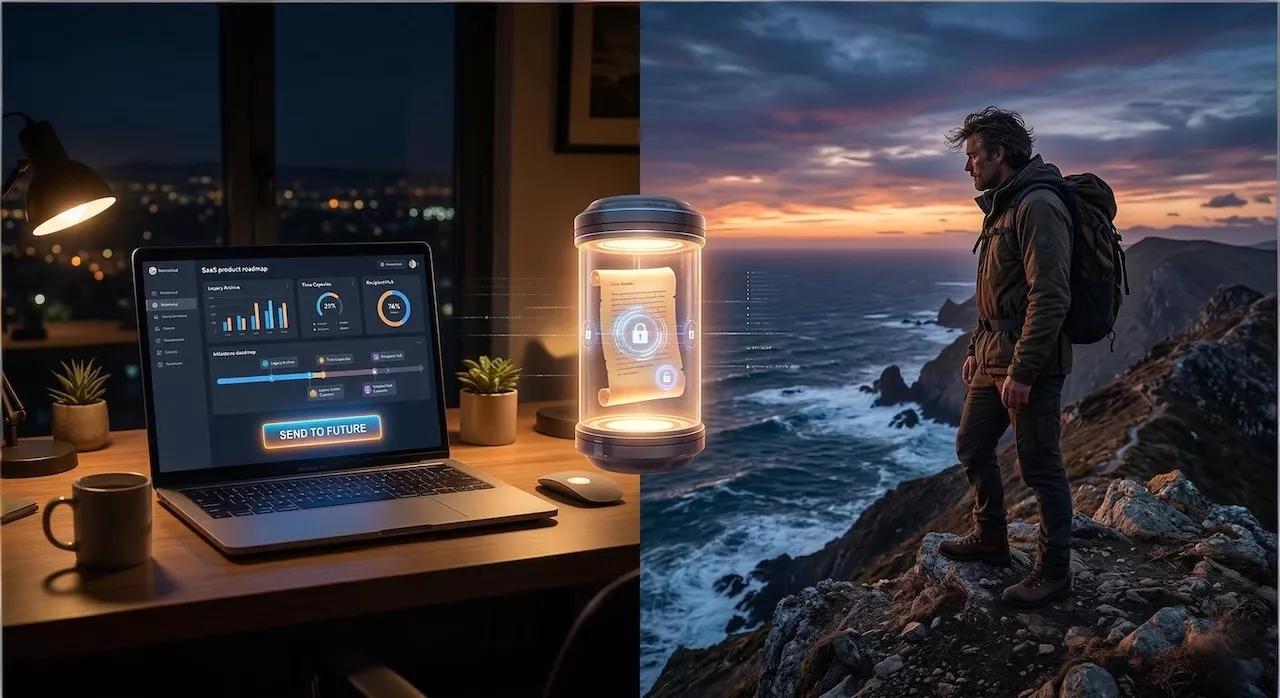
Why I Built EterMail: A Time Capsule for the People I Love Most
I’m a Product Manager who spends all week optimizing for the "immediate now." But getting lost off the grid on a mountain ridge made me realize I had zero infrastructure for the "forever." Here’s why I stopped worrying about conversion rates for a moment and built EterMail—a secure, tamper-proof digital time capsule for the people I love most.

The Most Radical Letter to Your Future Self Is a Promise to Stay Unfinished
The best letter to your future self isn't a memory—it's a mandate. Learn how writing to the version of you still working with love changes everything.

The Ice Tray at Midnight: On Grief, Domestic Minutiae, and the Quiet Work of Becoming Yourself Again
Why do the smallest habits hurt most after someone leaves? A reflection on grief, domestic minutiae, and the quiet moment healing finally begins.