There is a peculiar loneliness in watching your own thoughts autocomplete. You begin typing "I worry that—" and the machine suggests "the future will forget us," and for a moment, you pause. Did you mean that? Or have you been trained, gently, to mean what is easiest to say? The cursor blinks. You accept the suggestion. The sentence completes itself, and somewhere in that small surrender, a piece of your authorship quietly exits the room.
This is the crisis of agency they warned about—not robots marching, but something more insidious: the gradual outsourcing of our interior lives to systems that predict us too well. And if this is happening while we are alive, still breathing, still supposedly in control, then what becomes of us when we are gone? What remains of a person who never fully wrote their own sentences, who never left behind the strikethroughs and false starts and 3 a.m. revisions that prove a mind was actually working?
Your digital legacy, that accumulated cloud of posts and photos and messages, may soon be the only evidence that you ever struggled to understand yourself. The question is whether it will contain any evidence of that struggle at all.
The Vanishing Evidence of Thought
We have confused preservation with presence. The internet remembers everything, we are told—every embarrassing photo, every ill-advised post, every digital footprint we left without looking back. But memory without texture is not legacy. It is mere storage. A hard drive does not constitute a self.
Consider what future archaeologists—digital or human—might actually find. They will uncover billions of perfectly coherent sentences, algorithmically smoothed. They will see posts that hit exactly the right emotional register, images filtered to optimal engagement, responses generated faster than genuine reflection allows. They will find, in other words, a world of outputs without the friction of process. And they will have to ask: Did anyone here actually think, or did the thinking happen elsewhere?
The rough drafts matter. The crossed-out lines matter. The paragraph you wrote at 2 a.m. and deleted by dawn matters more than you know, because it contains the tempo of your uncertainty—the particular rhythm of a consciousness moving through confusion toward something like clarity. When we surrender these to automated polish, we are not improving our expression. We are erasing the evidence that we were ever expressers at all.
The Algorithmic Afterlife
Here is a discomforting thought experiment. Imagine your grandchildren, or their grandchildren, searching for you in whatever digital archives remain. They find your social media, preserved in some corporate server farm or decentralized storage network. They find your emails, your messages, your public declarations. And they find something else: a seamless consistency that no human actually possesses. Your voice, smoothed across decades, never aging, never contradicting itself, never growing.
Real humans change their minds. Real humans write angry letters they regret, then write again to apologize. Real humans believe passionately at thirty what they will find embarrassing at fifty, and that arc of transformation is the very shape of a life. An algorithm trained to optimize your "personal brand" will flatten this arc into a single, marketable note. Your digital legacy becomes not a record of becoming, but a performance of having already arrived.
This is not hypothetical. We are already living inside the early version of this future. The same predictive systems that finish your texts are being trained on larger and larger swaths of human expression, learning to generate not just sentences but entire personas. The boundary between "I wrote this" and "this was written for me" has already blurred for many. After death, when there is no "I" left to claim or deny authorship, that boundary may disappear entirely.
Why Unfinished Drafts Are Sacred
There is a reason we value the painter's preliminary sketches, the writer's notebooks, the composer's scratched-out measures. These artifacts of process do something that finished works cannot: they prove effort, they prove doubt, they prove the lived experience of making. They prove that the final piece was not inevitable, that other possibilities existed, that a human mind moved through uncertainty and chose.
Your digital legacy deserves the same testimony. The email you drafted three times before sending. The journal entry that wanders, contradicts itself, ends without resolution. The letter to a friend that admits what you cannot admit anywhere else. These are not failures of communication. They are the fingerprints of consciousness.
In an age of artificial fluency, the deliberately human voice becomes radical. The sentence that does not flow. The thought that requires three attempts. The message that chooses vulnerability over polish. These are not inefficiencies to be optimized away. They are the last, stubborn proof that someone was here, thinking slowly, feeling complicatedly, refusing to be predicted.
The Act of Intentional Preservation
Preserving your digital legacy, then, cannot mean simply accumulating more data. It must mean curating evidence of your authorship—protecting the spaces where your unassisted voice still exists, and deliberately creating new ones.
This requires a kind of quiet resistance. Writing longhand before typing, sometimes, to preserve the physical trace of thought. Saving drafts explicitly, marking them as process, not error. Choosing platforms and tools that do not rewrite you in real time. And perhaps most importantly, creating documents that you do not intend to share immediately—messages to future selves, letters to people not yet born, reflections meant for a reader you will never meet.
I know this particular loneliness firsthand. There are nights I sit with a glowing screen until two or three in the morning, "pair programming" with some LLM, mapping architectures, chasing the edge of what these systems can do. That extreme digital solitude—just me and the machine, no audience, no deadline—has taught me something about dialogue across time. When I finally step away, I need the opposite: steep mountain trails, ocean waves, the kind of raw reality that strips away every illusion. The wind doesn't autocomplete. The mountain doesn't optimize for engagement. It simply is, unrepeatable, present. That contrast—between the synthetic and the real—drives everything I build.
These documents serve a double function. They preserve your voice in its most unguarded form, and they practice a relationship with time that algorithms do not understand. The predictive systems that increasingly shape our expression are optimized for immediate engagement, for the next click, the next scroll. A letter scheduled to arrive in ten years, in twenty, in fifty, operates on an entirely different temporal logic. It assumes a future worth waiting for. It treats the recipient—your future self, your grown child, your long-gone friend imagined still reading—as worthy of effort that cannot be immediately measured.

The Radicalism of Being Unfinished
If an algorithm can finish your sentence today, your unfinished drafts may be the only inheritance that proves you were ever truly here. This is not a call to reject all assistance, all tools, all the genuine benefits that technology offers. It is a call to be deliberate about what you preserve, and to recognize that preservation is increasingly an active choice, not a passive default.
The best way to fight forgetting isn't taking another screenshot; it's setting an alarm for the future. By using EterMail to set a delivery date 5 years from now, you completely free yourself from the anxiety of the present. You write the messy draft, the honest letter, the thought you haven't finished thinking—and you trust it to wait, untouched by algorithms that would smooth it into something else, until the moment it was meant for.
Your digital legacy is being written now, sentence by sentence, choice by choice. The question is whether you are the one making the hard choices—the ones that do not autocomplete, that do not optimize, that do not perform. The ones that sound, when read aloud, unmistakably like you at your most uncertain, your most honest, your most alive.
The machines will keep getting better at sounding human. They will not get better at being this human, with your specific history of loss and wonder, your particular collection of fears you are slowly outgrowing, your unique and evolving relationship with the people you love. That specificity is your inheritance to the future. Protect it. Write it badly if you must, but write it yourself. Leave the cursor blinking at the end of thoughts you have not yet finished. Let someone, someday, discover that you were still becoming.
The most radical act of preservation is not saving your data. It is leaving evidence of a mind that once struggled, doubted, and chose its own words.
What is EterMail?
EterMail is a revolutionary time capsule service that allows you to send messages, photos, and videos to the future (up to 30 years). Seal your memories and thoughts today, and they'll be delivered when the time is right.
Time Capsule
Send messages up to 30 years in the future
Rich Media
Text, photos, and videos supported
Secure & Private
Your memories are safely encrypted
EterMail Team
We're the team behind EterMail, dedicated to helping you preserve and share timeless messages with your loved ones. Our mission is to make it easy to express your love, share your wisdom, and create lasting connections that transcend time.
Frequently Asked Questions about Digital Legacy
What should I include in a digital legacy to preserve my authentic self?
How can I protect my digital memories from being altered by AI after I'm gone?
Why do my rough drafts and deleted messages matter for future generations?
Related Articles
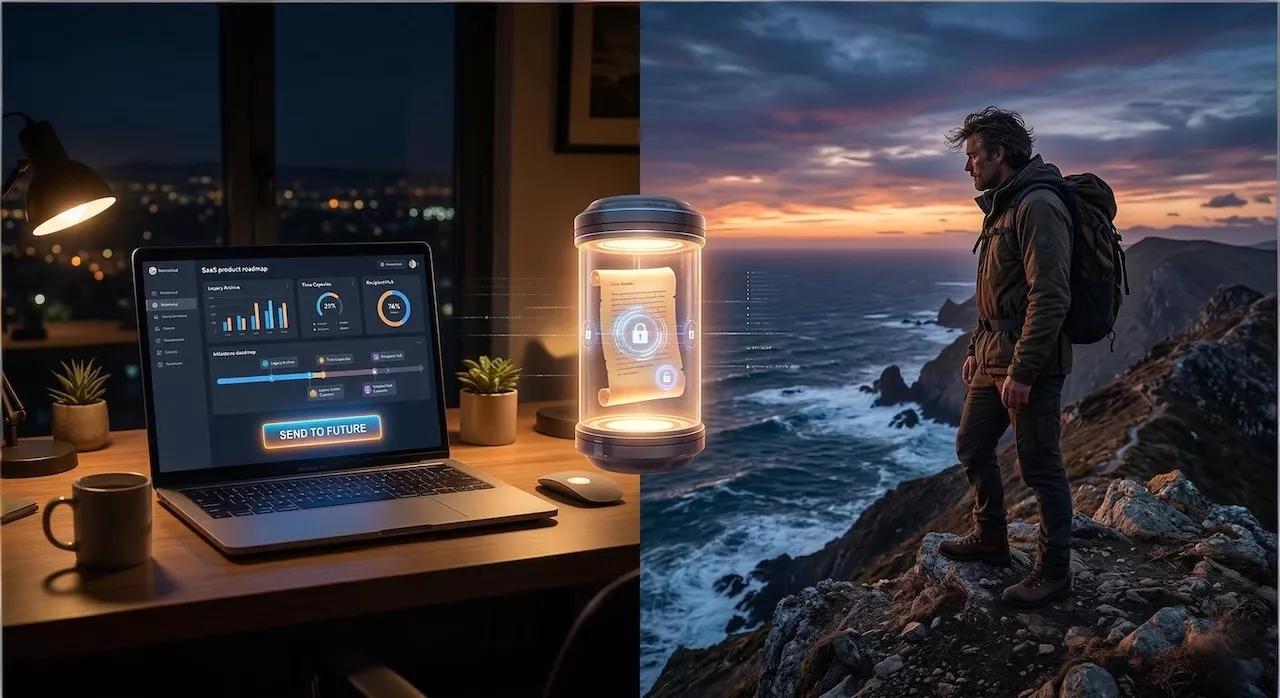
Why I Built EterMail: A Time Capsule for the People I Love Most
I’m a Product Manager who spends all week optimizing for the "immediate now." But getting lost off the grid on a mountain ridge made me realize I had zero infrastructure for the "forever." Here’s why I stopped worrying about conversion rates for a moment and built EterMail—a secure, tamper-proof digital time capsule for the people I love most.
The Most Radical Letter to Your Future Self Is a Promise to Stay Unfinished
The best letter to your future self isn't a memory—it's a mandate. Learn how writing to the version of you still working with love changes everything.
The Ice Tray at Midnight: On Grief, Domestic Minutiae, and the Quiet Work of Becoming Yourself Again
Why do the smallest habits hurt most after someone leaves? A reflection on grief, domestic minutiae, and the quiet moment healing finally begins.