The Moment I Forgot to Remember
I was thirty-four, standing in my mother's kitchen after her funeral, holding a thumb drive that contained everything she had deemed worth saving. Twenty-three years of careful curation: her published research, award citations, the professional headshots where she looked competent and composed. I scrolled for an hour, searching for the woman who burned pancakes on Sunday mornings, who hummed off-key to Joni Mitchell while folding laundry, who cried at every commercial featuring a dog.
She had preserved her resume with forensic precision. She had forgotten to preserve herself.
This is the quiet crisis of our digital age—not that we will be forgotten, but that we will be remembered incompletely. The polished avatar survives while the breathing, stumbling, ordinary human evaporates like morning fog. And somewhere in that gap between curation and existence lies the true meaning of digital legacy.
The Performance of Permanence
We have inherited strange instincts about what deserves to survive us. Perhaps it began with grave goods and epic poems, this human impulse to bury our best versions alongside our bones. The pharaohs packed gold; we pack LinkedIn endorsements. The mechanism changes. The anxiety remains identical.
Our cloud storage becomes a mausoleum of achievement. We save the promotion announcement, the finished marathon, the carefully composed family portrait where everyone is looking at the camera. We rarely save the text sent from a hospital waiting room at 2 AM, the photo blurry with motion, the voice memo recorded while walking home through rain—words half-formed, breath audible, city sounds intruding.
Why do we trust our curated peaks more than our messy plateaus?
The answer sits uncomfortably close to shame. We have confused legacy with judgment. We imagine some future tribunal—our older selves, our children, some stranger scrolling through dead files—and we want to appear before them accomplished, coherent, worthy of the server space. We edit for an audience we cannot name, in a theater that may never fill.
But here is what I have come to believe, sitting with that thumb drive and its hollow competence: the people who will love us in the future do not need us to have been impressive. They need us to have been present.
The Tuesday That Saved Me
Three months after my mother's death, I found a video buried in her phone. Not in the album labeled "Important." In the chaos of recently deleted, auto-saved, algorithmically ignored fragments. She had been filming her garden, apparently aiming for something picturesque, when she tripped over the hose. The camera kept recording as it fell into tomato vines. For forty-seven seconds, there was only her laughter—surprised, unguarded, slightly wheezy—and the green blur of leaves, and her voice saying, "Oh for God's sake, Margaret, you're sixty-two."
I have watched those forty-seven seconds perhaps a hundred times. They contain more of my mother than every certificate she archived. The competence was what she performed. The stumble was what she inhabited.
This is the paradox at the heart of meaningful digital legacy planning: the moments we least think to preserve are often the ones that most preserve us.
The Radical Act of Unfiltered Preservation
I began to wonder what it would mean to approach our digital traces differently. Not as curation, but as witness. Not as argument, but as testimony.
Consider what your future self—or your future bereaved—will actually hunger for. Not the announcement that you succeeded. The record of how success felt hollow, or terrifying, or briefly sweet before the next wanting began. Not the relationship milestone captured in coordinated outfits. The ordinary Tuesday when you noticed your partner's particular way of buttering toast, and felt something move in your chest that you did not name.
The texture of being alive is almost always found in texture itself: the uncomposed, the unremarkable, the slightly embarrassing. The song playing in the background. The quality of light you would never call beautiful but would recognize instantly. The person you were becoming without knowing it, visible only in retrospect's rearview mirror.
This is not sentimentality. It is structural. Memory does not attach to narrative climax. It attaches to sensory specificity, to emotional context, to the unexpected detail that unlocks an entire era of being. Your future self will not need to know that you got the job. Your future self will need to remember how possibility felt in your body before the result arrived.
The Courage of Present Imperfection
There is something quietly brave about preserving your present without knowing how the story ends. We are so accustomed to retrospective coherence—the memoir's shaped narrative, the eulogy's through-line—that we forget most of life is lived without such luxury. We do not know which moments matter. We cannot predict what will become poignant, what will become painful, what will simply become unrecognizable.
To document your ordinary Tuesdays is to resist the tyranny of outcome. It is to say: this moment matters not because it led somewhere, but because it was. It is to trust that whoever opens your files decades from now—including, possibly, yourself—will have the imagination and the generosity to meet you where you were, not where you were headed.
This requires a different kind of digital literacy than we typically cultivate. Not the literacy of optimization and personal branding, but the literacy of digital mindfulness: noticing what you are actually experiencing, capturing it without immediate editorial intervention, trusting the medium to hold what you cannot yet understand.
What Survives the Filter
I have started keeping what I call an emotional time capsule—not the significant events, but the ambient conditions. The playlist I cannot stop playing. The text exchange that made me laugh in a grocery store line. The photograph of my kitchen table at 6:47 AM, coffee cooling, notebook open to a page where I wrote something I no longer understand but recognize as urgent.
These fragments will not impress anyone. They may not even interest my future self. But they are the closest I can come to preserving the experience of consciousness in this particular body, at this particular hinge in history, before I become someone else.
And that, ultimately, is what protecting online memories truly means. Not building a monument to who you were, but leaving a map for who you are still becoming. Not ensuring you will be remembered well, but ensuring you will be remembered at all—in your full, unfinished, contradictory, ordinary aliveness.
The Builder's Midnight Confession
I need to tell you something about the person writing this.
I am the kind of person who builds things until 2 or 3 AM, face lit by a screen, arguing with an LLM about architecture decisions while the rest of the world sleeps. That extreme solitude—just me and the glow and the quiet hum of possibility—has taught me something I couldn't learn any other way. When you spend that many nights alone with code, you start to understand that the digital world isn't cold. It's just waiting for someone stubborn enough to make it breathe.
But here's the contradiction: the moment I step away from that keyboard, I run straight into the harshest physical reality I can find. Steep mountain trails. Ocean waves that could break me. Ski slopes where control is a fiction. That feeling of being small against something massive and unscripted—it strips away every illusion the digital world sells you. It reminds me that the present moment is unrepeatable, uncurated, and completely irreplaceable.
I have built e-commerce platforms and game engines and now this. I have wrestled with APIs and server deployments and codebases that threatened to swallow me whole. And through all of it, I have carried this wild, slightly embarrassing fantasy: that I could build a bridge between the physical and the digital, something that lets consciousness travel where the body cannot. Not to escape being human, but to preserve what being human actually feels like.
That is what brought me to build EterMail.
I obsessed over end-to-end encryption and extreme server redundancy because I know something most people haven't faced yet. A letter written to the future needs to be guarded more fiercely than a bank password. The ordinary Tuesday you capture today—the blurry photo, the half-formed thought, the voice memo with rain in the background—deserves to survive not just technological decay, but the slow erosion of your own memory. The best way to fight forgetting isn't taking another screenshot; it's setting an alarm for the future. By using EterMail to set a delivery date 5 years from now, you completely free yourself from the anxiety of the present. You write the truth of right now, exactly as messy as it is, and trust the system to carry it forward.
The Gift of Being Unfinished
My mother did not know she was dying when she tripped over that hose. She was simply living, poorly filmed, unimportant, alive. The video survived through accident, through technological indifference, through my stubborn refusal to empty her deleted folder. It survived because it was not precious enough to curate and not worthless enough to destroy.
Most of our lives occupy this exact middle space.
The radical act is to recognize that middle space as sacred. To stop waiting for worthiness before you press record, before you save the draft, before you send the message that says this is where I am right now and I do not know what it means yet.
Your digital legacy does not need your greatest hits. It needs your B-sides, your outtakes, your accidental recordings, your unfiltered Tuesdays. It needs the courage of your present imperfection, offered as gift to whoever opens your files decades from now—including, with strange luck, yourself.
The sunlight on your kitchen table. The song playing. The person you were becoming without knowing it.
These are the things that outlast us. Not because we made them important, but because we let them be real.
What is EterMail?
EterMail is a revolutionary time capsule service that allows you to send messages, photos, and videos to the future (up to 30 years). Seal your memories and thoughts today, and they'll be delivered when the time is right.
Time Capsule
Send messages up to 30 years in the future
Rich Media
Text, photos, and videos supported
Secure & Private
Your memories are safely encrypted
EterMail Team
We're the team behind EterMail, dedicated to helping you preserve and share timeless messages with your loved ones. Our mission is to make it easy to express your love, share your wisdom, and create lasting connections that transcend time.
Frequently Asked Questions about Digital Legacy
What should I include in a digital legacy to make it feel authentic?
How do I overcome the urge to only save my best digital memories?
What happens to my digital memories if I don't plan for them?
Related Articles
When the Swipe Dies, What Survives? Reclaiming Intimacy From the Architecture of Abandonment
Bumble killed the swipe. But the real question is who controls the vulnerable messages, desires, and selves we reveal on platforms we don't own.
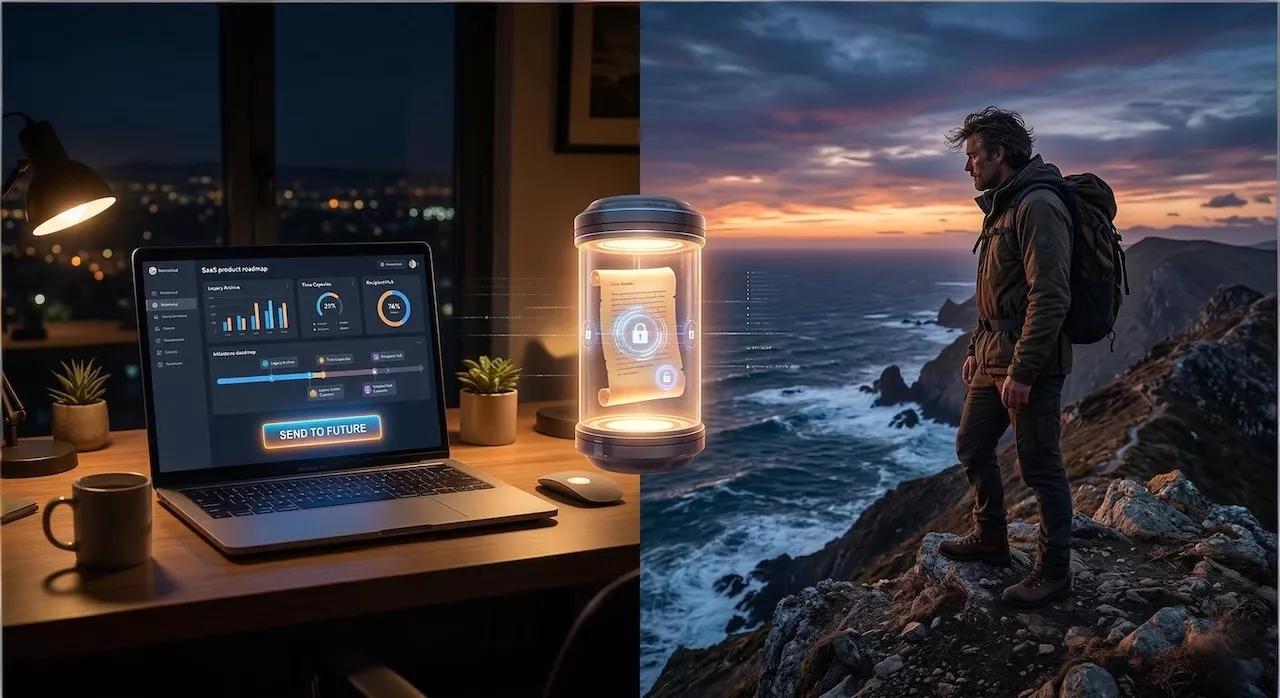
Why I Built EterMail: A Time Capsule for the People I Love Most
I’m a Product Manager who spends all week optimizing for the "immediate now." But getting lost off the grid on a mountain ridge made me realize I had zero infrastructure for the "forever." Here’s why I stopped worrying about conversion rates for a moment and built EterMail—a secure, tamper-proof digital time capsule for the people I love most.
The Most Radical Letter to Your Future Self Is a Promise to Stay Unfinished
The best letter to your future self isn't a memory—it's a mandate. Learn how writing to the version of you still working with love changes everything.