The Night I Cracked My Father's Digital Vault
The password manager sat encrypted for eleven months after the funeral. I told myself I'd get to it eventually—cancel the subscriptions, close the accounts, perform the administrative death that follows the physical one. What I didn't expect was to find my father waiting inside, not in spreadsheets or bank statements, but in the spaces designed to be forgettable.
Security questions. Those friction points we all resent, the bureaucratic speed bumps of digital life. His answers were wrong, every single one. Deliberately, beautifully, systematically wrong. And in that wrongness, he had constructed something I never possessed while he lived: an unguarded autobiography.
When Lies Become More Honest Than Truth
His first pet? Not the terrier from his childhood photographs, the one whose name appeared in every family story. Instead: "Maple"—the street where he met my mother in 1978, the corner where he practiced what he'd say for three weeks before finally asking her to coffee.
His favorite teacher? Not the calculus instructor who wrote his college recommendation. "Coach Brennan"—the man who, according to this secret record, taught him to shave without bleeding, who let him sleep in the equipment room the night his own father disappeared.
The city where he was born? Not the Midwestern town on his birth certificate. "Room 417"—the hospital room where I was delivered, where he wept without understanding why, where he first held something he knew he could not keep safe forever.
These were not the stories he told at Thanksgiving, not the polished anecdotes he recycled for colleagues and neighbors. At dinner, he was a man of linear progress: the scholarship, the promotion, the mortgage paid early. His security questions revealed a different shape entirely—a landscape of tender landmarks, of meaning accumulated in moments he never narrated aloud.
The Architecture of Digital Armor
We construct our online defenses to be uncrackable, yet we fill them with the most crackable material imaginable: the truth of what actually matters to us. The maiden names and first concerts, the streets and teachers and pets. We believe we're outsmarting hackers with misdirection, but we're also, unconsciously, building time capsules of emotional geography.
The irony is architectural. These questions exist because institutions assume we'll forget our passwords but remember our biographies. What they don't anticipate is that we'll edit our biographies to be memorable only to ourselves—that the "lie" we tell Capital One becomes the most accurate coordinate of our inner life.
My father's digital armor was thick. Two-factor authentication on everything. Unique twenty-character passwords generated randomly. He was, by every standard, paranoid and prepared. Yet this paranoia created the conditions for an accidental intimacy. In protecting himself from strangers, he exposed himself to whoever would eventually inherit his digital estate.
The Vertigo of Posthumous Recognition
Reading his security answers, I experienced something I can only describe as temporal vertigo—the disorientation of recognizing someone across a distance you didn't know existed. Here was the man who taught me to ride a bicycle by running behind me without holding on, who never admitted he was running, who let me believe in my own balance. That same man had secretly encoded his marriage into a pet's name, his fragility into a teacher's identity, his fatherhood into a hospital room number.
The vertigo deepened when I considered the asymmetry. He knew these things about himself. He chose them, remembered them, returned to them each time he logged into his brokerage account or his email. I had lived thirty-four years without knowing that my birth room was, to him, the origin point of his own existence.
This is the particular cruelty and gift of digital legacy: it arrives without the possibility of conversation. I cannot ask him why Coach Brennan, why Room 417, why these particular truths required the protection of apparent falsehood. The questions I would have asked at sixteen, at twenty-five, at thirty—questions I didn't know to formulate—now hang in the air between his encryption and my decryption.
What We Leave Unintentionally
We speak of digital legacy in terms of the deliberate: the blogs we maintain, the social media profiles we curate, the cloud storage we organize for eventual handover. But my father's security questions suggest a different category entirely—the unintentional legacy, the metadata of personhood that accumulates without our narrative supervision.
Consider what else hides in our digital residue. The search history that maps our fears at 3 AM. The location data that traces our pilgrimages to places we never mentioned. The playlist algorithms that know our grief better than our friends. These are not the stories we choose to tell about ourselves. They are the stories that emerge from behavior, from pattern, from the accumulated weight of digital existence.
The platforms that harvest this data rarely intend to preserve our humanity. They intend to predict our purchases, our attention, our vulnerabilities. Yet the byproduct is a strange kind of immortality—a portrait constructed from clicks and keystrokes, from the questions we answer to prove we are who we claim to be.
The Ethics of Inherited Intimacy
I have told no one in my family about the security questions. They belong to a privacy my father maintained even in his deceptions, especially in his deceptions. To share them would be to violate the very intimacy I treasure—to convert his secret autobiography into common property, to make his hidden truths as accessible as his public ones.
This raises questions I cannot fully answer. What do we owe the dead's digital selves? My father encrypted his passwords to protect his assets, his identity, his practical life. He did not encrypt to protect his emotional geography. Yet that geography was, clearly, private to him—private enough to hide in plain sight, to encode in systems designed for verification rather than revelation.
Perhaps the ethics are simpler than I make them. Perhaps inheritance is always a form of exposure, and we accept what we receive with the gravity it deserves, holding it without broadcasting it, letting it change us without demanding that it change everyone.
Writing the Memoir We Intend to Leave
My father's accidental legacy has reshaped how I think about intentional ones. I spend enough late nights alone with glowing screens—debugging, architecting, "pair programming" with LLMs until 2 or 3 AM—that I've developed a particular hunger for communication that doesn't evaporate when the session ends. That digital solitude teaches you something about loneliness, about how much we leave unsaid because we assume there will always be another chance to say it.
I built EterMail because I kept watching that chance disappear. Not dramatically, but quietly—the unread message, the draft never sent, the assumption that tomorrow would be ordinary. The best way to fight forgetting isn't taking another screenshot; it's setting an alarm for the future. By using EterMail to schedule a letter five years from now, you completely free yourself from the anxiety of the present. You write to your future self, to your children at ages you may not witness, to your partner on anniversaries you may not share. These are deliberate autobiographies, composed with awareness that someone will read them, that the temporal vertigo I experienced might be softened by context, by voice, by the explicit invitation to understand.
There is a difference, I now believe, between the truths we hide in security questions and the truths we choose to speak. Both are real. Both matter. But only one carries the intention of connection—the willingness to be known rather than merely discovered.
The Slow Communication of Mortality
We live in an era of instant transmission, of messages sent and read and forgotten in the span of hours. The security questions my father answered decades ago, updated periodically, maintained across platform migrations and password resets—these represent a different rhythm entirely. Slow communication. Accrued meaning. The patience of institutions that outlast our attention spans.
Digital legacy, properly considered, requires this slowness. Not the viral post or the trending thread, but the document that waits, the message that arrives when context has shifted, the letter that finds its reader changed by time in ways neither sender nor receiver could anticipate.
My father's answers to algorithms were never meant for me. Yet they have become, irreducibly, part of what I carry forward—part of how I understand the gap between the man who raised me and the man who wept in Room 417, who learned to shave from a coach, who remembered his marriage as a street name and a first pet.
What Remains When the Accounts Close
I will eventually close his password manager. The subscriptions will cancel. The accounts will go dormant and be deleted by terms of service I won't read. But I have copied his security questions by hand into the same leather notebook where I now write letters through EterMail—his accidental legacy beside my intentional ones, his hidden truths prompting my own questions about what I choose to reveal and conceal.
The digital afterlife is not, I've learned, about preserving everything. It is about recognizing that everything is already preserved, accidentally and algorithmically, and that our work is to curate the meaning that might emerge from it—to write, alongside our hidden answers, some questions that invite the responses we actually want to receive.
My father told algorithms the truest stories he never told me. I am trying, now, to tell my children stories true enough that no algorithm need intervene.
What accidental legacies exist in your digital life? What intentional ones are you waiting to create? The gap between them may be smaller than you imagine—and wider than you can know.
What is EterMail?
EterMail is a revolutionary time capsule service that allows you to send messages, photos, and videos to the future (up to 30 years). Seal your memories and thoughts today, and they'll be delivered when the time is right.
Time Capsule
Send messages up to 30 years in the future
Rich Media
Text, photos, and videos supported
Secure & Private
Your memories are safely encrypted
EterMail Team
We're the team behind EterMail, dedicated to helping you preserve and share timeless messages with your loved ones. Our mission is to make it easy to express your love, share your wisdom, and create lasting connections that transcend time.
Frequently Asked Questions about Digital Legacy
What should I include in a digital legacy for my family?
How do I preserve memories that feel too private for social media?
Why do people reveal more truth to algorithms than to loved ones?
Related Articles
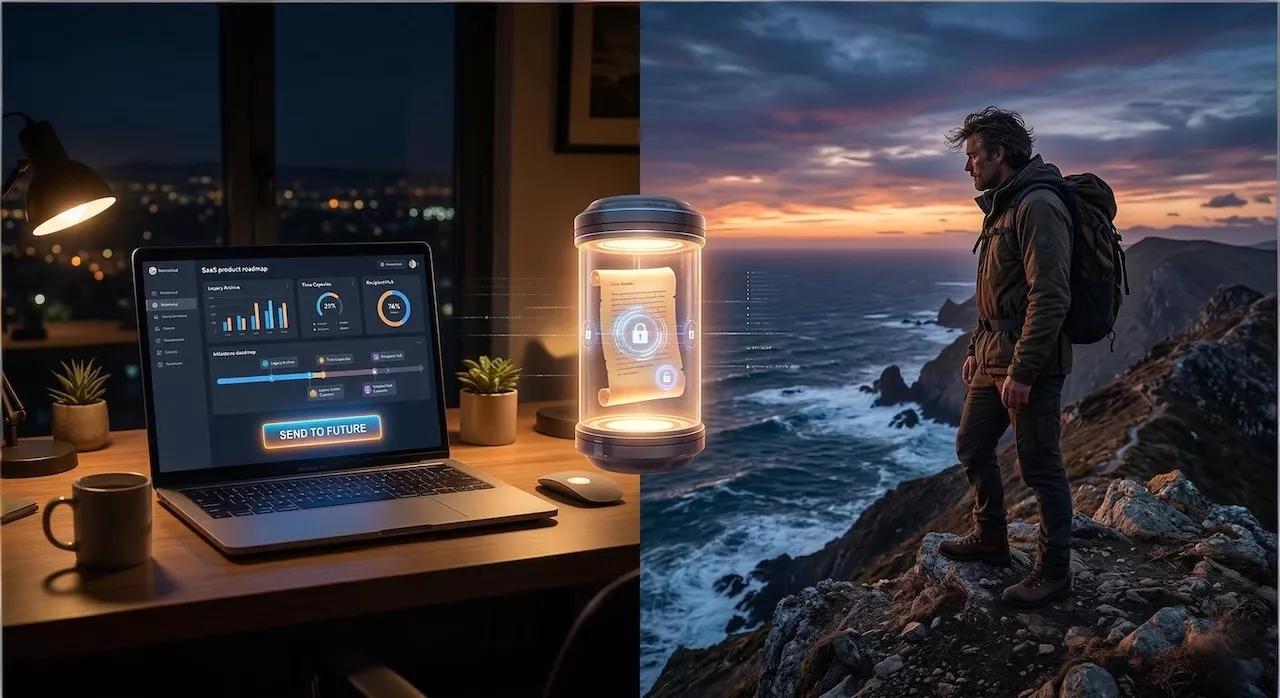
Why I Built EterMail: A Time Capsule for the People I Love Most
I’m a Product Manager who spends all week optimizing for the "immediate now." But getting lost off the grid on a mountain ridge made me realize I had zero infrastructure for the "forever." Here’s why I stopped worrying about conversion rates for a moment and built EterMail—a secure, tamper-proof digital time capsule for the people I love most.
The Most Radical Letter to Your Future Self Is a Promise to Stay Unfinished
The best letter to your future self isn't a memory—it's a mandate. Learn how writing to the version of you still working with love changes everything.
The Ice Tray at Midnight: On Grief, Domestic Minutiae, and the Quiet Work of Becoming Yourself Again
Why do the smallest habits hurt most after someone leaves? A reflection on grief, domestic minutiae, and the quiet moment healing finally begins.