
The Question That Waits in Every Inbox
There is a folder in your cloud storage that you never open. Drafts of emails never sent. Photos you meant to organize. Voice notes recorded at 2 AM, full of something you couldn't name then and still can't. We are all collectors of our own almosts.
I found one such folder after my mother died. Not her will, not her passwords, but a note titled simply "Tuesday." It read: "The lilacs are early this year. I keep thinking I should tell someone, but who wants to hear about flowers?" She died in March. The lilacs came in April. She never saw them, and she never sent the note. But someone—me, her future—found it. And in that failure to communicate, I found her more completely than in any finished letter she ever wrote.
This is the paradox of our digital legacy. We have built systems to preserve everything, yet what survives is rarely what we intended. The cloud holds not our wisdom but our wandering. And perhaps that is exactly what we should be leaving behind.
The Myth of the Complete Self
We imagine legacy as curation. The polished memoir. The organized photo album. The farewell video with proper lighting and a script. But our digital traces tell a different story—one of interruption, revision, and perpetual becoming.
Consider the evidence. The average person has 240 unread emails at death, 34,000 unorganized photos, and dozens of half-written messages in various apps. These are not failures of housekeeping. They are archaeological records of a consciousness in motion, a creature perpetually reaching toward understanding and perpetually falling short.
The Stoics taught that we should live each day as if it were our last. They did not anticipate that our last day might include a browser history of 47 tabs: a recipe, a medical symptom, a news article we barely read, a message we started twelve times. This is not the clutter of a wasted life. It is the texture of an engaged one.
We die mid-sentence. We always have. The difference now is that the sentence remains, suspended in digital amber, waiting for a future that may never come—or may come in a form we cannot imagine.
The Honesty of Unfinished Business
There is a particular intimacy to the unfinished. A completed letter performs a self. It knows its audience, its purpose, its ending. But the draft? The draft is where we actually live.
I have a friend who, after her father's death, discovered a file of unsent messages to his estranged brother. Thirty years of grievance and longing, never transmitted. "At first I thought he was a coward," she told me. "Now I think he was brave enough to feel something he couldn't resolve."
This is what our digital legacy increasingly contains: not resolutions but resonances. The questions we never answered. The apologies we couldn't complete. The love we typed but deleted because it felt too large for the medium, too small for the moment, too risky for the relationship as it existed.
I know this terrain intimately. I've spent years building products in Silicon Valley—e-commerce platforms, game engines, now SaaS—and the irony isn't lost on me. I can architect complex systems, negotiate brutal API documentation, deploy code at 2 AM while pair-programming with an LLM in the darkened silence of my apartment. But the messages that matter? The ones to my mother, to old friends, to versions of myself I haven't met yet? Those stay in draft. The screen glows, the cursor blinks, and I sit there, suspended between what I feel and what I can make real.
The Inheritance of Wondering
What do we actually want to leave behind? The philosopher Derek Parfit argued that personal identity is not a binary—alive or dead, present or absent—but a matter of degrees. We survive in others' memories, in our effects, in the traces we leave on the world. Our digital legacy extends this survival into spaces we never fully inhabited.
But here is the harder question: Is it better to leave wisdom or wondering? A set of instructions for living, or a record of the struggle to understand? My mother's lilac note contained no advice. It asked nothing. It simply registered presence, attention, a consciousness moving through time and noticing. That is what I inherited: not her conclusions but her attention.
The most valuable digital legacy may be precisely what we did not mean to create. The search history that reveals our fears. The abandoned drafts that map our growth. The photos we took but never posted, which show not our performed selves but our actual ones: uncomposed, unfiltered, uncertain.
This is the gift of the unfinished: it invites continuation. A completed legacy says, "Here is what I knew." An unfinished one says, "Here is where I was. Where are you?"
The Moral Weight of Digital Persistence
There is a cruelty to digital memory. Paper fades. Physical objects decay. But the cloud, we are told, is forever. This creates a new kind of responsibility: not to preserve, but to consider what our preservation costs.
Every unsent message we leave is a potential inheritance, but also a potential burden. The drafts of grievance. The photos of pain. The evidence of our worst moments, preserved with the same fidelity as our best. We are the first generation to leave behind not selective memory but comprehensive data, and we do not yet know what this means for those who survive us.
Some choose to curate aggressively. Delete the messy. Organize the rest. Leave behind a coherent narrative. Others—myself among them—are coming to believe that coherence is itself a kind of lie, and that our survivors deserve the complexity we actually lived.
When I step away from the keyboard, I head for mountains and ocean. Skiing steep lines, surfing heavy swell—moments where control dissolves and you're left with raw, unfiltered reality. That stripping away teaches me something I try to carry back to the screen: the present moment is unrepeatable, and our digital traces should honor that messiness, not sanitize it.
The Eternal in the Ephemeral
We began with an ancient question: What happens when we die? The digital age has not answered it. It has, perhaps, made the question more urgent by making our traces more persistent. We cannot escape the record of our reaching, and we cannot complete the reach itself.
But there is something in this failure that approaches the eternal. Not the cloud's promise of infinite storage, but the human act of continuing to wonder, to type, to delete, to begin again. My mother's lilac note was not meant for me. It was not meant for anyone. Yet it reached me across death and time, and in its very aimlessness, it aimed true.
I built EterMail because I kept asking myself: what if the draft didn't have to stay a draft? What if we could send our wondering across time, not as random data but as intentional reach? I obsessed over end-to-end encryption and extreme server redundancy because I know this: a letter written to the future needs to be guarded even more fiercely than a bank password. The unfinished deserves a destination. The wondering deserves to arrive.
The most eternal thing you might leave behind is not wisdom but the honest record of your wondering. The draft that admits confusion. The message that arrives years later, when the recipient is finally ready to hear it. The time capsule that says, "I was here, I noticed, I cared enough to try and fail at saying so."
Your cloud holds questions you never answered. Have you failed? Or have you finally given your future someone—your future self, your future child, your future stranger—something true to inherit? The answer is not in the archive. It is in the act of reaching, again and again, toward a connection that outlives our understanding of it.
And perhaps that is enough. Perhaps that is the only eternity we get, and the only one we need.
What is EterMail?
EterMail is a revolutionary time capsule service that allows you to send messages, photos, and videos to the future (up to 30 years). Seal your memories and thoughts today, and they'll be delivered when the time is right.
Time Capsule
Send messages up to 30 years in the future
Rich Media
Text, photos, and videos supported
Secure & Private
Your memories are safely encrypted
EterMail Team
We're the team behind EterMail, dedicated to helping you preserve and share timeless messages with your loved ones. Our mission is to make it easy to express your love, share your wisdom, and create lasting connections that transcend time.
Frequently Asked Questions about Digital Legacy
What should I include in a digital legacy for my family?
How do I organize my digital assets before I die?
Is it better to leave a completed memoir or scattered digital fragments?
Related Articles
Why I Built EterMail: A Time Capsule for the People I Love Most
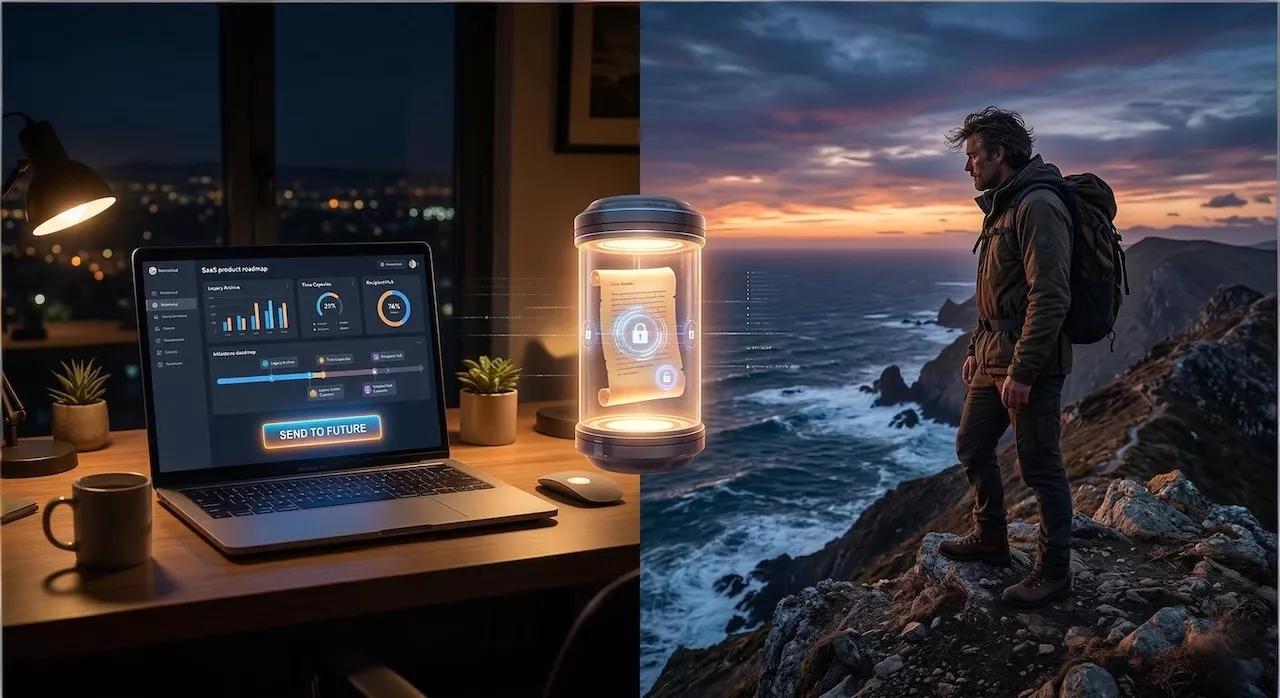
I’m a Product Manager who spends all week optimizing for the "immediate now." But getting lost off the grid on a mountain ridge made me realize I had zero infrastructure for the "forever." Here’s why I stopped worrying about conversion rates for a moment and built EterMail—a secure, tamper-proof digital time capsule for the people I love most.

The Most Radical Letter to Your Future Self Is a Promise to Stay Unfinished
The best letter to your future self isn't a memory—it's a mandate. Learn how writing to the version of you still working with love changes everything.

The Ice Tray at Midnight: On Grief, Domestic Minutiae, and the Quiet Work of Becoming Yourself Again
Why do the smallest habits hurt most after someone leaves? A reflection on grief, domestic minutiae, and the quiet moment healing finally begins.