Louise Glück wrote: "Whatever returns from oblivion returns to find a voice." Read it once, and it sounds like poetry. Read it twice, and it sounds like a warning.
We live in the first era where humanity produces more content than it can possibly consume, where algorithms generate paragraphs in milliseconds, where our photographs auto-upload to servers we never chose and our memories dissolve into the hum of cloud storage. The voice Glück spoke of—the one that returns from silence, from forgetting, from the particular oblivion of being alive and then no longer being quite the same person—is drowning in noise. Digital mindfulness is not about preserving everything. It is about the radical act of choosing what deserves to survive.
The Infinite Archive and the Vanishing Self
We have built systems of perfect memory and discovered, too late, that perfect memory erases the texture of being human. Your phone contains 47,000 photographs. You have saved 12,000 articles you will never read. Your email auto-archives conversations you forgot having. This is not remembrance. This is hoarding dressed in technological clothing, and it produces the same spiritual effect: anxiety, paralysis, the creeping sense that nothing matters because everything persists.
The philosopher Byung-Chul Han argues that the digital age has replaced contemplation with information. We no longer reflect; we process. And in this processing, something essential is lost: the pause, the selection, the weight of deciding that this moment, and not another, deserves to be held. Digital mindfulness asks us to restore that pause. It asks us to write not for platforms but for the future self who will need to remember—not everything, but the right things.
The Urgency of Imperfection
Consider what happens when you sit down to write a letter to yourself ten years from now. You cannot outsource this. No AI can generate the specific weight of your grief at thirty, your hope at twenty-five, your confusion at forty. The algorithm can produce syntactically perfect sentences about "personal growth" and "life transitions," but it cannot reproduce the particular cadence of your doubt, the strange syntax of your joy. The deliberate act of writing something that could only come from you—imperfect, urgent, unmistakably human—becomes the only true resurrection we can promise ourselves.
This is where digital mindfulness diverges sharply from the productivity cults that dominate our discourse. It is not about optimizing your morning routine or hacking your attention span. It is about slowness as resistance. When you compose a message scheduled to arrive in 2034, you are performing an act of faith: that you will still exist, that you will still be capable of surprise, that the person you are becoming deserves to hear from the person you were. The platform does not matter. The encryption does not matter. What matters is the intention—the choice to speak across time rather than across feeds.
The Ethics of Selection
There is a violence to curation that we rarely acknowledge. To choose is to exclude. To save one memory is to let another fade. Digital mindfulness does not pretend otherwise. It asks us to sit with that violence, to recognize that meaning emerges not from accumulation but from sacrifice.
Think of the letters that have survived centuries: not the comprehensive archives of bureaucrats, but the single page a soldier folded into his coat, the note a mother pressed into her daughter's hand. These objects endured because someone decided they must. The decision was emotional, irrational, urgent. It was the opposite of our default mode, which is to save everything and value nothing.
When you practice this ancient art of selection, you are saying: This fear. This hope. This particular Tuesday when everything felt possible. You are not building an archive. You are building a voice—the voice that Glück promised would return from oblivion, not because technology preserved it, but because you chose to speak.
Against the Generated Self
The emergence of large language models has introduced a new threat to authentic memory: the generated self. We are increasingly tempted to let algorithms compose our reflections, to ask AI to "write a heartfelt letter to my future self" as if heartfelt were a style rather than a quality of attention. This is not mindfulness. This is outsourcing—the delegation of our most intimate temporal relationships to systems that do not experience time, that do not know what it means to wait, to wonder, to change.
I spend my nights "pair programming" with these same systems, mapping architectures until 2 or 3 AM, and I understand their seduction. The glow of the screen at that hour feels like companionship. But I've also learned its limits. The extreme solitude of those sessions—me, the code, the hum of servers—has taught me that the most valuable dialogues happen across time, not across tokens. The letter you struggle to write at midnight, alone, carries a weight that no LLM can simulate.
Digital mindfulness demands that we resist this temptation, not from technophobia but from self-respect. The letter you struggle to write, the one with crossed-out lines and embarrassing admissions, carries more truth than any polished algorithmic substitute. Your future self will recognize it immediately. They will hear the voice.
The Practice of Temporal Attention
So what does digital mindfulness look like in practice? It begins with a simple recognition: that the tools we use shape the selves we become. A platform designed for instant gratification will produce a self addicted to instant gratification. A platform designed for delay, for surprise, for the long arc of becoming—this produces something different.
The practice involves several disciplines:
- Writing without editing for the first draft, allowing the raw material of your consciousness to surface
- Scheduling delivery at moments of anticipated transformation—before a milestone birthday, after a projected career change, on the anniversary of a loss you have not yet processed
- Reading your past self without judgment, recognizing that the person who wrote was doing their best with incomplete information
- Destroying what no longer serves, whether that means deleting old messages or simply choosing not to preserve every digital trace
These practices restore what the digital age has eroded: the weight of communication. When every message arrives instantly, no message carries the gravity of arrival. When you choose to delay, to make your words travel through time rather than space, you restore that gravity. You make your voice matter again.
The Voice That Returns
Glück's line haunts because it suggests that oblivion is not the enemy. Oblivion is the condition. What matters is what we choose to pull back from it—what we deem worthy of resurrection. In an age of infinite content, this choice becomes our most profound ethical act. We cannot preserve everything. We should not want to. The self that emerges from mindful selection is leaner, stranger, more particular than the self that drowns in digital abundance.
The best way to fight forgetting isn't taking another screenshot; it's setting an alarm for the future. I built EterMail because I kept losing my own voice in the noise—thousands of notes, journals, half-finished thoughts scattered across apps that wanted my attention now, not my meaning later. By using EterMail to set a delivery date five years from now, you completely free yourself from the anxiety of the present. You write for the person you will become, not the feed that demands your next click.
Your future self is waiting. Not for your complete archive, your searchable database, your perfectly tagged photos. They are waiting for your voice—the one that only you can produce, at this particular moment, with all its imperfections intact. Send it forward. Let it find them. This is digital mindfulness: not the preservation of everything, but the courage to choose what survives.
What is EterMail?
EterMail is a revolutionary time capsule service that allows you to send messages, photos, and videos to the future (up to 30 years). Seal your memories and thoughts today, and they'll be delivered when the time is right.
Time Capsule
Send messages up to 30 years in the future
Rich Media
Text, photos, and videos supported
Secure & Private
Your memories are safely encrypted
EterMail Team
We're the team behind EterMail, dedicated to helping you preserve and share timeless messages with your loved ones. Our mission is to make it easy to express your love, share your wisdom, and create lasting connections that transcend time.
Frequently Asked Questions about Digital Mindfulness
What is digital mindfulness and how does it differ from regular mindfulness?
How can writing to my future self improve my present mental health?
Why is imperfect, handwritten-style communication more valuable than polished digital content?
Related Articles
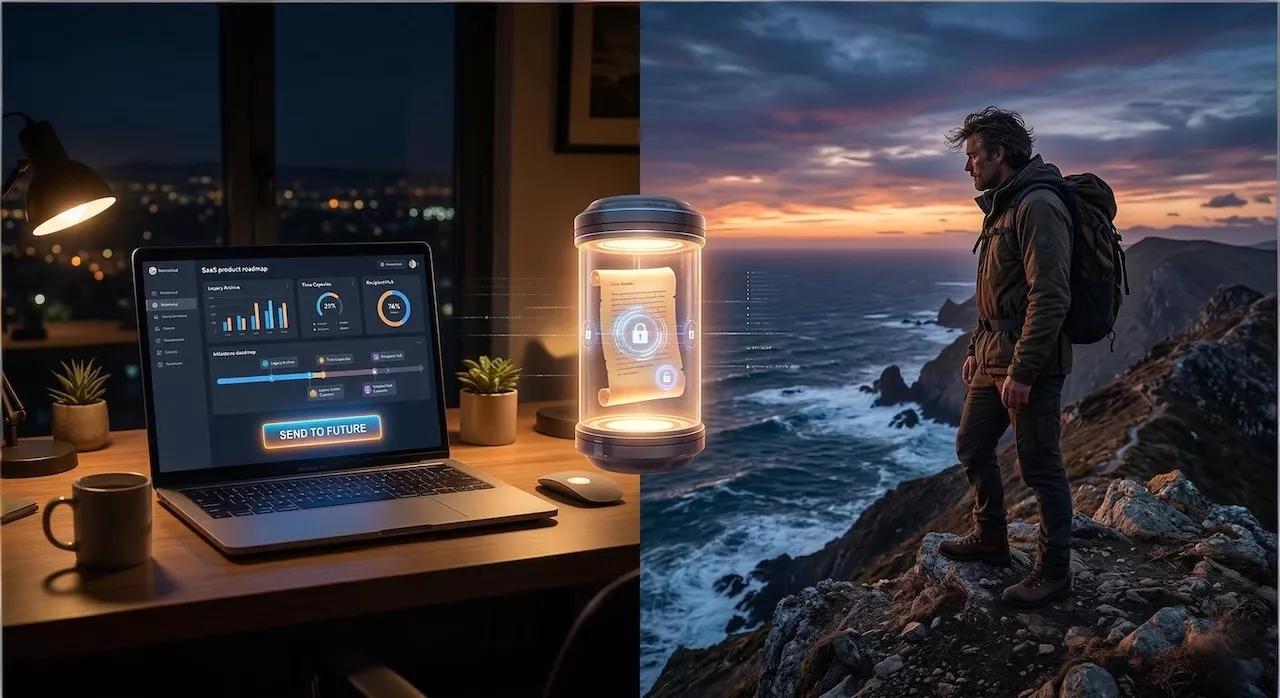
Why I Built EterMail: A Time Capsule for the People I Love Most
I’m a Product Manager who spends all week optimizing for the "immediate now." But getting lost off the grid on a mountain ridge made me realize I had zero infrastructure for the "forever." Here’s why I stopped worrying about conversion rates for a moment and built EterMail—a secure, tamper-proof digital time capsule for the people I love most.

The Most Radical Letter to Your Future Self Is a Promise to Stay Unfinished
The best letter to your future self isn't a memory—it's a mandate. Learn how writing to the version of you still working with love changes everything.

The Ice Tray at Midnight: On Grief, Domestic Minutiae, and the Quiet Work of Becoming Yourself Again
Why do the smallest habits hurt most after someone leaves? A reflection on grief, domestic minutiae, and the quiet moment healing finally begins.