
You are lying in the dark, thumb moving in small, exhausted circles, and the world is ending. Again. A pandemic you already survived. A war thousands of miles away rendered in high definition. The collapse of something—democracy, the housing market, the bees. Your body does not know this is a screen. Your nervous system responds as if the predator is in the room. René Magritte once warned that life is wasted when we make it more terrifying, and we have, with astonishing efficiency, engineered our own dread. We have made existence more terrifying precisely because it is so easy to do so.
But here is the question that haunts the 3 a.m. scroll: What if the terror is not the truth? What if it is just the default setting?
The Algorithmic Banality of Pessimism
Pessimism has become a kind of ambient noise, the elevator music of the internet. It is not that suffering has disappeared, or that injustice should be ignored. It is that our attention has been commodified, and the commodity that sells best is alarm. The platforms do not hate us; they are indifferent to us. They simply learned that fear keeps eyes on glass longer than hope does. Doomscrolling is not curiosity. It is a trance state, a digital self-harm dressed up as staying informed.
We have begun to mistake the feed for the world. We speak of "the discourse" as if it were weather. We cancel plans because the timeline feels heavy. We forget that somewhere, in the same hour that we absorbed three crises and zero solutions, a friend laughed so hard they snorted, a stranger held a door with genuine warmth, and the light fell through a window in a way that would have broken your heart open if you had been looking.
Digital mindfulness is not the grim discipline of self-optimization. It is not another productivity hack, not a meditation app subscription, not the optimized morning routine of a founder who wakes at 4 a.m. It is something older and quieter. It is the courage of joy.
What Digital Mindfulness Actually Means
True digital mindfulness is the practice of intentional enchantment. It is the refusal to let your emotional landscape be shaped by engagement metrics. It means asking, before every swipe: Is this nourishing me, or is it merely activating me? Activation feels like information, but it is often just adrenaline with no outlet. Nourishment is slower. It does not demand a reaction.
This requires a kind of rebellion. The algorithm wants you reactive. It wants you commenting, outraged, certain, afraid. Joy, by contrast, is interior. It leaves no trace the platform can monetize. Wonder is bad for business. And that is precisely why it is worth protecting.
There are small, radical acts available to anyone. Curate your inputs like you would a garden, not a landfill. Follow the botanist who photographs lichen. The poet who writes about their neighbor's dog. The historian who reminds you that people have survived worse and still made art, still fell in love, still cooked bad soup and laughed about it. Seek the accounts that make the world larger, not smaller.
But there is a deeper practice, one that moves beyond consumption and into creation.
The Radical Act of Preserving Wonder

We have forgotten how to write for slowness. Most of what we produce online is designed for immediacy: the hot take, the reply, the story that disappears in twenty-four hours. We are fluent in urgency and illiterate in permanence. But there is another kind of writing, one that operates on an entirely different timescale. A letter to your future self. A message to a child who cannot yet read. A time capsule of the ordinary miracles you are living through right now, sealed against the day you will have forgotten them.
This is where EterMail exists—not as an escape from the digital, but as a reimagining of it. The platform lets you send eternal letters and time capsules into the future: to yourself, to the people you love, to versions of people who do not yet exist. It is a tool, but more than that, it is a philosophy of memory. It asks: If you knew this message would be read in five years, or ten, or fifty, what would you choose to preserve? Not your anxiety. Not your take on the news cycle. Your wonder. The smell of your grandmother's kitchen. The way your partner's hair looked in the morning light. The hope you still held, even now, especially now.
Writing as an Act of Resistance
To write a letter to the future is to make a bet against despair. It says: I believe I will still be here. I believe you will still be here. I believe what matters will still matter. It is one of the few digital acts that cannot be scrolled past. It waits. It accrues meaning through patience.
Consider what you would include. Not the headlines. The headlines will age badly, always. Include instead the song you cannot stop playing. The conversation that changed your mind. The fear you overcame, not to perform resilience, but to honor the difficulty of becoming. Include the questions you do not yet have answers to. The future you, reading this, will not need your certainty. They will need your presence.
This practice changes your relationship to the present. When you know you are preserving something, you begin to notice differently. The feed loses its gravity. The sunset gains it. You become, in small but real ways, the author of your own attention.
The Self That Remembers How to Be Surprised

There is a kind of self that no platform can sell you. It is the self that remembers how to be surprised. The self that has not hardened into a set of opinions. The self that can hold contradiction without collapsing into cynicism. This self is not born; it is cultivated, slowly, through the choices you make about what to let in and what to keep.
Digital mindfulness, practiced this way, becomes less about restriction and more about devotion. Devotion to the real. To the tactile. To the relationships that do not exist in pixels alone. To the letter that will arrive on a morning you cannot yet imagine, carrying words from a version of you who refused to let the timeline win.
Magritte's warning was not a call to naive optimism. It was a call to accuracy. The world contains enough genuine terror without our assistance. But it also contains more beauty than the algorithm will ever show you. The work is to become a better witness. To train your gaze on what endures. To write, not in reaction to the feed, but in defiance of it.
A Different Kind of Inheritance
What we leave behind digitally is rarely what we intend. Our search histories, our deleted drafts, our angry comments at midnight—these are not legacies. They are debris. But we can choose to build something else. A collection of letters that map the interior life of a person who lived through difficult times and still found reasons to be glad. A time capsule for a child who will want to know not what you feared, but what you loved. A record of wonder, preserved against forgetting.
I built EterMail because I know what it is to lose hours to a glowing screen at 2 a.m., chasing some fragment of meaning through code and conversation with machines. That extreme digital solitude taught me something: the things we build in the dark should eventually lead us back to the light, and to each other. EterMail is my attempt at that bridge—a digital spaceship meant to cross the dimension of time, carrying what matters most. End-to-end encrypted, cloud-based, future-proofed against the erosion of memory and platform. But the technology is only the container. What matters is the choice: to write for the long now, to believe in the future enough to speak to it, to refuse the banality of pessimism in favor of something harder and more necessary. The courage of joy.
The reader who learns this now will possess something no platform can sell them. A self that remembers how to be surprised. A self that knows the feed is not the world. A self that, years from now, will open a letter and find not anxiety, but enchantment—carefully preserved, patiently waiting, entirely their own.

That is the self worth building. That is the self worth writing to.
What is EterMail?
EterMail is a revolutionary time capsule service that allows you to send messages, photos, and videos to the future (up to 30 years). Seal your memories and thoughts today, and they'll be delivered when the time is right.
Time Capsule
Send messages up to 30 years in the future
Rich Media
Text, photos, and videos supported
Secure & Private
Your memories are safely encrypted
EterMail Team
We're the team behind EterMail, dedicated to helping you preserve and share timeless messages with your loved ones. Our mission is to make it easy to express your love, share your wisdom, and create lasting connections that transcend time.
Frequently Asked Questions about Digital Mindfulness
How can I practice digital mindfulness without deleting all my apps?
Why does doomscrolling feel so hard to stop even when it makes me miserable?
What should I write in a letter to my future self to cultivate hope?
Related Articles
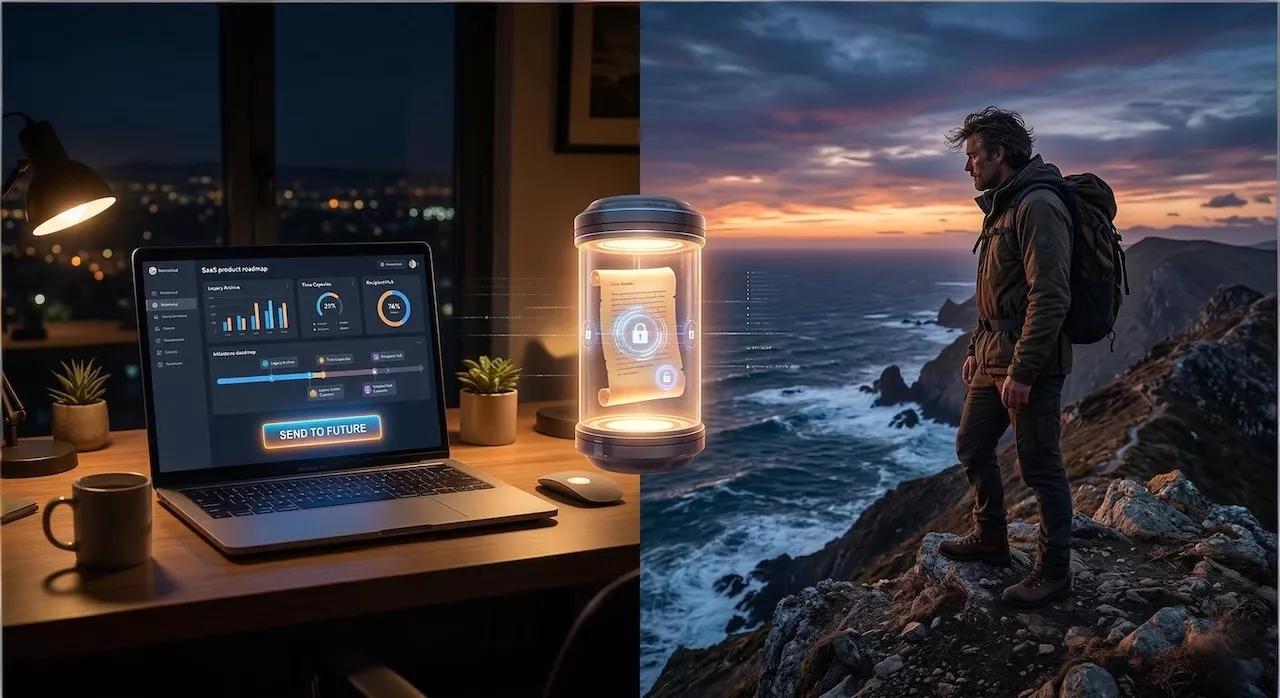
Why I Built EterMail: A Time Capsule for the People I Love Most
I’m a Product Manager who spends all week optimizing for the "immediate now." But getting lost off the grid on a mountain ridge made me realize I had zero infrastructure for the "forever." Here’s why I stopped worrying about conversion rates for a moment and built EterMail—a secure, tamper-proof digital time capsule for the people I love most.

The Most Radical Letter to Your Future Self Is a Promise to Stay Unfinished
The best letter to your future self isn't a memory—it's a mandate. Learn how writing to the version of you still working with love changes everything.

The Ice Tray at Midnight: On Grief, Domestic Minutiae, and the Quiet Work of Becoming Yourself Again
Why do the smallest habits hurt most after someone leaves? A reflection on grief, domestic minutiae, and the quiet moment healing finally begins.