The Thumb Hover
You scroll past it at least once a month. Maybe during a group text cleanup, or when you're searching for your dentist's number, or at 2 AM when insomnia has you thumbing through the alphabetized ruins of your social life. There it sits: a name that no longer belongs to anyone breathing. Their number, still saved. Their photo, still thumbnail-small in the corner.
Your thumb hovers. You know what comes next. Either you keep scrolling, letting the name blur back into the digital wallpaper of your life, or you enter the contact, stare at the details, and exit without changing anything. Again.
This is not sentimentality. This is digital haunting—the particular grief of a generation that buries its dead in cloud storage and carries their voices in voicemails nobody dares replay.
The Archaeology of the Address Book
Our phones have become emotional sedimentary rock. Layer upon layer of connections, each stratum marking who we were when we saved them. The college roommate with three area codes of history. The ex whose number you memorized before you learned to guard your heart. The colleague who became family, then became memory.
Dr. Elaine Kasket, psychologist and author of All the Ghosts in the Machine, notes that digital artifacts extend the "continuing bonds" we form with the dead. In pre-digital eras, these bonds required physical objects—photographs, letters, a watch, a sweater that still smelled of them. Now we carry entire interactive memorials in our pockets. We can still call them. The phone will ring. Someone else's voice will answer, or no one will, and either way, the ritual of reaching toward absence becomes possible.
But here's what we don't discuss: the exhaustion of maintenance.
Every saved contact requires micro-decisions. When you get a new phone, you choose to migrate them. When you update your OS, they persist. When you clear storage, you protect them. These choices, invisible and automatic, constitute a form of emotional labor we never agreed to perform. We are unpaid archivists of our own pain.
Why Deletion Feels Like Betrayal
The word itself—delete—carries violence. We delete errors. Spam. Embarrassments. To delete a loved one suggests they belong to this category of discardable things. Our technology offers no vocabulary for graceful release. There is no "retire to memory." No "honor and remove." Just the binary: keep or destroy.
This linguistic poverty shapes our behavior. A 2019 study in Death Studies found that 72% of bereaved participants had kept at least one digital connection to the deceased active years after the death. Not because they used it—most never called, never texted, never opened the chat history—but because removal felt like complicity in forgetting.
We have confused presence with remembrance.
Consider the physical equivalent. We do not, typically, keep a deceased parent's chair permanently occupied at the dinner table. We find other ways to remember. A framed photograph. A story told at holidays. The chair itself might be passed on, reupholstered, placed in a grandchild's first apartment—transformed rather than preserved in amber.
Digital space has no such natural cycles of transformation. The contact stays exactly as it was: frozen at the last update, the last photo shared, the last emoji reaction. It becomes a mausoleum rather than a memory.
The Cost of Fossilization
There is a quieter harm in keeping what we cannot use. Grief requires movement. The bereavement researchers Stroebe and Schut describe a "dual process model"—healthy mourning oscillates between loss-oriented coping (confronting pain) and restoration-oriented coping (engaging with life). Digital stasis interrupts this oscillation. The contact, permanently present, permits neither full confrontation nor full restoration.
We scroll past. We feel the small shock. We scroll on. This is not remembrance. This is rehearsal of wound.
The psychologist Sherry Turkle has written extensively on how technology that promises connection often delivers the simulation of intimacy without its substance. The saved contact offers the possibility of connection—"I could call"—without the reality. We maintain a relationship with the idea of the person, increasingly distant from the actual complexity of who they were.
Worse, we maintain it publicly. Our phones are social objects. Someone might see their name in our favorites. "Oh, you still talk to—?" The explanation becomes its own small trauma, repeated, or the lie of omission becomes its own small shame.
The Ritual of Release
What would it mean to design a better goodbye?
Some cultures have always understood that memory requires intentional practice rather than passive preservation. The Mexican Día de los Muertos builds altars that are dismantled. The Jewish yahrzeit candle burns for exactly twenty-four hours. These are bounded rituals—sufficient, complete, allowing return to ordinary life without ordinary life being colonized by death.
Digital mindfulness asks us to create similar boundaries. Not to forget, but to remember actively rather than be reminded accidentally.
This might look like:
- The intentional archive: Moving the contact to a dedicated space—exporting the information, the photos, the voice memos—to a specific memorial folder or platform, then removing the daily trigger from your active address book.
- The composed farewell: Writing what you never said, not to send (the number is silent now) but to witness your own feelings, then scheduling that letter to yourself for a future date when you might need to remember how you loved them.
- The transformed object: Using the phone number itself as seed for something new—a donation made in their name, a tradition started on their birthday, a recipe of theirs cooked annually and photographed, building living memory rather than frozen data.

What We Actually Fear
Beneath the hesitation to delete lies a deeper anxiety: the fear that we are the only remaining record. If their name disappears from our phone, who else is keeping them present? Social media memorialization is fragile—accounts are deleted, platforms die, algorithms bury. The contact feels like proof.
But proof of what? That they existed? Existence does not require our verification. That we loved them? Love does not require our suffering.
I've spent too many nights alone with a glowing screen, pair-programming with LLMs until 2 or 3 AM, to believe that digital permanence equals meaning. That extreme solitude taught me something: the most important dialogues happen across time, not in real-time. A letter written at midnight and read years later carries more weight than any contact left rotting in an address book. When I step away from the keyboard—into mountain trails, into ocean waves, into the raw reality where control slips away—I remember what actually matters. The unrepeatable moment. The deliberate choice. The word sent forward, not hoarded.
The digital legacy movement has begun addressing this fear more constructively. Rather than individual phones becoming accidental archives, we can build intentional ones. Letters written to future selves or designated recipients, scheduled for delivery years hence. Time capsules of voice and image, released not by the randomness of what we happened to save, but by the care of what we chose to preserve.
This is the shift: from hoarding to curating. From being haunted by data to being entrusted with story.
The Weight of the Unpressed Button
There will come a moment—perhaps it has already arrived—when you will decide. The phone upgrade that requires active migration rather than passive transfer. The contact sync that duplicates everything and forces review. The new relationship with someone who asks, gently, why you still have your former partner's mother saved as "Mom."
In that moment, you are not choosing to forget. You are choosing how you will remember.
The delete button, pressed with intention, can be its own ritual. A small death that acknowledges the larger one. A boundary drawn between the person you were when they answered, and the person you are now, carrying them differently.
Your phone contains multitudes. It does not need to contain graves.
Digital mindfulness is not about minimalism. It is about proportion. About refusing to let the technologies designed for connection become technologies of endless, exhausting preservation. About trusting that memory lives in us, in our stories, in our changed behavior—not in the alphabetical ordering of a contact list we scroll through with dread.
The name will fade from your thumb's muscle memory. The small shock will stop arriving. And in that quiet, you might find something unexpected: room to remember them as they were, rather than as your phone insists they remain.
Some goodbyes deserve more than a delete button. The best way to fight forgetting isn't taking another screenshot; it's setting an alarm for the future. By using EterMail to schedule a letter to yourself five years from now, or a message to someone you'll eventually leave behind, you completely free yourself from the anxiety of the present. You write the words. You choose the moment. Then you let time do what it does best—carry what matters forward.
What is EterMail?
EterMail is a revolutionary time capsule service that allows you to send messages, photos, and videos to the future (up to 30 years). Seal your memories and thoughts today, and they'll be delivered when the time is right.
Time Capsule
Send messages up to 30 years in the future
Rich Media
Text, photos, and videos supported
Secure & Private
Your memories are safely encrypted
EterMail Team
We're the team behind EterMail, dedicated to helping you preserve and share timeless messages with your loved ones. Our mission is to make it easy to express your love, share your wisdom, and create lasting connections that transcend time.
Frequently Asked Questions about Digital Mindfulness
Why do I feel guilty about deleting a dead loved one's contact information?
How can I preserve someone's digital memory without keeping their contact active?
What is digital grief and why is it different from traditional mourning?
Related Articles
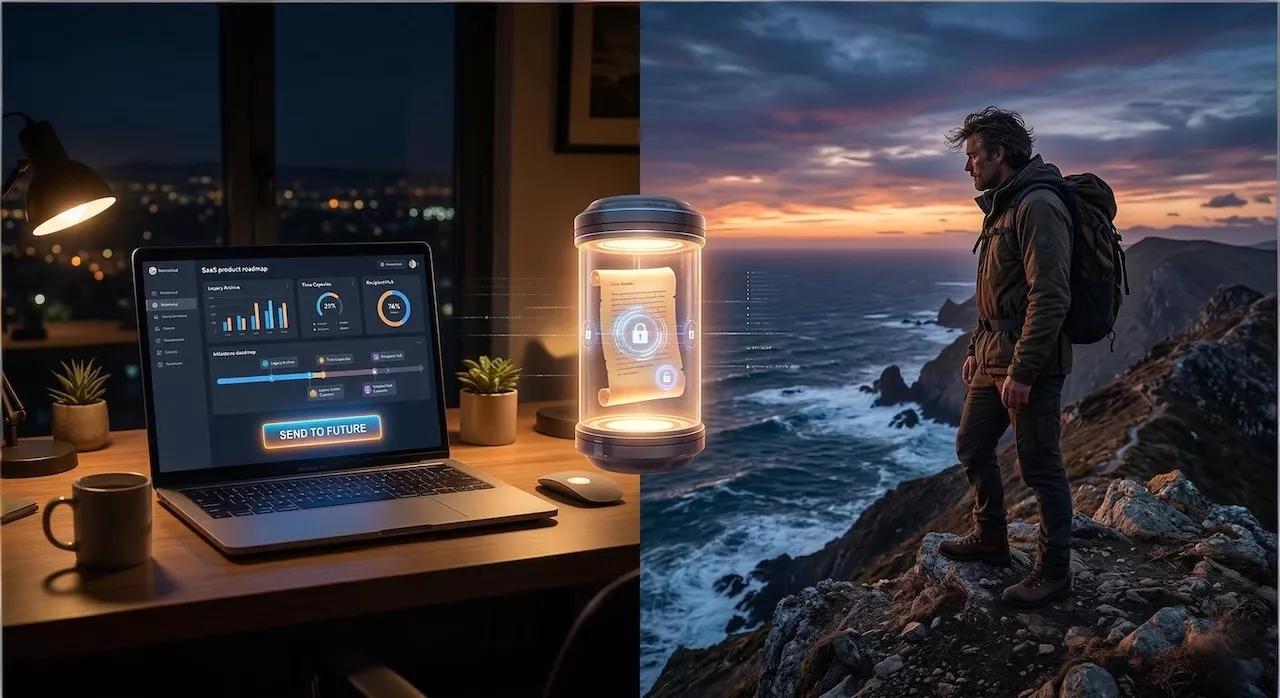
Why I Built EterMail: A Time Capsule for the People I Love Most
I’m a Product Manager who spends all week optimizing for the "immediate now." But getting lost off the grid on a mountain ridge made me realize I had zero infrastructure for the "forever." Here’s why I stopped worrying about conversion rates for a moment and built EterMail—a secure, tamper-proof digital time capsule for the people I love most.

The Most Radical Letter to Your Future Self Is a Promise to Stay Unfinished
The best letter to your future self isn't a memory—it's a mandate. Learn how writing to the version of you still working with love changes everything.
The Ice Tray at Midnight: On Grief, Domestic Minutiae, and the Quiet Work of Becoming Yourself Again
Why do the smallest habits hurt most after someone leaves? A reflection on grief, domestic minutiae, and the quiet moment healing finally begins.