The Notification That Never Came
There was a Tuesday last March when I caught myself scrolling past a photograph of my own hands. I had posted it three years earlier—kneading bread at midnight, flour ghosted across my knuckles, the caption something about finding peace in repetition. Three hundred people had liked it. I had no memory of taking it.
This is the quiet horror our devices deliver: the documentation of a life we were too distracted to inhabit. We archive everything and possess nothing. We become curators of experiences we never fully had, hoarding evidence of passions that slipped through our fingers while we were busy capturing them.
Simone de Beauvoir, writing in her sixties, warned that "in old age we should wish still to have passions strong enough to prevent us turning in on ourselves." She understood something our wellness apps miss entirely: the enemy of a meaningful later life is not time itself, but the gradual narrowing of our inner world until we become mere consumers of our own past. The scroll replaces the spark. The feed becomes the self.
What if digital mindfulness were not another productivity hack—another screen-time limit, another gray-scale setting—but instead a practice of deliberate preservation? What if the letter you write today, sealed against some future date, became the thread that pulled your future self back toward what you actually loved out loud?
The Architecture of Attention
Our devices are not neutral tools. They are attention architectures designed to fragment consciousness into monetizable units. Every pull-to-refresh trains us away from sustained engagement with our own minds. We become skilled at reacting and impoverished at reflecting.
The research on this is sobering but familiar. Studies from the University of Texas at Austin found that the mere presence of a smartphone, even face-down and silent, reduces available cognitive capacity. Our minds, it seems, maintain a background process of vigilance—a low-grade anxiety that something might demand our attention. We are never fully where we are.
But the deeper cost is harder to measure. It lives in the novels we never finished because we checked a notification at page twelve. The friendships that thinned because we were present in body but not in attention. The creative projects abandoned not from lack of talent but from the erosion of sustained focus—the kind of focus that requires boredom, struggle, and the willingness to be temporarily incompetent.
De Beauvoir's warning about "turning in on ourselves" describes precisely this contraction. Without passions that demand our full presence, we spiral inward toward the self as consumer rather than creator. The digital environment accelerates this spiral by offering infinite consumption disguised as connection.
Digital mindfulness, then, is not about rejecting technology but about reclaiming the temporal architecture of our lives. It asks: Who decides what deserves my attention? Who determines the rhythm of my days? And perhaps most urgently: What will I wish I had paid attention to when I can no longer recall what mattered?
The Letter as Resistance
There is a peculiar power in writing to someone you will become. The act forces a kind of temporal empathy—an imaginative leap across the years that interrupts the compulsive present of the scroll. You are no longer merely reacting; you are constructing a bridge.
Consider what happens when you sit down to write a letter scheduled to arrive on your sixty-fifth birthday. The blank page demands specificity. Not "I hope you're happy"—that hollow greeting card wish—but the particular texture of what you love right now: the smell of your child's hair after rain, the way your partner laughs with their whole body when surprised, the project that makes you lose track of hours despite its difficulty. These details become anchors of identity that future algorithms cannot predict or replace.
The philosopher Alasdair MacIntyre argued that personal identity is fundamentally narrative—we understand ourselves through the stories we tell about where we have been and where we are going. A future letter is an act of narrative authorship in an age of algorithmic curation. It says: I will be the one to tell my story. I will choose what persists.
This is where scheduled, encrypted correspondence becomes something more than a digital time capsule. It becomes a practice of temporal integrity—a way of keeping promises to selves who do not yet exist. End-to-end encryption matters not for paranoia but for intimacy: these are thoughts too raw for the performative contexts of social media, too provisional for the permanent record of a feed. They belong to a private conversation across time.
The Passions That Outlast Devices
I have a friend, now in her seventies, who began writing letters to her future self during a difficult divorce in her forties. She scheduled them annually, often forgetting their contents. The letters are remarkable for what they preserve—not the drama of the divorce, which she barely mentions, but the evidence of a self continuing to choose aliveness.
One letter, written at forty-three, describes teaching herself to identify birdsong during insomnia. Another, at fifty-one, recounts a failed attempt to learn pottery and her decision to try again. A third, at sixty, contains a list of questions she is still asking—about justice, about forgiveness, about whether she will ever feel at home in her own body.
"The surprising thing," she told me, "is how often my future self needed to be reminded of what she loved. The person I became was always in danger of forgetting."
This is the paradox of longitudinal selfhood: we are not continuous in the ways we imagine. Memory is reconstructive, shaped by present mood and recent narrative. The self who scrolls through her own archives is not reliably the self who lived them. We need external prompts—artifacts of attention, evidence of passion—to reconstitute who we were and, by extension, who we might still become.
Digital mindfulness, practiced through deliberate correspondence with our future selves, creates these prompts with intention rather than leaving them to the randomness of algorithmic resurfacing. It says: I will choose what my future self remembers. I will cultivate passions strong enough to survive my own forgetting.
The Ethics of Memory in an Age of Abundance
We face a strange historical situation. Never before have humans had access to so comprehensive a record of their pasts—photos, messages, locations, purchases, all timestamped and searchable. And never before have we felt so alienated from our own histories, so unable to locate the self within the archive.
The problem is not insufficient data but unstructured abundance. Without narrative frameworks, without the deliberate selection that constitutes meaning, our digital memories become not resources for self-understanding but burdens of undifferentiated information. We are haunted by the sheer volume of what we have accumulated without attending to.
Future letters solve this problem through the ethics of curation. They require us to choose what deserves to survive, what merits the attention of a self who will be different from our present one. This choosing is itself a practice of mindfulness—a slowing down, a weighing of value, an acknowledgment that not everything deserves preservation.

De Beauvoir's insistence on passions "strong enough" carries this ethical weight. She is not advocating for mere hobbies or distractions. She is describing commitments that structure a life, that give it direction and density, that prevent the inward collapse of the self into pure consumption. A passion strong enough is one that generates its own reasons for continuing, that creates communities of practice, that leaves traces in the world beyond the digital archive.
When we write to our future selves about these passions—when we describe not just what we love but why, and how it feels, and what it costs us—we are performing a kind of existential maintenance. We are keeping the machinery of meaning operational across the years.
The Builder's Midnight and the Letter's Promise
I spend a lot of nights alone with screens. Not scrolling—building. Hunched over architecture diagrams at 2 AM, arguing with an LLM about edge cases, deploying to cold servers while the rest of the world sleeps. There's a particular loneliness to it, a sense that you're constructing something in a dimension no one else currently inhabits. But that same solitude taught me something about time: the code I write tonight doesn't execute its purpose until some future moment, often years away, when a human hand finally opens what I built.
That gap between creation and reception—it's where meaning actually lives. I've chased that feeling in other forms too: surfing dawn patrol when the waves are raw and indifferent to whether you survive them, hiking ridges where the wind strips away every digital illusion. Those moments demand total presence. You can't perform them. You can only survive them, remember them, and hope the self who remembers is worth the effort.
The letter operates on the same principle. It's a bridge thrown across time, built in solitude, received in solitude. And like any bridge worth crossing, it needs to hold.
This is exactly why I obsessed over end-to-end encryption and extreme server redundancy when building EterMail. Because I know that a letter written to the future needs to be guarded even more fiercely than a bank password. The thoughts you send across decades deserve to arrive exactly as you wrote them—intact, private, immune to the platform rot that will consume everything else you've posted.
The Self That Aged Deliberately
I return often to that photograph of my hands in flour. I have come to see it as a warning and an invitation. The warning: documentation without attention is a kind of premature death, a living burial of experience. The invitation: it is not too late to change the pattern, to begin practices of presence that will accumulate into a self worth remembering.
The letter I am writing now, scheduled to arrive in fifteen years, contains no photographs. It contains instead a list of what I am struggling to love, what I am afraid of losing, what I hope will still surprise me. It is awkward and provisional and painfully sincere. It is, I suspect, exactly what my future self will need.
This is what no longevity app can deliver: not more years, but more self across the years. Not the preservation of youth but the cultivation of a person who aged deliberately, who remained capable of passion, who can look back not at an archive of forgotten moments but at a correspondence with selves who chose, again and again, to pay attention.
Your feeds will go dark. Your passwords will be forgotten. The platforms will change or disappear or become unrecognizable. What remains is the letter you wrote to the person you hoped to become—and the passions strong enough to ensure you became someone worth writing to.
The scroll will not save you. But the letter might.
What is EterMail?
EterMail is a revolutionary time capsule service that allows you to send messages, photos, and videos to the future (up to 30 years). Seal your memories and thoughts today, and they'll be delivered when the time is right.
Time Capsule
Send messages up to 30 years in the future
Rich Media
Text, photos, and videos supported
Secure & Private
Your memories are safely encrypted
EterMail Team
We're the team behind EterMail, dedicated to helping you preserve and share timeless messages with your loved ones. Our mission is to make it easy to express your love, share your wisdom, and create lasting connections that transcend time.
Frequently Asked Questions about Digital Mindfulness
What should I include in a letter to my future self to maintain digital mindfulness?
How does writing to my future self differ from keeping a digital journal or social media archive?
Can digital mindfulness practices actually improve how I age and remember my life?
Related Articles
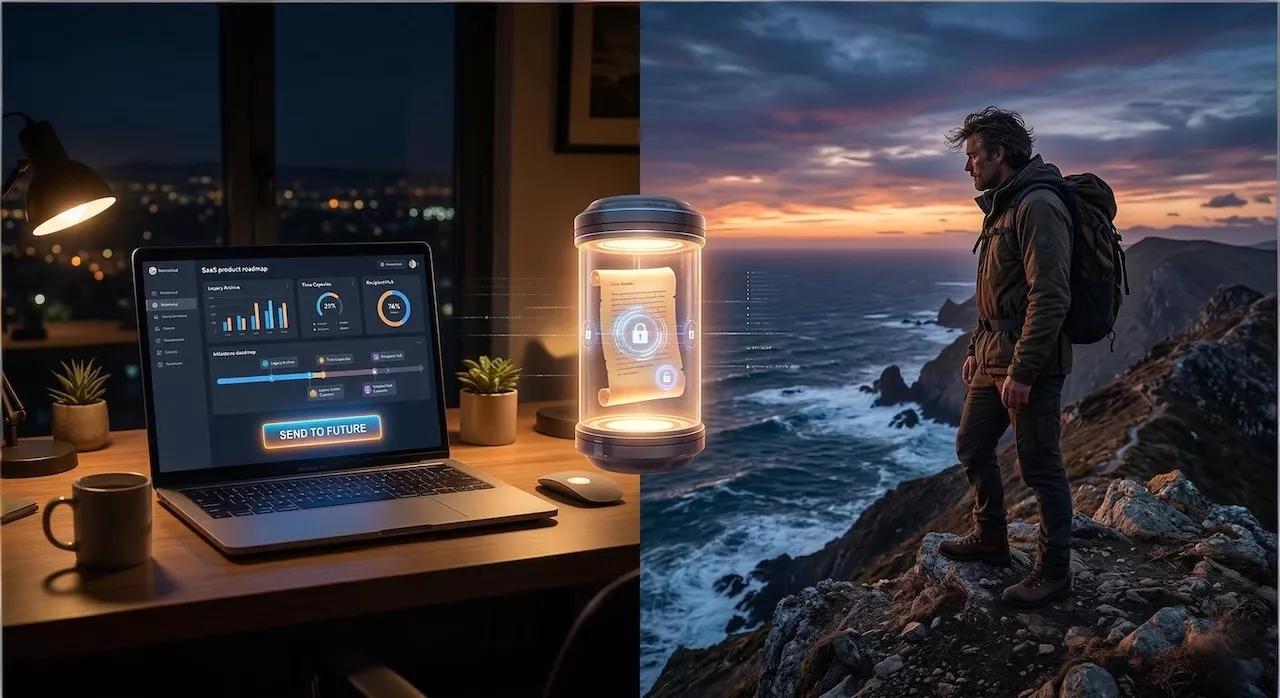
Why I Built EterMail: A Time Capsule for the People I Love Most
I’m a Product Manager who spends all week optimizing for the "immediate now." But getting lost off the grid on a mountain ridge made me realize I had zero infrastructure for the "forever." Here’s why I stopped worrying about conversion rates for a moment and built EterMail—a secure, tamper-proof digital time capsule for the people I love most.

The Most Radical Letter to Your Future Self Is a Promise to Stay Unfinished
The best letter to your future self isn't a memory—it's a mandate. Learn how writing to the version of you still working with love changes everything.

The Ice Tray at Midnight: On Grief, Domestic Minutiae, and the Quiet Work of Becoming Yourself Again
Why do the smallest habits hurt most after someone leaves? A reflection on grief, domestic minutiae, and the quiet moment healing finally begins.