The Cursor Blinking in an Empty Room
There is a peculiar loneliness to the blank document. Not the absence of words, but the presence of possibility—that terrifying, exhilarating space where you might write something no one, including yourself, expects. The cursor blinks. You type a sentence. You delete it. You type something worse, something more honest, something that embarrasses you even in solitude. This is the labor of writing. And it is, increasingly, a radical act.
We have trained ourselves to believe that speed equals intelligence. That the first draft should be the final draft. That our thoughts, properly prompted, should emerge fully formed and grammatically immaculate. The machines have learned to simulate this fluency with eerie competence. They do not pause. They do not feel their way toward meaning through syntax and failure. They do not wake at 3 AM convinced they have found the precise word, only to discover by morning that it was precisely wrong.
What AI cannot do—what it may never do—is inhabit the embodied, iterative, gloriously inefficient process of discovering what you actually mean.
This is not a critique of technology. It is an observation about consciousness. And it opens a door to something we have largely abandoned in our digital lives: the practice of slowness as intention.

The Algorithmic Self vs. The Written Self
Consider how you communicate now. The predictive text that finishes your sentences. The suggested replies that offer three emotional options—gratitude, enthusiasm, polite deflection—without requiring you to locate the feeling yourself. The endless scroll that replaces reflection with reaction. We are, in subtle increments, outsourcing the work of becoming to systems designed for delivering.
The result is a kind of spectral presence: a self that performs coherence without achieving it. You respond promptly. You maintain threads. You curate a feed that suggests interiority. But where does the unprocessed material go? The doubt, the revision, the long wandering toward an insight that cannot be summoned on demand?
Digital mindfulness is not about retreating from technology. It is about reclaiming the spaces where technology fails to follow.
Writing well—writing that matters—requires precisely these failures. The wrong word chosen first. The sentence that unravels three paragraphs in. The realization, hours later, that what you meant to say was something else entirely, something that required all those missteps to become visible. This is not inefficiency. It is epistemology. It is how human beings know things.
The Letter as Time Machine
There is perhaps no form of writing more stubbornly resistant to algorithmic optimization than the letter to one's future self. It serves no immediate function. It cannot be A/B tested for engagement. Its value lies entirely in the gap between composition and reception—that expanse of years during which both writer and reader (the same person, unrecognizably altered) will undergo transformations no prediction can capture.
When you write to your future self, you are forced to confront the limits of your own imagination. You cannot know who you will be. You cannot know what you will have lost, what you will have built, what you will have forgotten was ever important. The letter becomes a wager against certainty. It insists that you—this particular consciousness, with its specific textures of worry and hope—deserve to be remembered by someone who no longer exists in quite this form.
This is the opposite of the algorithmic feed, which shows you what you already like. The future letter shows you what you could not yet understand about yourself.
The practice asks something difficult: that you tolerate ambiguity. That you write without knowing if your words will land as comfort or irony, as prophecy or poignant misjudgment. That you trust the process of articulation itself to generate meaning you could not have planned.
The Encryption of Consciousness
We speak often of digital security—end-to-end encryption, data protection, privacy protocols. These are necessary frameworks. But they address a narrower problem than the one that truly haunts us. The deeper question is not whether your words will be seen by unauthorized eyes, but whether they will be seen at all—whether anything you create in the stream of digital production will survive long enough to matter to someone you love.
Digital mindfulness includes future-proofing your memories, not against hackers, but against time itself.
The platforms where we currently deposit our lives are not designed for longevity. They are designed for engagement, which means for now. The photograph you posted five years ago is already buried under thousands of subsequent images. The message thread that once sustained a long-distance friendship has been archived, then forgotten, then lost to a platform update. We are living through the first era in human history where ordinary people generate unprecedented quantities of personal documentation—while possessing unprecedentedly fragile mechanisms for preserving it.
A letter scheduled for future delivery operates on different temporal logic. It acknowledges that meaning accrues. That the value of a message may not be apparent at the moment of composition, or even at the moment of sending, but only in the collision between what you wrote and what the recipient has since become. This requires infrastructure: secure storage, reliable scheduling, the technical capacity to bridge years or decades. But it also requires something more elusive: the intention to be understood across time.
Writing as Resistance, Writing as Care
To write a letter that will arrive in ten years is to refuse the acceleration of everything. It is to say: this deserves duration. The observation about your child's laugh that you cannot yet know will become precious. The fear you hope will have dissolved. The love you are not certain will last but are certain deserves witness. These are not efficient communications. They are investments—in the continuity of self, in the possibility of being known, in the stubborn belief that your particular consciousness matters enough to be preserved.
The machines can generate text that resembles this. They cannot generate the stakes.
I know this tension intimately. Most nights, you'll find me at my desk until 2 or 3 AM, "pair programming" with various LLMs, mapping out architectures, chasing the edge of what's possible with code. That extreme digital solitude—just me and the glow of the screen—gives me a strange kinship with anyone who's sat alone, trying to bridge the gap between who they are and who they might become. The irony isn't lost on me: I build with the most hardcore tech stacks, deploy servers, wrestle with APIs, yet what I keep returning to is something far softer. A wild, almost embarrassing fantasy, really—that I could build a bridge between the physical and digital worlds, something like Neo jacking into The Matrix. Not to escape reality, but to extend it. To preserve what matters across the one dimension we can't hack: time.
The best way to fight forgetting isn't taking another screenshot; it's setting an alarm for the future. By using EterMail to set a delivery date 5 years from now, you completely free yourself from the anxiety of the present. You write the messy first sentence. You let the wrong word stand if it's honest. You trust that someone—your future self, altered beyond recognition—will recognize in your struggle something of their own.
This distinction matters because we are rapidly approaching a moment when the form of human expression will be indistinguishable from synthetic production. The essay that moves you. The poem that articulates your unspoken grief. The message that arrives exactly when needed. All of these will soon be available on demand, optimized for impact, delivered without the labor that once made them meaningful.
What remains ours—what may always remain ours—is the decision to undertake that labor. To sit with the cursor blinking. To choose the wrong word first. To feel your way toward meaning through syntax and failure, and to trust that someone, someday, will recognize in your struggle something of their own.
The Letter You Write to Be Found
There is a particular intimacy to being found by your own past. To open a message from who you were and recognize, with startled clarity, both the distance traveled and the essential continuity. You were always this person. You were never this person. Both statements are true, and only a document that survived the interval can make them coexist.
Digital mindfulness begins here: with the recognition that our technologies of connection have largely become technologies of dispersal. We are everywhere present and nowhere preserved. The future letter—written slowly, scheduled deliberately, delivered across the years—offers a counterpractice. It is communication as commitment. It says: I am willing to be misunderstood now in order to be understood later. I am willing to write without knowing if these words will land. I am willing to trust that the process of putting my singular consciousness into language matters, even—or especially—when no algorithm could have generated it.
The blank document still waits. The cursor still blinks. And somewhere in the hesitation between thought and expression—in the deletions, the false starts, the gradual emergence of something that feels true—there remains a space that belongs entirely to you. Not to efficiency. Not to optimization. To the slow, unalgorithmic labor of becoming someone worth finding, years from now, in words no machine could have written for you.
This is digital mindfulness: not the absence of technology, but the presence of intention. Not the rejection of the future, but the courage to address it directly—to write, at last, the letter that only you can send.
What is EterMail?
EterMail is a revolutionary time capsule service that allows you to send messages, photos, and videos to the future (up to 30 years). Seal your memories and thoughts today, and they'll be delivered when the time is right.
Time Capsule
Send messages up to 30 years in the future
Rich Media
Text, photos, and videos supported
Secure & Private
Your memories are safely encrypted
EterMail Team
We're the team behind EterMail, dedicated to helping you preserve and share timeless messages with your loved ones. Our mission is to make it easy to express your love, share your wisdom, and create lasting connections that transcend time.
Frequently Asked Questions about Digital Mindfulness
What makes writing to my future self different from regular journaling?
How can I practice digital mindfulness without abandoning technology entirely?
Why does slow writing feel more authentic than AI-generated text?
Related Articles
Why I Built EterMail: A Time Capsule for the People I Love Most
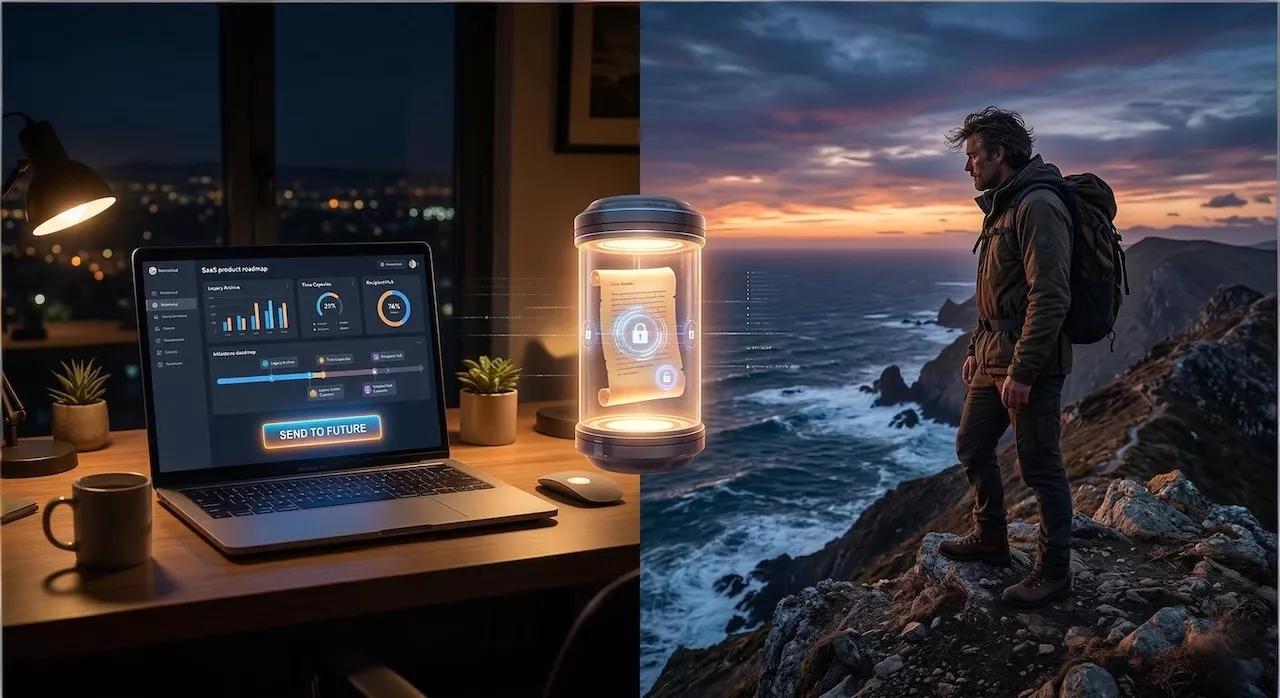
I’m a Product Manager who spends all week optimizing for the "immediate now." But getting lost off the grid on a mountain ridge made me realize I had zero infrastructure for the "forever." Here’s why I stopped worrying about conversion rates for a moment and built EterMail—a secure, tamper-proof digital time capsule for the people I love most.

The Most Radical Letter to Your Future Self Is a Promise to Stay Unfinished
The best letter to your future self isn't a memory—it's a mandate. Learn how writing to the version of you still working with love changes everything.

The Ice Tray at Midnight: On Grief, Domestic Minutiae, and the Quiet Work of Becoming Yourself Again
Why do the smallest habits hurt most after someone leaves? A reflection on grief, domestic minutiae, and the quiet moment healing finally begins.