You tell yourself you're staying informed. That you're connected, present, aware. But somewhere between the third swipe and the seventeenth refresh, you realize you haven't actually felt anything in hours. The notification glows, you tap, you scan, you move on. Another headline. Another image. Another moment that passes through you like water through cupped hands.
This is the architecture of modern attention: not absence, but half-presence. We have perfected the art of witnessing without participating, of consuming without digesting, of archiving experiences we never actually lived. The paradox is almost elegant—we are more documented than any generation in history, and yet, when asked to recall what we felt last Tuesday, we draw blank after blank.
The Performance of Monitoring
There is a specific quality to how we now inhabit digital space. We do not scroll with the desperate urgency of doomscrolling's early pandemic peak. That, at least, had the honesty of panic. What has replaced it is stranger: a hollow performance of vigilance, the endless refresh masquerading as care. You check again not because you expect change, but because the act of checking has become synonymous with being.
The psychologist Sherry Turkle once warned of being "alone together." We have evolved a new condition: together alone, surrounded by the artifacts of connection while the substance evaporates. We favorite posts we barely read. We send reactions instead of sentences. We maintain the form of relationships through constant low-grade surveillance—stories viewed, locations noted, read receipts accumulated—while the content atrophies.
The damage is cumulative and invisible. Each micro-abandonment—starting a video, getting distracted, never returning—trains the brain that experience is disposable. That depth is inefficient. That presence is a luxury you cannot afford when there is always more to monitor.
The Memory Paradox
Here is what the platforms will not tell you: abundance erodes recollection. When every meal is photographed, no meal is remembered. When every sunset is captured, no sunset is absorbed. The cognitive science is unambiguous—memory formation requires what researchers call "encoding," the deep processing that happens when we pay sustained, undivided attention. The smartphone raised between you and experience is not a neutral tool. It is a filter that strips the moment of its capacity to become memory.
We have built external storage so comprehensive that we have outsourced our internal archives. The cloud remembers so we do not have to. But memory is not mere data retrieval. It is the architecture of self—the accumulated evidence that you were here, that you felt, that you changed. A hard drive of unviewed photos is not a life. It is a mausoleum of moments you never permitted yourself to fully inhabit.
The tragedy compounds across generations. Children now grow up with their entire childhoods documented in unprecedented resolution, yet studies suggest they form fewer durable autobiographical memories than previous cohorts. The camera's presence alters the event. The parent's attention divided between the child and the lens produces a different quality of interaction, one that the child internalizes as normal. Surveillance replaces attunement. The archive grows; the attachment frays.
The Antidote Is Not Escape
The prescription offered by digital wellness culture—delete the apps, buy the dumb phone, retreat to analog purity—misses something essential. Most of us cannot opt out. Our work lives, our family connections, our civic participation run through these channels. The problem is not the technology itself but the mode of attention we have learned to bring to it.
Digital mindfulness is not about reduction but about intentionality. It asks: what if you approached the screen as you might approach a letter—knowing that what you send into the digital ether will persist, that your attention is itself a form of creation, that the quality of your presence matters more than the quantity of your output?
This is where the practice of future-letter writing becomes something more than sentimental exercise. When you compose a message to your future self, you are forced to witness your own life with intention. You cannot perform half-presence for an audience of one, separated by years. The form demands specificity: not "having fun at the beach" but the particular temperature of the water, the unexpected conversation with the stranger, the precise shade of doubt you are trying to outrun.

The act slows time. It requires you to select from the infinite scroll of experience the moments that deserve preservation, that shaped you, that your future self will need to recognize. In doing so, you rehearse a different relationship with attention—one where you are the curator rather than the curated, where memory is built through deliberate choice rather than algorithmic accident.
The Letter as Technology of Presence
There is a reason cultures across history have developed practices of delayed communication—time capsules, buried manuscripts, letters to be opened on specific anniversaries. These technologies acknowledge a truth that instantaneous messaging obscures: meaning accrues through duration. The message that travels through time carries weight that the message sent and consumed in the same breath cannot achieve.
When you write to your future self, you are practicing temporal empathy—the imaginative extension of care across the distance of years. You are saying: I believe you will exist. I believe you will have changed in ways I cannot predict. I believe you will need to remember who I was, what I feared, what I hoped, in order to understand who you have become.
This is the opposite of the infinite refresh. It is commitment in an age of abandonment, depth in a medium designed for surface. The letter does not demand immediate response. It does not compete for attention in a feed. It waits, patient and encrypted, for the moment you designated—graduation, anniversary, the birthday when you will need to hear from someone who knew you before.

Rebuilding the Architecture of Attention
I know this tension intimately. There are nights when I'm still coding at 2 AM, "pair programming" with an LLM, chasing some architectural problem through the dark hours while the rest of the world sleeps. That digital solitude has its own strange beauty, but it also teaches you something about loneliness—about how easy it is to be present everywhere and nowhere at once. And then there are the weekends when I force myself offline entirely, hiking steep trails or surfing until my arms burn, where the cold wind or the raw unpredictability of a wave strips away every illusion of control. Those moments hurt. They also remind me what's real.
The practice does not require grand pronouncements. It begins with a single question, asked with genuine curiosity: What would my future self need to receive? Not what would impress, not what would perform well, but what would serve—what would illuminate, comfort, or challenge the person you are becoming.
This question, repeated, becomes a habit of mind. You begin to notice differently. The conversation that might have been background noise becomes material. The ordinary Tuesday contains something your future self should know. You are training yourself to witness rather than to monitor, to participate rather than to surveil.
The platforms will not teach this. Their business model depends on your fragmentation, your anxiety, your endless return. But you can build alternative structures—practices that reclaim attention as a resource to be invested rather than a commodity to be harvested.
This is exactly why I obsessed over end-to-end encryption and extreme server redundancy when building EterMail. Because I know that a letter written to the future needs to be guarded even more fiercely than a bank password. The infinite refresh offers only the illusion of movement. The letter offers something rarer: the possibility that your attention, properly directed, might outlast the moment of its application. That what you witness with intention might become, years from now, exactly what you need to remember.
What is EterMail?
EterMail is a revolutionary time capsule service that allows you to send messages, photos, and videos to the future (up to 30 years). Seal your memories and thoughts today, and they'll be delivered when the time is right.
Time Capsule
Send messages up to 30 years in the future
Rich Media
Text, photos, and videos supported
Secure & Private
Your memories are safely encrypted
EterMail Team
We're the team behind EterMail, dedicated to helping you preserve and share timeless messages with your loved ones. Our mission is to make it easy to express your love, share your wisdom, and create lasting connections that transcend time.
Frequently Asked Questions about Digital Mindfulness
What is digital mindfulness and how is it different from regular mindfulness?
Why do we form fewer memories when we're constantly on our phones?
How can writing to my future self improve my relationship with technology?
Related Articles
Why I Built EterMail: A Time Capsule for the People I Love Most
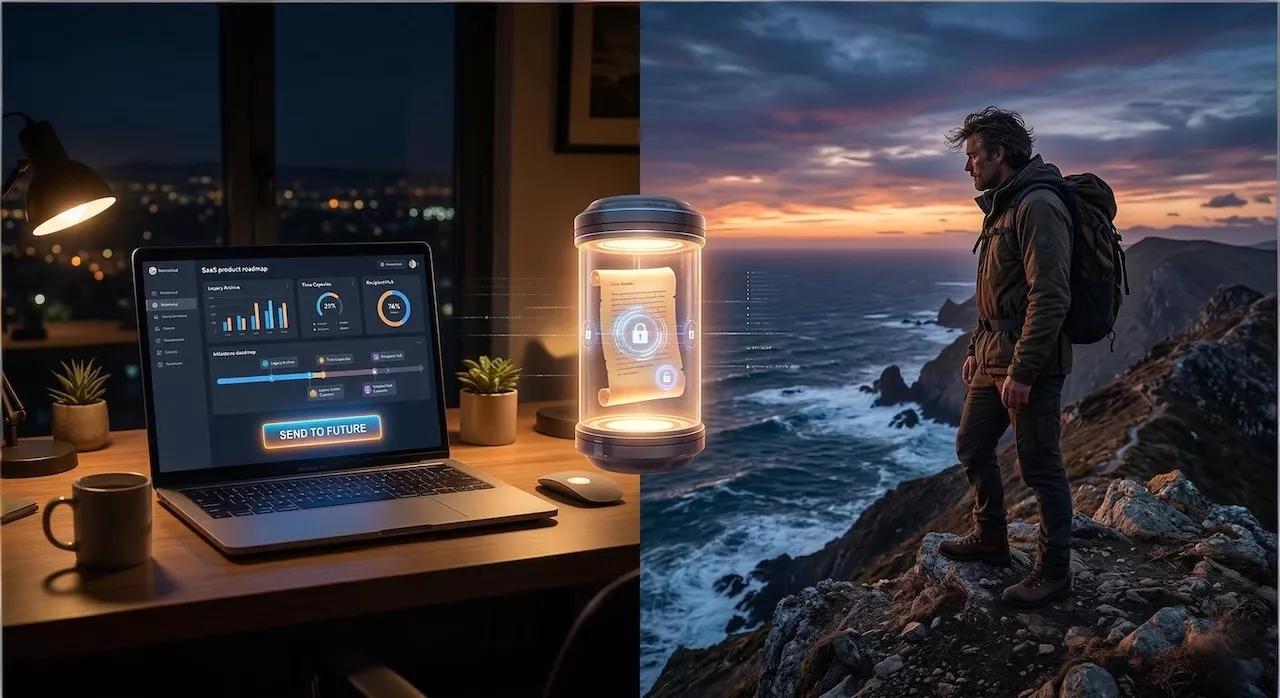
I’m a Product Manager who spends all week optimizing for the "immediate now." But getting lost off the grid on a mountain ridge made me realize I had zero infrastructure for the "forever." Here’s why I stopped worrying about conversion rates for a moment and built EterMail—a secure, tamper-proof digital time capsule for the people I love most.

The Most Radical Letter to Your Future Self Is a Promise to Stay Unfinished
The best letter to your future self isn't a memory—it's a mandate. Learn how writing to the version of you still working with love changes everything.

The Ice Tray at Midnight: On Grief, Domestic Minutiae, and the Quiet Work of Becoming Yourself Again
Why do the smallest habits hurt most after someone leaves? A reflection on grief, domestic minutiae, and the quiet moment healing finally begins.