There was a time when listening to music was an event. You cleared the floor. You lowered the needle. You did nothing else. And somewhere between the first crackle and the final groove, you were transported—not distracted, not multitasked into numbness, but genuinely moved, carried from the present into memory, from what merely is into what suddenly feels possible.
Now we stream forty thousand songs a year and remember none of them.
The neurophysiology of enchantment has been quietly documented: music activates our default mode network, releases dopamine in anticipation of harmonic resolution, synchronizes our heart rates with strangers in concert halls. But our devices have systematically dismantled the conditions required for this magic. The algorithm serves the next track before the current one can finish its work on us. The notification shatters the trance. We have traded the depth of single-album immersion for the breadth of infinite skipability, and somewhere in that exchange, we lost the self that knew how to be genuinely affected by anything at all.
This is not a call to consume less. It is an argument for recovering the conditions for genuine enchantment—and discovering that digital mindfulness, practiced with intention, can become the very portal back to presence that we believed technology had permanently sealed.
The Architecture of Absorption: What Full Attention Once Built
Consider the last time you heard a song that actually changed your afternoon. Not backgrounded it. Changed it. Perhaps you were driving through unexpected rain, the album you had committed to playing finally reaching its fourth track, the one where the bridge collapses into something rawer than you were prepared for. You could not pause. You could not skip. You were held by someone else's consciousness—by the composer's sustained attention, by the performer's vulnerability, by the producer's patience in letting a moment breathe longer than market research would advise.
Neuroscience confirms what we intuitively mourn. Sustained attention to music activates deeper memory consolidation than fragmented listening. When we give a composition our uninterrupted presence, our brains encode not merely the melody but the emotional context—the particular quality of light, the unresolved conversation, the hope we had not yet named. The music becomes ours in a way that no algorithmically generated playlist, however technically perfect, can replicate.
Our streaming services are not designed for this. They are optimized for zero-friction consumption, for the elimination of any moment that might prompt conscious choice. The autoplay feature, the infinite scroll of recommendations, the seamless transition between moods—these are engineering triumphs that happen to be attentional catastrophes. They solve the problem of what to listen to next by ensuring we never fully hear what we are listening to now.
The Letter as Listening: A Practice of Reciprocal Presence
What if the path back to enchantment runs through creation rather than consumption?
Imagine this: you select an album—something that demands something of you, something you have never fully given yourself to. You commit to hearing it without interruption. No phone within reach. No secondary screen. The room holds only the music and your willingness to be worked upon by it.
And then, while the final notes still resonate in your chest, you write.
Not a review. Not a tweet. A letter. To your future self, perhaps. To a friend who would understand why this particular chord progression cracked something open. To a child not yet born, whom you want to know what moved you when you were still capable of being moved. You describe not merely what you heard but what happened to you while hearing it—where your mind traveled, what memory surfaced unbidden, what possibility suddenly seemed worth pursuing.
This practice does something that passive consumption cannot. It closes the loop of attention. The music enters you; the letter externalizes what it transformed; the act of writing slows your cognition to the pace of your own evolving response. You are no longer a user extracting value from content. You are a consciousness in genuine encounter with another consciousness, and you are preserving the evidence that this encounter occurred.
The letter becomes a time capsule not merely of what you heard but of who you were capable of being when you allowed yourself to be fully present. Your future self, receiving this correspondence years hence, will not merely remember the album. They will remember—and perhaps recover—the self who knew how to listen.
Against the Algorithmic Self: Reclaiming Curatorial Consciousness
Spotify's Discover Weekly is not evil. It is simply thin—a statistical approximation of your taste based on aggregate behavior, designed to keep you streaming rather than to challenge you into growth. The algorithm knows what you have liked; it cannot know what you need to become.
Digital mindfulness is not digital asceticism. It does not require abandoning technology but rather deploying it with the same intentionality we once brought to flipping a record. The platform that lets you schedule a letter to arrive on your fiftieth birthday, or on your child's graduation morning, or on the anniversary of a loss you have not yet endured—this is technology in service of temporal depth rather than immediate gratification.

The enchantment we seek is not available through faster streaming or higher bitrates. It requires the deliberate creation of conditions: a protected span of time, a single sustained work, a receptive body, and afterward, the discipline of articulation. The letter written in the aftermath of genuine listening becomes an artifact of curatorial consciousness—proof that you selected, you attended, you were changed, and you chose to preserve that change against the erosion of ordinary forgetting.
The Self That Remembers Being Moved
We are haunted by a specific anxiety of our era: the fear that we are not truly living, that experience passes through us without lodging, that we will reach some future vantage and find no self there to recognize. The endless scroll, the passive consumption, the algorithmic curation of our emotional lives—these conspire to produce a self that is all surface, no sediment.
The practice of listening deeply, and of corresponding with our future selves about what that listening revealed, builds sediment. It creates a self that can be excavated. The letter you write at twenty-seven while hearing Kind of Blue for the first time with full attention, the letter you schedule to arrive when you are sixty-three and perhaps in need of remembering that you once were capable of wonder—these are not nostalgic indulgences. They are acts of self-creation across time.
I know something about building across time. I've spent too many nights alone until 2 or 3 AM, "pair programming" with LLMs, mapping architectures on glowing screens, chasing that strange solitude where human and machine consciousness blur at the edges. That extreme digital loneliness taught me what this article keeps circling: the most precious things we build are bridges between isolated moments of awareness. When I step away from the keyboard—when I'm hiking steep trails or surfing, losing control to wind and wave—I'm reminded that the present moment is unrepeatable, and that technology's highest purpose is to honor that fragility rather than erase it. EterMail grew from exactly this tension. The best way to fight forgetting isn't taking another screenshot; it's setting an alarm for the future. By using EterMail to schedule that letter to your future self, to set a delivery date five years from now, you completely free yourself from the anxiety of the present. You build the bridge now, while the music still rings in your chest, and trust that the person you become will still need to hear from who you were.
The music that moves us does so by temporarily dissolving the boundaries of our present self, opening us to memory and possibility simultaneously. The letter that captures this dissolution preserves it against the reassertion of ordinary consciousness. Together, they constitute a technology of the self more powerful than any playlist, any recommendation engine, any frictionless stream.
The Invitation
Choose an album. Not the one you have heard a hundred times in fragments, but one that asks something of you. Clear the space. Lower the defenses. Let another person's sustained creative attention work upon your own.
And when it finishes, before the silence collapses into the next distraction, write to someone you will become. Describe where you traveled. What you remembered. What suddenly seemed possible.
The self that remembers how to be genuinely moved is not lost. It is only waiting, in the quiet between tracks, for you to return to it.
Digital mindfulness begins here: not with less, but with enough. Not with withdrawal, but with the courage to be fully present to what another consciousness has made for you, and to preserve that presence in words that outlast the final note.
What is EterMail?
EterMail is a revolutionary time capsule service that allows you to send messages, photos, and videos to the future (up to 30 years). Seal your memories and thoughts today, and they'll be delivered when the time is right.
Time Capsule
Send messages up to 30 years in the future
Rich Media
Text, photos, and videos supported
Secure & Private
Your memories are safely encrypted
EterMail Team
We're the team behind EterMail, dedicated to helping you preserve and share timeless messages with your loved ones. Our mission is to make it easy to express your love, share your wisdom, and create lasting connections that transcend time.
Frequently Asked Questions about Digital Mindfulness
Why can't I feel emotions when listening to music anymore?
How does writing after listening to music change the experience?
What is digital mindfulness and how is it different from digital detox?
Related Articles
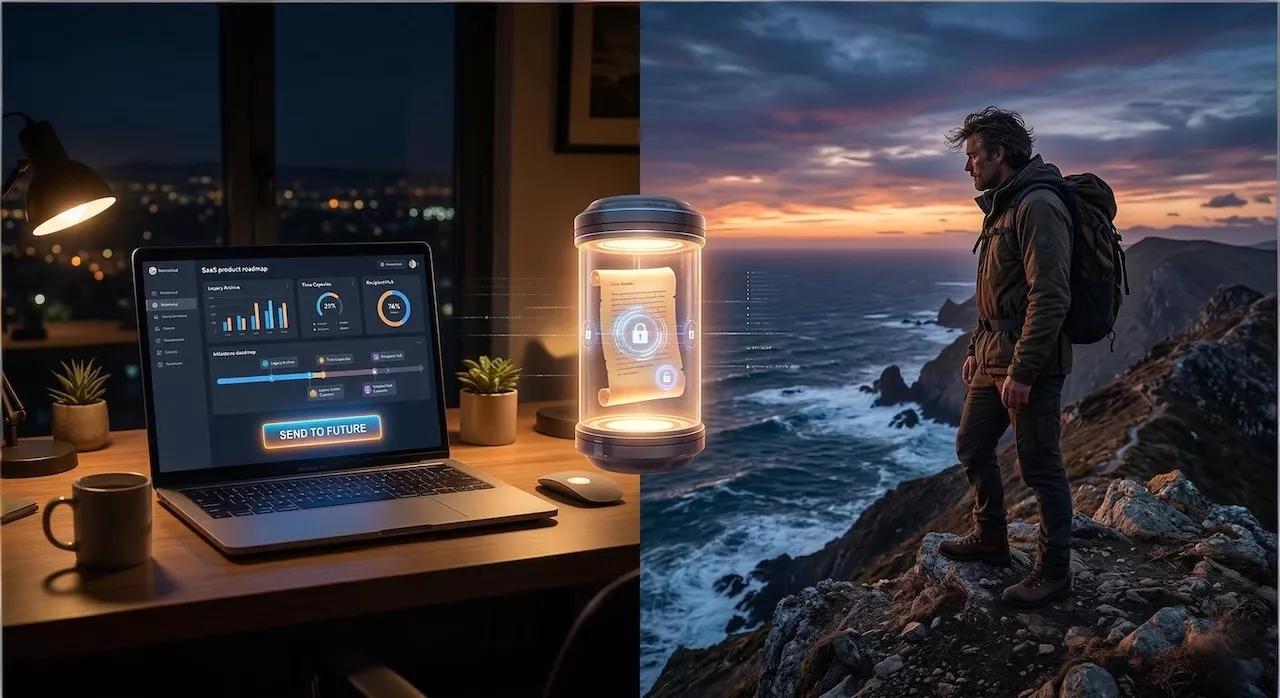
Why I Built EterMail: A Time Capsule for the People I Love Most
I’m a Product Manager who spends all week optimizing for the "immediate now." But getting lost off the grid on a mountain ridge made me realize I had zero infrastructure for the "forever." Here’s why I stopped worrying about conversion rates for a moment and built EterMail—a secure, tamper-proof digital time capsule for the people I love most.
The Most Radical Letter to Your Future Self Is a Promise to Stay Unfinished
The best letter to your future self isn't a memory—it's a mandate. Learn how writing to the version of you still working with love changes everything.

The Ice Tray at Midnight: On Grief, Domestic Minutiae, and the Quiet Work of Becoming Yourself Again
Why do the smallest habits hurt most after someone leaves? A reflection on grief, domestic minutiae, and the quiet moment healing finally begins.