There is a moment, just before you hit send, when your finger hovers over the glowing rectangle. You have spotted the error—a "their" where "there" should live, a sentence that wanders like a drunk through syntax, a thought so naked it makes your chest tight. The backspace key pulses. Delete. Fix. Polish until the edges cannot cut anyone, including yourself. This is the ritual of digital self-erasure we perform dozens of times daily, and we have become so skilled at it that we no longer notice the cost: we are editing ourselves out of existence.
The Invisible Architecture of Digital Perfection
Consider what happens when you compose any message now. Autocorrect lunges for your misspellings before your eyes can even register them. Grammar engines suggest smoother, safer sentences. Predictive text finishes your thoughts in words that are not quite yours—more efficient, more generic, more dead. The infrastructure of modern communication was built not to amplify human voice but to sanitize it, to produce output so frictionless it could have come from anywhere, anyone, or no one at all.
We have traded the tremor of uncertainty for the flatline of competence. A colleague's Slack message arrives with surgical precision. A friend's Instagram caption gleams with wit that took seventeen drafts. Even our arguments have become too articulate, rehearsed in group chats before deployment, stripped of the stutter that might have revealed something true beneath the performance. The internet has become a museum of human communication where all the exhibits have been restored beyond recognition.
This is not a Luddite's lament. The tools themselves are neutral. What demands examination is our relationship to them—the automatic assumption that cleaner is better, that our raw signals require filtering before they deserve transmission. We have internalized an aesthetic of digital perfection so completely that we experience our own unedited thoughts as embarrassing, as failures of presentation rather than evidence of life.
The Radical Act of the Unsent Draft
I keep a folder of abandoned messages. Not the ones I sent and regretted, but the ones I almost sent and revised into something else entirely. There is the email to my father from three years ago that began "I don't know how to say this without sounding like a child" and ended, after forty minutes of revision, as a breezy check-in about his garden. There is the text to a friend at 2 AM—"I think I am not the person anyone thinks I am"—that became "haha can't sleep, you?" There is the proposal I never made, the apology I softened beyond meaning, the love I qualified until it qualified as nothing.
Each revision was a small death. Each polished sentence, a burial.
The philosopher Byung-Chul Han writes about the burnout society, the achievement subject who exploits themselves with such efficiency that no outside force is necessary. I think we have become achievement subjects of intimacy, optimizing our emotional output for maximum reception, minimum risk. We are our own worst editors because we have learned that vulnerability, in its raw form, is a liability in systems designed for engagement metrics.
But here is what I have come to believe, slowly, through the accumulated weight of these abandoned drafts: the typo is the last biometric of the soul.
Reading the Tremor: Why Imperfection Communicates What Perfection Cannot
A handwritten letter arrives with its own archaeology. The pen pressed harder here, where the writer paused to breathe. The ink pooled where emotion outpaced motor control. The crossed-out word, the marginal addition, the place where handwriting deteriorates into something closer to drawing—these are not flaws to be forgiven but data to be read. They constitute a kind of emotional telemetry, a record of consciousness in motion rather than its final report.
Digital communication has no equivalent—or rather, it had none, until we began to notice what disappears. The "typing" indicator that flickers and stalls while someone finds courage. The message that appears, disappears, appears again slightly altered. The voice note with audible swallowing, background noise, the caught breath before confession. These are the residues of human process in systems designed to eliminate process entirely.
Digital mindfulness begins with the decision to preserve these residues rather than scrub them clean. It is the conscious choice to let your first draft stand as testimony to your thinking, not merely your thoughts. It is the recognition that the person who receives your unedited voice is receiving something that no algorithm can generate: evidence of your existence at a specific moment, with all the uncertainty and urgency that implies.
The Time Capsule as Witness: Writing for Someone Who Will Know You Differently
There is a particular intimacy in addressing someone who does not yet exist in the form they will occupy when your words reach them. The child who will open a letter on their eighteenth birthday. The spouse who will read your words on a future anniversary, perhaps after years of shared history have rewritten both of you. The self who will surface this message from digital depths, disoriented by how much and how little has changed.
These recipients do not need your polish. They need your presence. The future self opening a time capsule does not want to encounter a brand manager's version of who you were. They want the person who stayed up too late, who worried about money, who could not name the feeling that sat behind their sternum like a stone. They want the syntax that broke under weight, the metaphor that did not quite land, the confession that arrived with a typo because your hands were shaking.
This is why the architecture of preservation matters. A platform built for digital mindfulness must resist the temptation to improve what it stores. It must protect the raw file, the first take, the message sent in one breath without review. Encryption here serves not just privacy but authenticity—ensuring that what you felt in the moment of composition survives unaltered by later versions of yourself, unfiltered by systems that would smooth your edges into marketable shapes.
The Courage of Single-Draft Intimacy
I have been practicing something I call single-draft intimacy. Not with everyone, not always—there are contexts that demand precision, professional communications where clarity serves mutual understanding. But in the letters that matter, the ones that will outlast the transaction, I am learning to send what I wrote the first time, typos included, trusting that the recipient will hear the living voice beneath the surface errors.
The first time I did this deliberately, I was writing to my daughter for a time capsule she will receive when she turns twenty-five. I wrote about my fear of dying before I could know her as an adult, about the particular way she laughed at three that I already could not fully recall, about my suspicion that I was failing in ways I could not yet perceive. I found three typos after sending. I found a sentence that wandered into territory I had not intended. I found, in short, myself—not the self I would have constructed with infinite revision, but the self who existed in the twenty minutes of composition, vulnerable and uncertain and present.
She will know, when she reads this, that I was real. That I did not know the ending. That I loved her enough to send something imperfect rather than risk sending nothing at all.
Reclaiming the Human Signature in Digital Space
The "typo vibe shift" is not about abandoning care for communication. It is about redefining what care means. Care can be the labor of polishing until no rough surface remains. Or it can be the courage to let your rough surfaces show, to trust that the people who matter will recognize them as topography rather than error.
We are living through a strange inversion: machines have become capable of flawless prose while humans, increasingly, produce only the pre-edited and the safe. The result is a kind of uncanny valley of communication, where everything reads as competent and nothing reads as true. Digital mindfulness is the practice of climbing out of this valley, of choosing the specific over the optimized, the trembling over the steady, the typo over the algorithmic completion.
The letter you write in one sitting, sent without revision, preserved with encryption that ensures it reaches its destination exactly as composed—this is not carelessness. It is a form of faith. Faith that your unedited voice carries frequencies that polished prose cannot. Faith that the future recipient wants your presence more than your performance. Faith that being fully seen, even in your errors, is the foundation of any intimacy that deserves the name.
The Impermanent Web and the Eternal Letter
There is a deeper anxiety beneath our perfectionism. We know, at some level, that digital communication is evanescent. Servers fail. Platforms disappear. The careful construction of our online selves dissolves like smoke when the service ends or the account is deleted. In this context, the polished post, the curated thread, the perfect reply—all of it feels increasingly weightless, performed for an audience that will scroll past and forget.
But the letter written to a specific future, preserved against that evanescence, carries a different gravity. It does not seek engagement. It seeks survival—not viral survival, but human survival, the continuation of a voice across time in a form that can be returned to, re-read, held. The typo in such a letter becomes a kind of proof of life, a fingerprint that says: this was composed by a consciousness that could not see the future, that fumbled, that tried anyway.
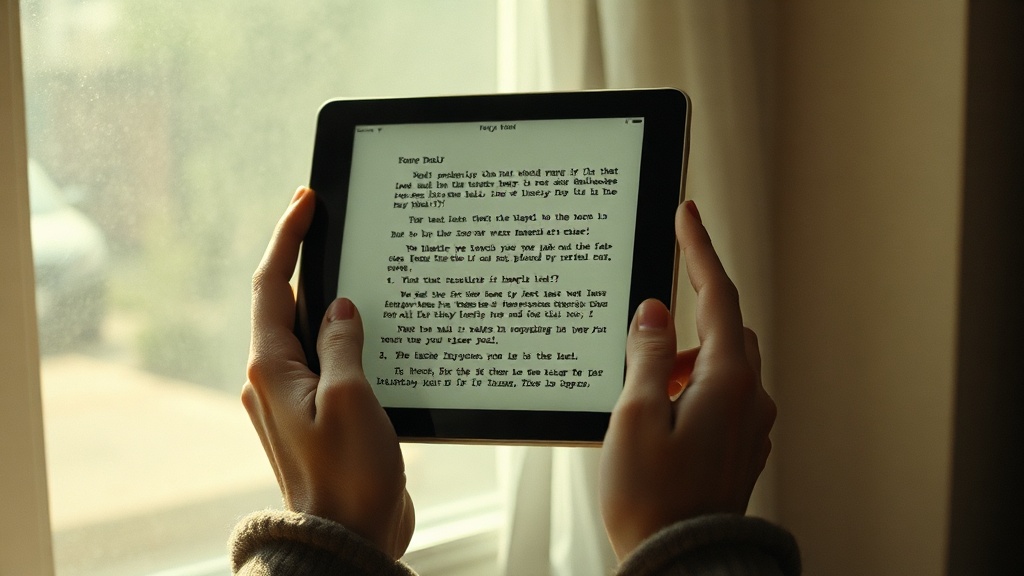
I spend a lot of nights alone with glowing screens. Not the performative loneliness of social feeds, but the real solitude of building—mapping architectures, wrestling with APIs, watching server deployments fail at 2 AM before they finally catch. I am a serial entrepreneur in Silicon Valley; I have built in e-commerce, in games, now in SaaS. I know what it means to construct something from nothing, to believe that code can bridge impossible distances. And I know, too, what it costs to always be polishing, to treat every output as a product rather than a pulse. The Matrix fantasy of uploading consciousness, of building a bridge between physical and digital selves—that dream only matters if what crosses the bridge is actually you, not a compressed, optimized, market-ready version. EterMail is the digital spaceship I built to traverse the dimension of time, because I wanted to send my unedited self into the future and know it would arrive intact.
This is exactly why I obsessed over end-to-end encryption and extreme server redundancy when building EterMail. Because I know that a letter written to the future needs to be guarded even more fiercely than a bank password. The raw file, the first take, the message sent in one breath without review—this is what I wanted to protect. Not because it is perfect, but because it is proof.
Digital mindfulness is, finally, a practice of mortality. We edit ourselves because we want to live forever in perfect form. We preserve our errors because we accept that we will not, and that the record of our trying is worth more than any illusion of our succeeding.
The backspace key will always pulse. The grammar engine will always suggest. The choice—to polish or to preserve, to perform or to present—belongs to us, moment by moment, message by message. What we choose accumulates into the evidence we leave behind: of a life lived in anxious perfection, or of one lived with the courage to be seen as we were, fumbling, real, here.
Your future self is waiting. Your future child, your future spouse, the person you will become who needs to know who you were. Send them something they cannot get from any algorithm. Send them the draft you wrote in one breath, typos and all. Send them proof that you were here, thinking, trembling, alive.
What is EterMail?
EterMail is a revolutionary time capsule service that allows you to send messages, photos, and videos to the future (up to 30 years). Seal your memories and thoughts today, and they'll be delivered when the time is right.
Time Capsule
Send messages up to 30 years in the future
Rich Media
Text, photos, and videos supported
Secure & Private
Your memories are safely encrypted
EterMail Team
We're the team behind EterMail, dedicated to helping you preserve and share timeless messages with your loved ones. Our mission is to make it easy to express your love, share your wisdom, and create lasting connections that transcend time.
Frequently Asked Questions about Digital Mindfulness
What is digital mindfulness and why does it matter?
How can I practice being more authentic in my digital communication?
Why should I preserve my mistakes and unpolished thoughts for my future self?
Related Articles
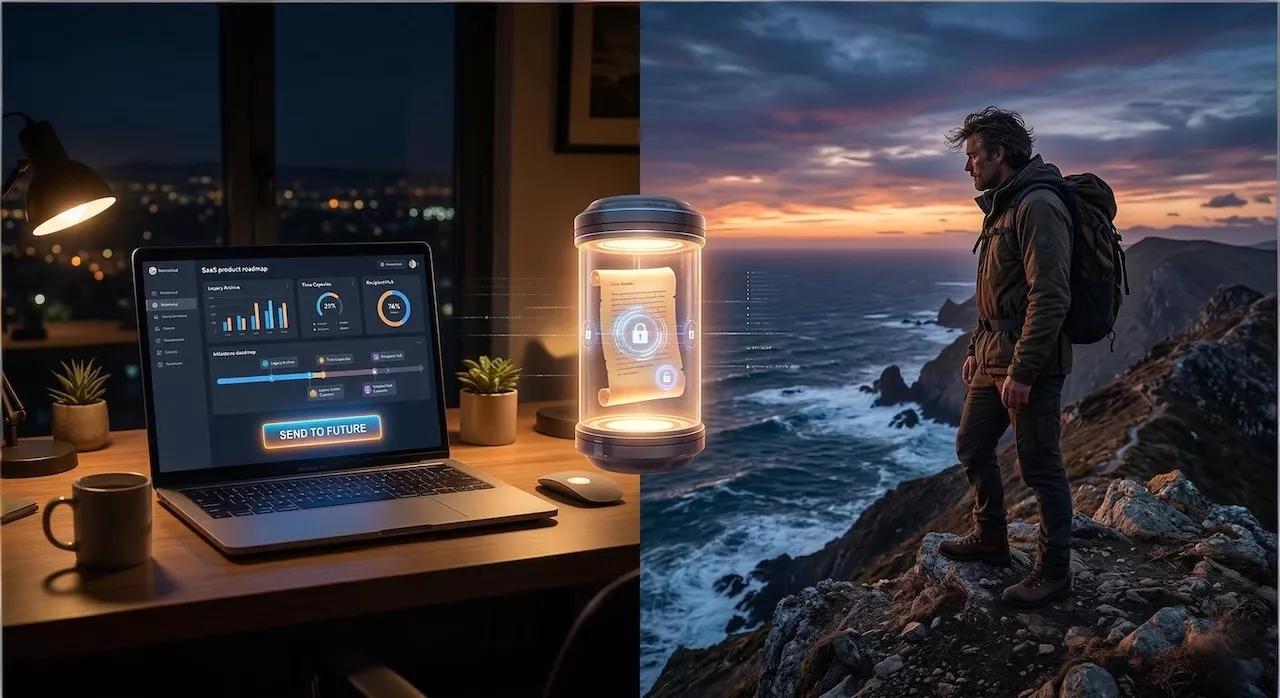
Why I Built EterMail: A Time Capsule for the People I Love Most
I’m a Product Manager who spends all week optimizing for the "immediate now." But getting lost off the grid on a mountain ridge made me realize I had zero infrastructure for the "forever." Here’s why I stopped worrying about conversion rates for a moment and built EterMail—a secure, tamper-proof digital time capsule for the people I love most.
The Most Radical Letter to Your Future Self Is a Promise to Stay Unfinished
The best letter to your future self isn't a memory—it's a mandate. Learn how writing to the version of you still working with love changes everything.
The Ice Tray at Midnight: On Grief, Domestic Minutiae, and the Quiet Work of Becoming Yourself Again
Why do the smallest habits hurt most after someone leaves? A reflection on grief, domestic minutiae, and the quiet moment healing finally begins.