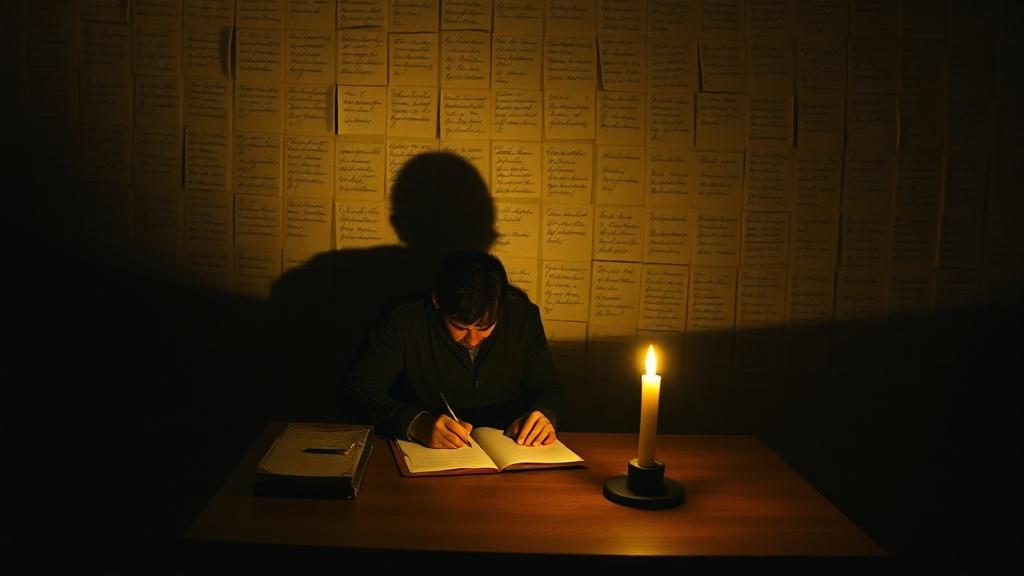
The Moment You Realize Your Voice Has No Paper Trail
Last month, a novelist I admire admitted that she'd used an AI tool to revise a single paragraph in her memoir. The confession detonated across literary Twitter with the fury usually reserved for plagiarism or fraud. Commenters parsed her syntax like forensic linguists, hunting for the tell—the slightly too-smooth transition, the metaphor that landed too cleanly. She had written 99% of the book herself, but that single paragraph became the story. The scandal wasn't about what she had done. It was about what we could no longer prove she hadn't.
This is the confusion we are living through now. Not the fear that machines will replace human writing, but the deeper vertigo of realizing that human writing no longer carries its own evidence of humanity. Every word you type exists in a system that is already training itself to doubt you.

The Detection Arms Race Is a Distraction
The technology press loves to cover AI detection tools as if they represent a solution. Turnitin promises to flag synthetic student essays. Watermarking schemes propose invisible signatures in generated text. Startups raise millions to build the "Shazam for ChatGPT." But this framing conceals a more unsettling truth: the project of proving authenticity is itself an act of taking custody of your voice.
When a platform scans your message to verify it is "human," it is not protecting your authorship. It is creating a database of your stylistic patterns, your syntactic tics, your emotional rhythms. The proof that you are real becomes a profile that someone else owns. And that profile, like everything else in the platform economy, can be sold, breached, or simply deleted when the business model changes.
Consider what we have already normalized. Your most intimate messages—late-night confessions to a partner, raw grief sent to a friend, the letter you drafted to your mother and never sent—pass through servers that mine them for advertising signals, train language models on their patterns, and reserve the right to scan their contents for "safety." The AI writing scandal is not a new invasion. It is the moment we finally noticed that the invasion had already succeeded, that our words were already being treated as data rather than testimony.
The Metadata of Memory
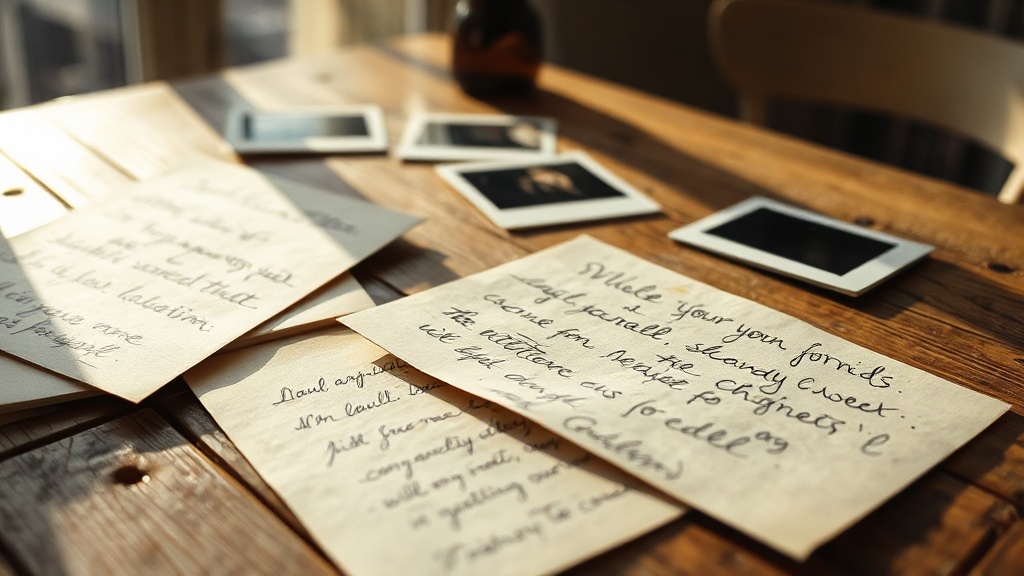
There is a peculiar loneliness to digital communication that we rarely acknowledge. A handwritten letter carries material proof of its origin: the pressure of the pen, the particular blue of the ink, the paper chosen, the stamp licked and placed. These are not sentimental details. They are forensic evidence of a specific person, at a specific moment, making a specific choice. The letter says: I was here. This is how my hand moved. This is what I cared enough to commit to physical form.
Digital messages strip away this metadata of presence. An email from 2019 looks identical to one sent yesterday. The platform may record timestamps and IP addresses, but these are administrative facts, not human ones. They do not capture the hesitation before sending, the three drafts deleted, the decision to write at 2 AM because sleep felt impossible. When authenticity becomes contested—as it now inevitably will—we have no artifact to present in our own defense.
This matters beyond scandal. It matters for how we remember ourselves. The journal you kept at nineteen, even if embarrassing, bears the unmistakable marks of your nineteen-year-old mind: the overuse of certain adjectives, the grandiose conclusions, the misspellings that suggest speed and urgency. These imperfections are not flaws to correct. They are the texture of consciousness evolving, the record of who you were becoming. A future self reading them recognizes their author not through stylistic verification but through the shock of familiar awkwardness, the intimate recognition of a mind you have since outgrown but still inhabit.
When Verification Replaces Trust
The deeper danger of the AI writing confusion is philosophical. We are building systems that substitute verification for trust, that treat human expression as a problem to be solved rather than a relationship to be entered. This is not merely about technology. It is about what kind of social world we want to inhabit.
Trust, in its healthiest form, operates on a different logic than proof. When a friend tells you they are struggling, you do not demand cryptographic verification of their emotional state. When a parent writes to a child, the value of the message lies not in its stylistic uniqueness but in the history of care it emerges from. The question "did a human write this?" is already the wrong question. The right question is: does this communication preserve the conditions for genuine human encounter, or does it reduce both parties to nodes in a verification system?
Yet here we are, constructing exactly that system. The same platforms that profit from our attention now promise to authenticate our expression, as if the two projects were compatible. They are not. A system designed to maximize engagement will inevitably degrade the conditions for authentic communication, then sell you tools to repair the damage it has caused. The AI detection feature is the second product. The first product was the attention economy that made us doubt each other in the first place.
Reclaiming Custody of Your Voice
What would it mean to hold your own words with the dignity they deserve? Not as content to be optimized, not as data to be verified, but as the ongoing record of a consciousness navigating time?
This requires thinking differently about where and how we write. The cloud is convenient, but convenience has become the ideology that justifies every extraction. When your words exist only on platforms that reserve the right to read, modify, or delete them, you have accepted a form of tenancy in your own inner life. The terms of service are the landlord, and the landlord can change the locks.
There is a stubborn, almost political act in choosing to write outside these systems. To compose a message knowing it will not be scanned for advertising relevance. To save a letter in a form that does not depend on a company's quarterly earnings. To create a record of your thinking that remains yours to release, on your own schedule, to the people you choose.
The Time Capsule as Authenticity Strategy
Some of the most human writing we do is addressed to futures we cannot yet imagine. The letter to your child on their eighteenth birthday, written when they are still learning to read. The message to your future self, composed in the raw aftermath of a decision whose consequences remain unknown. The words you prepare for a partner decades from now, trusting that the love will persist even as the people transform.
These writings have a peculiar relationship to authenticity. They cannot be verified in advance. They exist in a space of commitment, of promised presence across time. Their value lies precisely in their resistance to immediate consumption and algorithmic analysis. They are not content. They are covenant.
This is why the architecture of how we preserve such messages matters so deeply. A time capsule buried in your backyard carries obvious risks—flood, forgetfulness, the slow decay of materials—but it also carries an equally obvious integrity. The risks are your risks. The preservation is your act of care. No platform's bankruptcy can dissolve it. No terms of service update can redefine its meaning.
The digital equivalent requires similar intentionality. End-to-end encryption, time-locked release, user-controlled keys: these are not technical fetishes but the structural conditions for maintaining custody of your own voice. When you write a message that no one—not even the service that stores it—can read until the moment you designated, you have created a small zone of autonomy in an otherwise captured landscape. The message remains suspect to no verification system. It simply waits, intact, for the future you chose.
The Scandal Is Not the Machine. It Is the Forgetting.
I spend a lot of nights alone with screens. Not the performative loneliness of social media, but the real kind—just me, a cursor blinking at 2:47 AM, trying to build something that outlasts the session. I've been that way since I started coding: the obsessive pull of making a thought concrete, of turning an abstraction into something another person might encounter later. There's a particular flavor of solitude to it, one that feels less like isolation and more like preparing a message in a bottle, then trusting the ocean to deliver it.
But the ocean I know is servers and APIs, redundancy zones and encryption protocols. I've spent years in that world, building things that scale, that optimize, that capture attention. And I've come to distrust it. Not the technology itself, but the economic logic that wraps around it—the same logic that treats your midnight confession as training data, your grief as an engagement signal, your voice as a problem to be authenticated rather than a presence to be preserved.
The deeper scandal—the one that will not resolve with better detection tools—is our collective amnesia about what it meant to hold words with care. To write slowly, knowing the recipient would read slowly. To preserve a message because its physical existence mattered. To trust in the accumulated context of a relationship rather than demand real-time verification of every exchange.
The AI writing confusion is ultimately a confusion about value. We have built systems that treat communication as friction to be reduced and authenticity as a classification problem to be solved. In doing so, we have made it harder to recognize the slower, more fragile forms of human expression—the ones that do not scale, that resist optimization, that only make sense within the long arc of a life shared with others.
Your words deserve better than suspicion. They deserve witnesses who will receive them in good faith, archives that will preserve them without claiming ownership, and futures that will read them with the generosity of context.
What We Choose to Save
The best way to fight forgetting isn't taking another screenshot; it's setting an alarm for the future. I've thought about this a lot, in those late hours when I'm mapping architectures or pair-programming with an LLM until the sky goes gray—what it means to build something that genuinely protects the fragile, unrepeatable act of human expression across time.
This is exactly why I obsessed over end-to-end encryption and extreme server redundancy when building EterMail. Because I know that a letter written to the future needs to be guarded even more fiercely than a bank password. The teenager hesitating before every sentence, wondering if their natural voice sounds "real enough." The parent who wants to write something lasting for a child but cannot find any container they trust. The elderly person watching decades of digital correspondence evaporate because a service discontinued, a password failed, a company pivoted. These are the people I built for. Not to authenticate them, but to give them a space where authentication becomes irrelevant—where a message can simply wait, unread by any system, until the exact moment its author chose.
Their confusion is the real scandal. And it will not be solved by better detection. It will be solved by rebuilding the material and ethical conditions for words to be held in trust—by the people who wrote them, for the people they were written for, across the distances that time always creates.
Your voice is not a problem to authenticate. It is a presence to preserve. The question is simply: who holds the proof that you were here, and what will they do with it?
What is EterMail?
EterMail is a revolutionary time capsule service that allows you to send messages, photos, and videos to the future (up to 30 years). Seal your memories and thoughts today, and they'll be delivered when the time is right.
Time Capsule
Send messages up to 30 years in the future
Rich Media
Text, photos, and videos supported
Secure & Private
Your memories are safely encrypted
EterMail Team
We're the team behind EterMail, dedicated to helping you preserve and share timeless messages with your loved ones. Our mission is to make it easy to express your love, share your wisdom, and create lasting connections that transcend time.
Frequently Asked Questions about Digital Privacy & Security
How can I protect my personal writings from being used to train AI models?
What makes a digital message feel authentically human to its recipient?
Why are handwritten letters still meaningful in an age of instant digital communication?
Related Articles

Why I Built EterMail: A Time Capsule for the People I Love Most
I’m a Product Manager who spends all week optimizing for the "immediate now." But getting lost off the grid on a mountain ridge made me realize I had zero infrastructure for the "forever." Here’s why I stopped worrying about conversion rates for a moment and built EterMail—a secure, tamper-proof digital time capsule for the people I love most.

The Most Radical Letter to Your Future Self Is a Promise to Stay Unfinished
The best letter to your future self isn't a memory—it's a mandate. Learn how writing to the version of you still working with love changes everything.

The Ice Tray at Midnight: On Grief, Domestic Minutiae, and the Quiet Work of Becoming Yourself Again
Why do the smallest habits hurt most after someone leaves? A reflection on grief, domestic minutiae, and the quiet moment healing finally begins.