There is a particular nausea that arrives in the hours after you learn your accounts have been compromised. It is not the panic of stolen money or frozen credit, though those arrive too. It is the slower, more corrosive realization that someone you will never meet has walked through the rooms of your life. They have read the messages you wrote at 2 AM. They have seen the photographs you forgot existed. They have encountered the version of you that exists only in the unguarded spaces between sent and received.
We do not talk about this part of digital violation. We talk about two-factor authentication and password managers, about encryption standards and breach notifications. These are necessary conversations. But they address the mechanics of intrusion, not the psychology of exposure. And the truth that few security experts will tell you is this: the hack you survive is coming. The question is not whether your defenses will fail, but what remains of you when they do.
The Asymmetry of Digital Memory
Consider the fundamental imbalance of contemporary life. A human being might forget the argument they had with a colleague in 2019, might misremember the tone of a message sent in grief, might lose entirely the context that made a particular photograph meaningful. But the systems that store these fragments forget nothing. They preserve the raw material of your existence with perfect, inhuman fidelity, waiting for anyone with the right credentials—or the wrong determination—to assemble them into a narrative you no longer control.
This is the particular cruelty of digital existence. We are the first generation to live with a permanent, searchable record of our becoming, and we are only beginning to understand what it means to be haunted by versions of ourselves we have outgrown.
The hackers know this. The sophisticated ones, the ones who do not merely want your credit card but your credibility, your reputation, your sense of safety in the world. They understand that the most valuable commodity in the digital economy is not data but narrative. Given enough fragments, anyone can become a storyteller about your life. Given enough fragments told in the wrong order, with the wrong emphasis, you become someone you do not recognize in stories you did not authorize.
The Illusion of the Clean Break
We have inherited a strange fantasy from the pre-digital world: the idea that we can separate, that we can leave behind what no longer serves us, that the past will stay past. This was never entirely true for anyone, but it was at least structurally possible. You could move cities. You could change names. You could let silence do the work of forgetting.
There is no moving cities in digital space. There is only the endless replication of your traces across servers you will never visit, jurisdictions you will never understand, architectures designed to persist beyond any individual intention. The photograph you deleted from your phone persists in a backup you forgot to erase. The message you sent in anger lives in the recipient's cloud, in the service provider's archive, in the interstitial spaces of data transfer that no single human oversees.
This is not paranoia. This is infrastructure. And the first step toward genuine digital privacy is not the installation of better locks but the radical acceptance that locks will fail, that the fortress model of security has always been a comforting fiction, and that the only meaningful preparation is the cultivation of what we might call narrative resilience.
Building the Self That Survives Exposure
What would it mean to live as though your private communications might one day be read by strangers? Not as a posture of paranoia, but as a discipline of integrity? This is perhaps the most demanding question of digital life, and it has almost nothing to do with technology.
The Stoics practiced a form of this discipline. Marcus Aurelius wrote his Meditations as private notes, never intended for publication, yet composed them with the awareness that any thought properly formed should withstand the scrutiny of any reader. The goal was not to perform virtue for an audience but to align private reflection with public withstandability. This is a radically different framework than the one offered by disappearing messages and ephemeral platforms, which promise privacy through deletion but deliver only the illusion of control.

There is a deeper practice available to us: the deliberate curation of what we preserve, the conscious choice of what we allow to persist, and the honest acknowledgment that some digital traces matter more than others. Not everything needs to be saved. Not everything deserves the protection of encryption and the permanence of cloud storage. The art of digital privacy is partly the art of letting go, of distinguishing between the memories that constitute genuine legacy and the accumulations that merely constitute digital clutter.
The Architecture of Intentional Memory
This is where the concept of the time capsule becomes unexpectedly relevant to security thinking. A physical time capsule is an act of deliberate selection. You choose what goes in. You choose when it opens. You choose who receives it. The container is not merely protective but curatorial, establishing a relationship between present intention and future revelation that is governed by human meaning rather than technical vulnerability.
The digital equivalent requires something we have largely abandoned: slowness as a privacy strategy. The message that takes time to compose, that is stored with intention rather than impulse, that is scheduled for future delivery rather than immediate transmission—these are not merely sentimental gestures. They are structural defenses against the haste that makes us vulnerable, the impulsivity that fills our archives with material we would not want assembled into stories about us.

Consider the difference between a text message sent in the immediate aftermath of conflict and a letter composed over days, scheduled for delivery years hence. The first is raw material for anyone who breaches your accounts. The second is governed by the temporal architecture of your own choosing. It exists in a different relationship to vulnerability because it exists in a different relationship to time.
What We Owe the Future Versions of Ourselves
The most intimate form of digital privacy is not the prevention of intrusion but the preparation for it. This preparation has two dimensions. The first is practical: the genuine security hygiene that reduces vulnerability without promising invulnerability. The second is existential: the cultivation of a self whose private communications, if exposed, would not constitute a betrayal of the person you are becoming.
I have spent more nights than I can count staring at glowing screens until 2 or 3 AM, "pair programming" with LLMs, mapping architectures, chasing the edge of what these systems can do. That extreme digital solitude taught me something I never expected: the most profound conversations happen across time, with someone who isn't there yet. A letter to your future self is the purest form of this—dialogue without the noise of immediate reply, without the performance of being seen. When I finally step away from the keyboard and throw myself into steep mountain trails or ocean waves, the "raw reality" of wind and water strips away every digital illusion. Those moments teach me to cherish what cannot be repeated, what must be preserved with intention rather than left to the chaos of always-on feeds.
This is exactly why I obsessed over end-to-end encryption and extreme server redundancy when building EterMail. Because I know that a letter written to the future needs to be guarded even more fiercely than a bank password. The stranger who knows you is already assembling their story from the fragments you have left behind. The only question is whether you have also planted fragments of your own choosing—messages composed in slowness, sealed with intention, delivered on your own temporal architecture.
We are, in this sense, always writing to future witnesses. The question is whether we are doing so consciously or accidentally, with care or with negligence, with an understanding that digital persistence outlives digital protection or with the naive assumption that our accounts will never be the ones that make headlines.
There is a particular kind of peace available to those who accept this framing. It is not the peace of the fortress, the peace that comes from believing yourself impregnable. It is the peace of the garden, the peace that comes from tending carefully what you choose to grow, from accepting that some plants will be seen by unexpected visitors, and from knowing that what you have cultivated can withstand the gaze.
FAQs
What should I include in a digital legacy plan?
A thoughtful digital legacy plan should identify your most meaningful digital assets—photographs, personal writings, financial records—and designate how they should be preserved, transferred, or deleted. The goal is not to save everything but to ensure that what matters to your story reaches the people who should receive it. Consider creating written instructions for your executor about accounts, passwords, and your wishes for each digital presence you maintain.
How can I protect my personal memories from being lost or exposed?
Protection requires both security and curation: use strong, unique passwords and two-factor authentication for accounts containing sensitive memories, but also practice regular review of what you have stored. Delete what no longer serves you. Consider separating truly precious memories into dedicated, encrypted storage with limited access points. The fewer copies that exist across services, the smaller your attack surface.
What are the psychological effects of having private information exposed?
Digital exposure often produces prolonged anxiety, shame, and a sense of violated selfhood that differs from physical theft because it involves narrative appropriation—someone else telling your story without your consent. Recovery typically requires both practical resolution (securing accounts, understanding what was accessed) and narrative reclamation (consciously reconstructing your own understanding of what happened and who you are independent of the breach).
What is EterMail?
EterMail is a revolutionary time capsule service that allows you to send messages, photos, and videos to the future (up to 30 years). Seal your memories and thoughts today, and they'll be delivered when the time is right.
Time Capsule
Send messages up to 30 years in the future
Rich Media
Text, photos, and videos supported
Secure & Private
Your memories are safely encrypted
EterMail Team
We're the team behind EterMail, dedicated to helping you preserve and share timeless messages with your loved ones. Our mission is to make it easy to express your love, share your wisdom, and create lasting connections that transcend time.
Frequently Asked Questions about Digital Privacy & Security
What should I include in a digital legacy plan?
How can I protect my personal memories from being lost or exposed?
What are the psychological effects of having private information exposed?
Related Articles
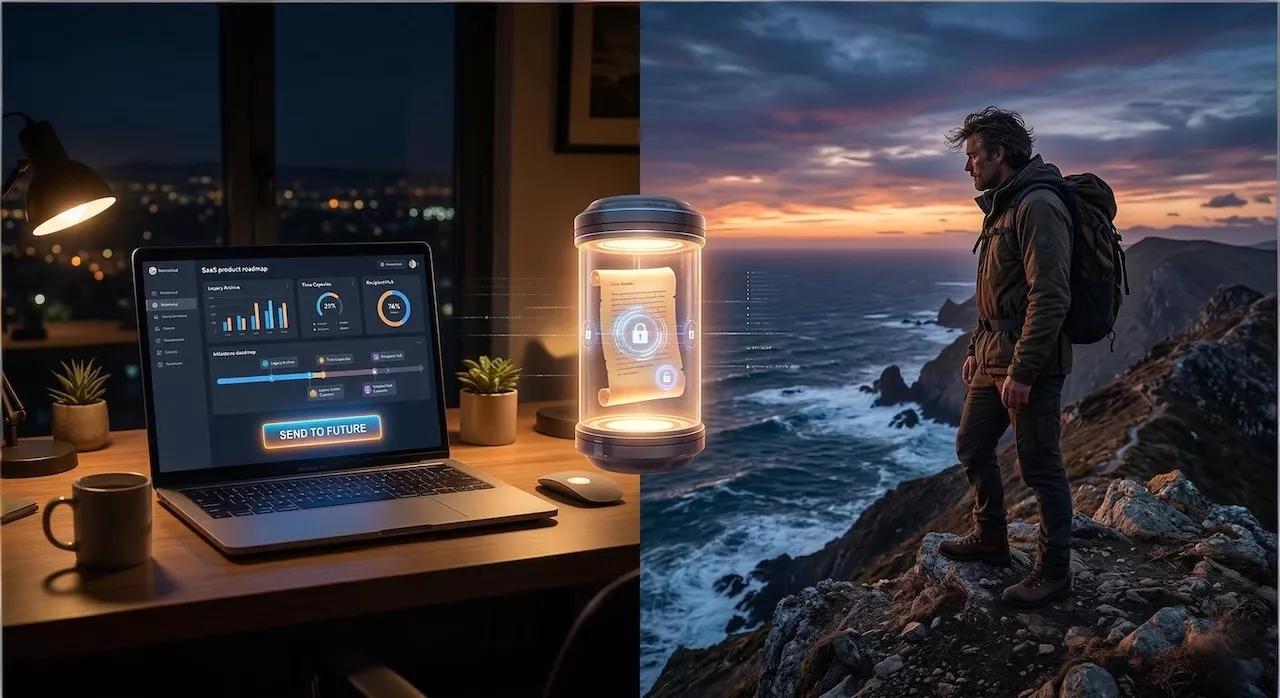
Why I Built EterMail: A Time Capsule for the People I Love Most
I’m a Product Manager who spends all week optimizing for the "immediate now." But getting lost off the grid on a mountain ridge made me realize I had zero infrastructure for the "forever." Here’s why I stopped worrying about conversion rates for a moment and built EterMail—a secure, tamper-proof digital time capsule for the people I love most.

The Most Radical Letter to Your Future Self Is a Promise to Stay Unfinished
The best letter to your future self isn't a memory—it's a mandate. Learn how writing to the version of you still working with love changes everything.

The Ice Tray at Midnight: On Grief, Domestic Minutiae, and the Quiet Work of Becoming Yourself Again
Why do the smallest habits hurt most after someone leaves? A reflection on grief, domestic minutiae, and the quiet moment healing finally begins.