The Question That Haunts the Servers
Late one night, scrolling through decade-old photos I didn't remember uploading, I found a version of myself I barely recognized. Not younger, exactly—just unfiltered. The unguarded comments. The locations I checked into without thinking. The relationships I documented in real-time, before they became painful to recall. All of it preserved with perfect, indifferent fidelity, waiting to be surfaced by some algorithm's whim.
Friedrich Nietzsche proposed a thought experiment he called the eternal return: imagine that your life, exactly as you've lived it, will repeat itself infinitely. Every joy, every humiliation, every mundane Tuesday—forever. The test, he suggested, was whether you could embrace this fate. Whether you could say yes to it.
What Nietzsche couldn't have anticipated was how literally his metaphor would manifest. Your digital life is already living its own eternal return. Every search query, every late-night purchase, every message sent in anger or grief—stored, replicated, backed up across continents. The servers don't judge. They don't forget. They simply preserve, with mechanical patience, a version of you that you may not have consented to become permanent.
The Architecture of Digital Permanence
We built this system without fully understanding what we were constructing. The early internet promised liberation from physical constraints—information wants to be free, we were told. What we received instead was a kind of unintentional immortality, distributed across infrastructure we neither own nor control.
Consider the mathematics of digital persistence. A single tweet, stored across multiple data centers, backed up to tape archives, cached by third-party services, screenshot by strangers—exists in perhaps fifty or more locations within minutes of posting. Delete the original, and dozens of copies remain. Your "right to be forgotten" collides with the technical reality of distributed systems designed for durability, not discretion.
This isn't paranoia. It's engineering. The same redundancy that protects your photos from hardware failure also prevents their complete erasure. The platforms you use don't merely store your data; they derive value from its persistence. Your past behaviors train predictive models. Your historical locations improve mapping algorithms. Your emotional expressions refine sentiment analysis. You are, in a very real sense, working for these systems long after you've stopped actively engaging with them.
The philosophical weight of this arrangement becomes clearer when we ask: who benefits from your digital eternal return? Not you, certainly—not in any way you've chosen. The beneficiaries are corporations building profiles, governments conducting surveillance, criminals harvesting identities, and future versions of yourself who may deeply regret what present-you made accessible.
The Asymmetry of Digital Memory
Human memory is merciful. It degrades, reconfigures, softens. We remember the gist of humiliation, not its precise texture. We reconstruct arguments in ways that flatter our evolving self-conception. This isn't dishonesty—it's psychological health. A mind that recalled every slight with perfect fidelity would be paralyzed by grievance.
Digital memory knows no such mercy. It preserves the exact words of a fight you barely remember having. It surfaces photos from a period of your life you've consciously chosen to leave behind. It allows others to encounter versions of you that no longer represent who you've become, without context, without narrative, without the softening that time normally provides.
This asymmetry creates what we might call temporal injustice—a disruption in the normal relationship between present self and past self. Where once you could trust that time would grant you the dignity of being forgotten, or at least of being remembered selectively, now you must contend with the possibility that any moment might be reactivated without warning.
The psychological research on this phenomenon is still emerging, but early findings suggest significant impacts on identity formation. Young people who grew up with comprehensive digital records report greater difficulty believing in their own capacity for change. The documented past feels prescriptive rather than merely descriptive—a script they're expected to continue performing.
Reclaiming Sovereignty Over Your Eternal Return
If Nietzsche's test asks whether you could embrace your life's repetition, the digital age demands a preliminary question: do you even recognize the life that's being preserved? The version of you constructed from data exhaust—click patterns, purchase histories, inferred preferences—may diverge substantially from your lived experience. You are, in effect, being asked to affirm an existence you didn't choose and cannot fully inspect.
The response to this condition need not be withdrawal or paranoia. It can be intentional curation—a deliberate practice of building digital artifacts that you would, in fact, want to encounter again. This is where the philosophy of the eternal return becomes practical rather than merely theoretical.
Consider what it would mean to create digital objects designed for persistence. Not the accidental accumulation of platform interactions, but deliberate communications crafted with future reception in mind. Letters to your future self that articulate your genuine values, not your performative ones. Messages to loved ones that express what you actually want them to remember. A record of your thinking that you could encounter in ten or twenty years without shame or confusion.
This practice inverts the typical power dynamic of digital existence. Instead of platforms extracting value from your unguarded moments, you become the architect of what persists. Instead of algorithms determining what surfaces and when, you establish the conditions of your own future encounters.
The technical implementation matters here. End-to-end encryption ensures that your words remain yours until the moment you choose to release them. Time-scheduled delivery allows you to address specific future selves or recipients, creating meaningful temporal bridges rather than chaotic permanent exposure. Your control over deletion means that if you change your mind about what should persist, that choice can be honored.
The Ethics of Selective Eternity
There's a deeper question beneath the practical concerns: what deserves to last? The infinite storage capacity of digital systems tempts us toward indiscriminate preservation, but wisdom has always involved discrimination. Not everything merits eternity.
The Stoics practiced premeditatio malorum—the contemplation of evils—precisely to prevent fear and regret from dominating their present. They didn't wallow in past mistakes; they used them as material for growth. A digital practice informed by this tradition would involve conscious selection of what to preserve for future reflection, rather than anxious hoarding of everything.
This selection is itself an act of self-definition. When you choose what to send to your future self, or what to leave for loved ones after your death, you are articulating what you believe matters about your existence. You are constructing a legacy rather than merely suffering one.
The platforms that currently host most of our digital lives offer no tools for this kind of intentional legacy-building. Their business models depend on continuous engagement, not deliberate transmission across time. They want you present, scrolling, generating—not thoughtfully composing for a recipient you won't meet for decades.
Building a Digital Self Worth Meeting
So we return to Nietzsche's challenge, adapted for our condition. Can you imagine encountering your complete digital record—every search, every message, every photograph—and saying yes to its eternal repetition? For most of us, the honest answer is no. The record is too partial, too extracted, too little representative of who we believe ourselves to be.
But this recognition is itself liberating. It clarifies that the work of digital life is not merely defensive—protecting privacy, preventing breaches—but constructive. We can build alternatives to the accidental archive. We can create systems of memory that serve human purposes rather than commercial ones.
I know this tension intimately. My days split between two extremes: staring at glowing screens until 2 AM, wrestling with LLMs and mapping out architectures in near-silence, then escaping entirely—hiking steep trails, skiing through harsh winds, surfing where the ocean demands complete presence. That raw reality, the feeling of losing control in nature, taught me to strip away digital illusions. It made me obsessed with building technology that serves genuine, soft human nature rather than extracting from it. EterMail emerged from this split life—late nights coding alone, weekends remembering what it means to be embodied, finite, real.
The eternal return, properly understood, is not a curse but a standard. It asks us to live in ways we could affirm—not perfectly, not without regret, but intentionally. To build a digital self worth meeting eternally is to accept responsibility for what we leave behind, to curate our persistence with the same care we bring to our present relationships.
This is exactly why I obsessed over end-to-end encryption and extreme server redundancy when building EterMail. Because I know that a letter written to the future needs to be guarded even more fiercely than a bank password. The best way to fight forgetting isn't taking another screenshot; it's setting an alarm for the future. By using EterMail to set a delivery date 5 years from now, you completely free yourself from the anxiety of the present. Don't wait for the perfect moment to start writing. Open EterMail, skip the complex formatting, type the very first sentence that comes to mind, set the date, and leave the rest to us.
Your data will outlast you. The only question is whether it will speak for you, or merely about you. Whether it will carry your voice, or only the statistical residue of your attention. Whether future encounters with your digital existence will deepen connection or deepen alienation.
The servers hum on, indifferent. But you are not indifferent. You can still choose what to send forward through time, and on what terms. The eternal return is already happening. The only remaining question is whether you'll participate in designing it.
What is EterMail?
EterMail is a revolutionary time capsule service that allows you to send messages, photos, and videos to the future (up to 30 years). Seal your memories and thoughts today, and they'll be delivered when the time is right.
Time Capsule
Send messages up to 30 years in the future
Rich Media
Text, photos, and videos supported
Secure & Private
Your memories are safely encrypted
EterMail Team
We're the team behind EterMail, dedicated to helping you preserve and share timeless messages with your loved ones. Our mission is to make it easy to express your love, share your wisdom, and create lasting connections that transcend time.
Frequently Asked Questions about Digital Privacy & Security
How can I protect my digital privacy when so much data is already stored online?
What should I consider when planning my digital legacy for family members?
Is it possible to truly delete something from the internet once it's been posted?
Related Articles
Why I Built EterMail: A Time Capsule for the People I Love Most
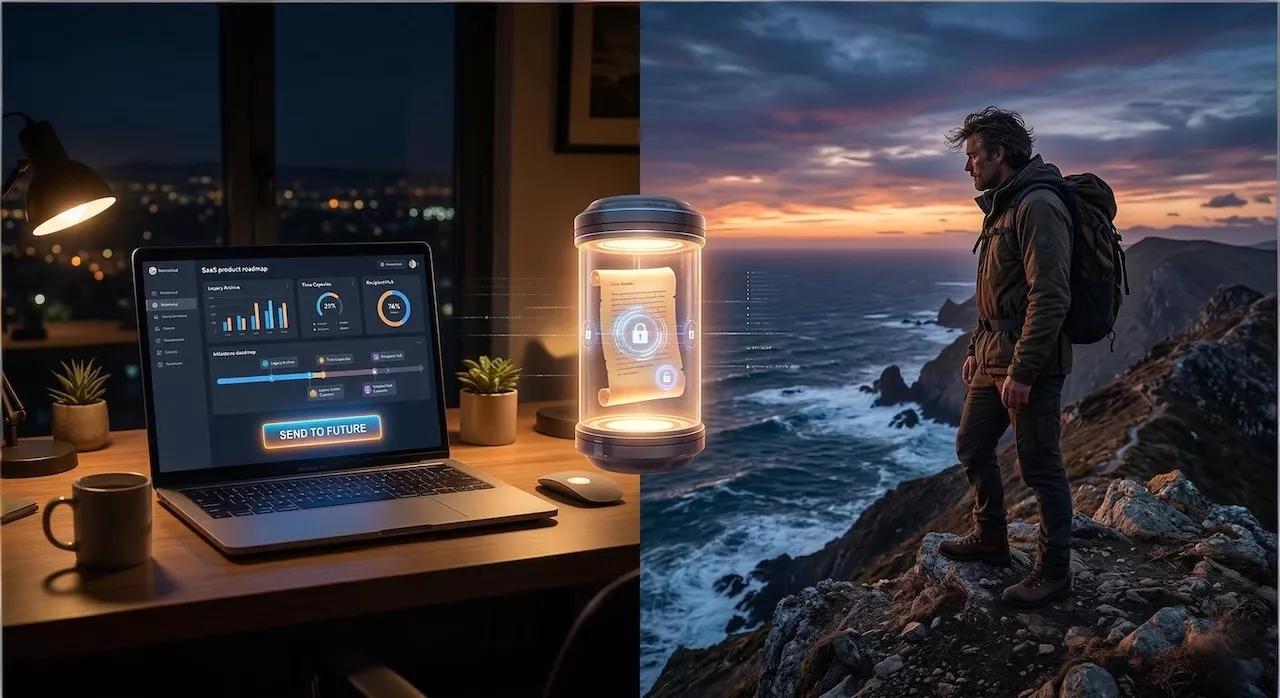
I’m a Product Manager who spends all week optimizing for the "immediate now." But getting lost off the grid on a mountain ridge made me realize I had zero infrastructure for the "forever." Here’s why I stopped worrying about conversion rates for a moment and built EterMail—a secure, tamper-proof digital time capsule for the people I love most.
The Most Radical Letter to Your Future Self Is a Promise to Stay Unfinished
The best letter to your future self isn't a memory—it's a mandate. Learn how writing to the version of you still working with love changes everything.

The Ice Tray at Midnight: On Grief, Domestic Minutiae, and the Quiet Work of Becoming Yourself Again
Why do the smallest habits hurt most after someone leaves? A reflection on grief, domestic minutiae, and the quiet moment healing finally begins.