
The Weight of Every Version of Yourself
There is a peculiar loneliness that arrives around age forty, when you first realize that your phone contains more photographs of who you were than who you are becoming. The screenshots of arguments you meant to resolve. The voicemails from numbers now disconnected. The cloud storage plan that quietly swelled to two terabytes, then four, then twelve—each gigabyte a small monument to the anxiety that forgetting might equal losing.
We have become the first generation to age alongside our data. Our grandparents kept shoeboxes. We keep encrypted servers. And somewhere between the two lies a question we have barely begun to ask: What does it mean to practice wisdom with information?
This is not a story about cybersecurity in the conventional sense. It is about the deeper architecture of digital privacy—the kind that asks not how to hide, but how to curate. How to hold. How to release. The ten voices that follow each illuminate a different facet of this continuous creative act, this lifelong negotiation between preservation and surrender.
1. The Archivist's Dilemma: On the Ethics of Saving Everything
Dr. Elena Voss, digital preservationist at the Library of Congress, speaks of "compulsive capture"—the modern condition of recording without the discipline of selection. "We confuse storage with memory," she told me. "But memory has always been an act of forgetting. The brain doesn't archive; it narrates. It leaves things out on purpose."
Her research suggests that people over sixty who actively curate their digital collections report higher life satisfaction than those who simply accumulate. The act of choosing what to keep—deleting the redundant sunset photos, the screenshots of transactions long resolved—mirrors the psychological work of integrating experience into identity.
"Digital privacy," Voss says, "is ultimately about editorial control. It's the dignity of deciding your own story."
2. The Stoic's Practice: Marcus Aurelius in the Age of Infinite Scroll
Ryan Holiday, author of The Daily Stoic, draws unexpected connections between ancient philosophy and modern data hygiene. "The Stoics practiced premeditatio malorum—the contemplation of worst-case scenarios—not to create anxiety, but to clarify value. What would you save if your house burned? That question reveals what you actually treasure."
Translated to our digital lives, this becomes a radical proposition: What if we lived as though our accounts might vanish tomorrow? Not as catastrophe, but as clarifying fiction. The photos we would rescue. The messages we would transcribe. The passwords we would bother to remember.
Holiday keeps a single encrypted folder labeled "If." Inside: letters to his children, instructions for his wife, the coordinates of meaning. Everything else, he says, is "practice in non-attachment."
3. The Mother's Calculus: On Outliving Your Own Surveillance
When Sarah Chen was diagnosed with early-onset Alzheimer's at fifty-three, she faced a question her mother's generation never encountered: How do you stage your own disappearance from the digital record?
"I spent six months downloading, then deleting," she wrote in a widely shared essay. "Not because I had secrets, but because I had dignity. I didn't want my daughters to one day find my search history, my drafts of unsent anger, my private negotiations with grief. I wanted to give them only what I chose to give."
Chen's project was not about shame. It was about intentionality as love. She used encrypted time-capsule services to schedule letters for future birthdays, ensuring her voice would arrive without the noise of her daily digital exhaust.
4. The Photographer's Eye: Learning to See Through Deletion
Alec Soth, Magnum photographer known for his slow, deliberate process, approaches digital archives like darkroom work. "In film, every frame costs something. You learn to see before you shoot. Digital abundance killed that discipline, but we can resurrect it in the edit."
Soth deletes ninety percent of his digital photographs—far more than his film ratio. "The delete key is the most underappreciated tool in photography. It's where you discover what you were actually looking for."
This applies beyond images. Our inboxes, our downloads, our endless browser tabs—all of it benefits from the photographer's ruthlessness. What remains after deliberate destruction often carries more weight than what was saved by default.
5. The Daughter's Inheritance: On Receiving What You Didn't Ask For
Maya Patel's father died suddenly, leaving her 47,000 emails and a Dropbox account of unknown scope. "The first month, I treated it like archaeology," she recalls. "The third month, like trauma. By the sixth month, I understood: his digital life was not my responsibility to curate, but it was my choice to engage."
She hired a digital estate service to archive everything encrypted, then spent one year opening selections on scheduled dates—his birthday, Father's Day, random Tuesdays when she missed him. The delay became the gift. She received his voice only when she was ready to hear it.
This is the architecture of what we might call compassionate privacy: systems that protect the dead from overexposure and the living from premature grief.
6. The Monk's Archive: Digital Minimalism as Spiritual Practice
Brother Paul Quenon, Trappist monk and former secretary to Thomas Merton, maintains what he calls "a cloud of unknowing"—a deliberately sparse digital presence. "Every file is a small attachment. Every backup, a small fear. I keep what serves my vocation and the community. The rest, I trust to God and good deletion."
His practice is not Luddite rejection but ascetic curation. He writes letters in a word processor, prints them, deletes the file. He photographs his garden, shares one image, erases the rest. "The garden remains," he says. "The photograph was always a kind of lie anyway."
7. The Scientist's Prediction: On the Half-Life of Digital Memory
Dr. James Wang, information theorist at MIT, studies what he calls "data decay"—not the technical corruption of files, but the semantic erosion of meaning. "A spreadsheet from 1995 is perfectly preserved and perfectly useless. A single sentence from your grandmother, handwritten, outlives every database."
Wang's research suggests that future-proofing is largely illusion. Formats change. Platforms vanish. The only reliable preservation is continuous migration—active engagement with your own archive, which paradoxically requires continuous letting go.
"The most secure data," he concludes, "is the data you still use. Everything else is archaeological speculation."
8. The Lover's Correspondence: Privacy as Intimacy's Container
When poets Jane Hirshfield and David Baker began their relationship, they established an unusual protocol: all digital communication self-destructed after seven days. "We wanted our words to exist in the moment of their speaking," Hirshfield explains. "Not as evidence, not as inventory. Just as gift."
They kept paper copies of what mattered—perhaps twenty letters across thirty years. The scarcity became the value. Their digital privacy was not about hiding from others, but about creating a sacred space for each other.
This reframing suggests that encryption can be an act of romance, a technological equivalent of the sealed envelope, the whisper, the hand pressed to glass.
9. The Activist's Vigilance: On Privacy as Collective Care
Edward Snowden, from his exile, speaks of privacy less as individual right than as social infrastructure. "When I was twenty-two, I thought privacy was about me. At forty, I understand it's about us. My data reveals networks, patterns, vulnerabilities that extend far beyond my own life."
This expands our obligation. To protect our data is to protect others—the contacts in our phones, the locations in our history, the relationships that our metadata maps. Digital hygiene becomes ethical practice.
10. The Future Self's Advocate: On Writing to Who You Will Become
Rachel Naomi Remen, physician and author, has spent decades working with the dying. Her observation: "People rarely regret what they didn't save. They regret what they didn't say."
This is where the architecture of digital privacy meets the architecture of meaning. The most secure message is the one that arrives exactly when needed—not exposed to daily scrolling, not vulnerable to platform collapse, but held in trust for a specific future moment.

The Continuous Creative Act
Growing older with our data requires a practice we have no name for—something between archiving and absolution, between hoarding and haiku. Each of the ten voices above suggests a different facet: the editor's discernment, the Stoic's clarity, the mother's love, the monk's release.
What unites them is the recognition that privacy is not the absence of sharing, but the presence of choice. We are learning, collectively, to age in public without losing our interiority. To preserve without becoming preserved. To hold what matters loosely enough that we can still feel its weight.
I built EterMail during one of those 2 AM coding sessions, when the weight of everything I wasn't saying to my future self became physically uncomfortable. As someone who spends my days wrestling with AI architectures and my weekends losing myself in mountain trails—where the only signal that matters is the one between your body and the rock face—I've developed a deep impatience for digital illusions. The best way to fight forgetting isn't taking another screenshot; it's setting an alarm for the future. By using EterMail to set a delivery date 5 years from now, you completely free yourself from the anxiety of the present. The message waits, encrypted, patient, like a letter pressed between the pages of a book you'll rediscover exactly when you need it.
The digital time capsule—properly constructed, properly encrypted, properly timed—extends this practice across the boundary of our own lives. It allows us to speak to futures we will not witness, to offer our wisdom without imposing our clutter, to choose what outlives us rather than leaving the choice to platform algorithms and probate courts.
The architecture of meaningful preservation begins with a single decision: what deserves to outlive the moment of its making. Whether you are thirty and imagining your fifties, or sixty and imagining your children's futures, the practice is the same. Write to who you will become. Trust the delay. Let the message arrive exactly when it is needed.
What is EterMail?
EterMail is a revolutionary time capsule service that allows you to send messages, photos, and videos to the future (up to 30 years). Seal your memories and thoughts today, and they'll be delivered when the time is right.
Time Capsule
Send messages up to 30 years in the future
Rich Media
Text, photos, and videos supported
Secure & Private
Your memories are safely encrypted
EterMail Team
We're the team behind EterMail, dedicated to helping you preserve and share timeless messages with your loved ones. Our mission is to make it easy to express your love, share your wisdom, and create lasting connections that transcend time.
Frequently Asked Questions about Digital Privacy & Security
How do I decide what digital content is worth preserving for my family?
What are the risks of leaving my entire digital life for family to sort through?
How can I ensure my digital memories remain accessible decades from now?
Related Articles
Why I Built EterMail: A Time Capsule for the People I Love Most
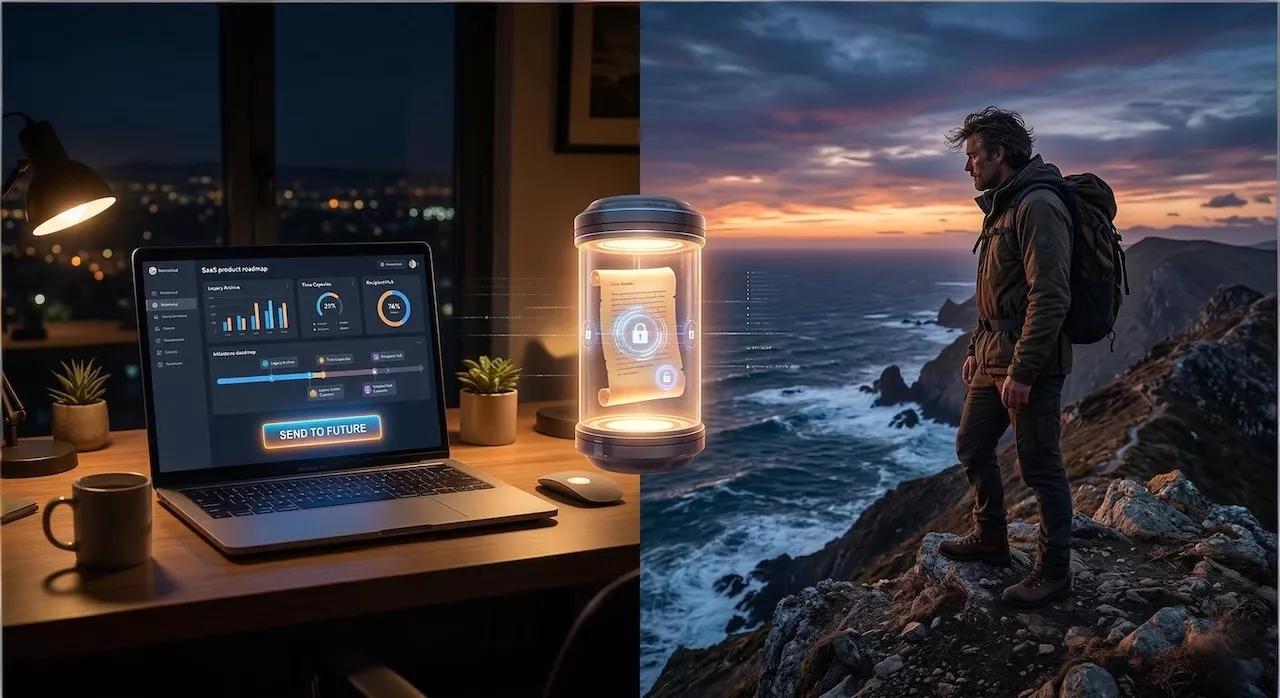
I’m a Product Manager who spends all week optimizing for the "immediate now." But getting lost off the grid on a mountain ridge made me realize I had zero infrastructure for the "forever." Here’s why I stopped worrying about conversion rates for a moment and built EterMail—a secure, tamper-proof digital time capsule for the people I love most.

The Most Radical Letter to Your Future Self Is a Promise to Stay Unfinished
The best letter to your future self isn't a memory—it's a mandate. Learn how writing to the version of you still working with love changes everything.
The Ice Tray at Midnight: On Grief, Domestic Minutiae, and the Quiet Work of Becoming Yourself Again
Why do the smallest habits hurt most after someone leaves? A reflection on grief, domestic minutiae, and the quiet moment healing finally begins.