The Smuggled Letter and the Server That Never Sleeps
In 1979, Václav Havel sat in a Communist prison cell and wrote about failure—not the dramatic kind, but the quiet devastation of giving everything and still falling short. His words survived because they traveled on folded paper, passed from hand to trusting hand, hidden from systems that would have scanned, archived, and algorithmically sorted them into irrelevance. The fragility of that paper was its protection. The risk of its loss was also the guarantee of its intimacy.
We no longer live in that world.
Today we pour our most vulnerable confessions into platforms designed to extract value from our exposure. We type our failures into text boxes with terms-of-service agreements we have never read. We upload our grief, our shame, our tentative hopes to servers that never sleep, never forget, and never truly belong to us. The question Havel never had to ask becomes ours alone: when you give your whole self to a digital witness that never forgets, who holds your failure when the servers do?
The Commodification of Confession
There is a particular loneliness to digital vulnerability. We have been trained to believe that sharing is healing, that visibility is authenticity, that the unexamined post is not worth living. The platforms have learned to reward this impulse with metrics that feel like connection—hearts, shares, the brief dopamine flicker of being seen. But the architecture beneath this exchange is not designed for human flourishing. It is designed for extraction.
Every word we type into these systems becomes training data. Every emotional disclosure refines the models that will eventually replace the very intimacy we sought. Our failures, once the raw material of private growth, become commodities in an attention economy that profits from our perpetual exposure. The platform does not care if you heal. The platform cares if you engage.
This is not paranoia. This is the business model. The same systems that archive our midnight anxieties also sell predictive profiles of our psychological vulnerabilities to advertisers, to insurers, to anyone with sufficient budget and insufficient scruples. Our failures do not simply exist in these spaces. They are leveraged.
And the cruelest irony? We volunteered for this. We clicked "agree" on contracts no human has time to read, trading the right to be forgotten for the convenience of immediate connection. We built digital prisons with our own hands, then decorated them with photographs of our children.
The Right to Be Incomplete
Human beings are not finished products. We contradict ourselves. We grow in directions that would horrify our younger selves, and we shrink from ambitions that once defined us. This inconsistency is not a flaw to be engineered away. It is the texture of consciousness itself.
But digital memory does not permit inconsistency. The tweet from 2012 sits adjacent to the statement from 2024, stripped of context, of growth, of the long messy process that transformed one person into another. The archive presents us as static entities, frozen at every moment of expression, denied the fundamental human right to have been wrong.
Consider what this does to the psychology of becoming. When every word is permanent, self-expression becomes self-censorship. We write not for our present understanding but for an unknown future tribunal—employers, partners, algorithms that will scrape our histories for predictive patterns. The result is a kind of preemptive conformity, a flattening of human complexity into brand-safe personas that never risk, never fail, never truly live.
Havel wrote his prison letters knowing they might be intercepted, destroyed, used against him. Yet he wrote anyway, because the act of honest expression was itself a form of resistance. What would he make of our more subtle imprisonment? We face not the threat of confiscation but the certainty of permanent exposure. The censor has been replaced by the algorithm, and the algorithm is more thorough than any secret police.
The Architecture of Memory as Control
There is a reason authoritarian regimes have always prioritized surveillance of private correspondence. The intimate letter is where thought becomes real, where dissent takes shape before it enters public space. To read private letters is to colonize the future, to prevent the formation of ideas that might challenge present power.
Our digital platforms accomplish this colonization with unprecedented efficiency. They do not merely read our letters. They anticipate them, predicting our emotional needs before we recognize them ourselves, shaping our desires through recommendation engines that optimize for engagement rather than human agency. The platform that knows you better than you know yourself is not a friend. It is a form of governance without consent.
This is the architecture of memory as control. Not the crude censorship of burning books, but the sophisticated manipulation of what can be thought by controlling the conditions under which thinking occurs. When our failures are permanently archived and algorithmically surfaced, we learn to think in ways that will survive future scrutiny. We become our own censors, internalizing the gaze of the platform until it feels like conscience.
Reclaiming the Private Failure
What would it mean to build digital spaces that honor the human need to fail, to change, to begin again? This is not a technical question alone. It is a question of values, of what we believe a human being deserves by right of being human.
The right to be forgotten is not merely a legal mechanism. It is an existential necessity. We require spaces where our vulnerabilities can exist without becoming assets, where our growth is not tracked as data but experienced as mystery. We need witnesses to our lives who are not also accountants, who hold our stories without calculating their value.
This is where the design of digital tools becomes a moral act. End-to-end encryption, user-controlled expiration, decentralized storage—these are not merely features. They are forms of care. They represent an acknowledgment that human beings are not datasets to be optimized but souls who require the shelter of privacy to become themselves.
The time capsule, that ancient technology of intentional memory, offers a different model. Not the passive archiving of everything, but the chosen preservation of something. A letter to a future self, sealed until the appropriate moment. A message to a child, held in trust until they are ready to receive it. These acts of selective memory honor the complexity of time. They acknowledge that meaning emerges not from total recall but from timely revelation.
The Last Human Freedom
Václav Havel survived his imprisonment and became president of a free Czech Republic. The letters that sustained him were eventually published, but they were published by his choice, at a moment of his choosing, to readers he addressed as moral equals. The delay between writing and reception was not a bug to be engineered away. It was the condition that made the communication meaningful.
We face a different imprisonment now. Not the concrete cell but the endless scroll, the permanent archive, the algorithmic feed that knows our weaknesses better than our friends do. The freedom Havel fought for— the freedom to speak truth to power—has been complicated by a new threat: the freedom to speak truth to ourselves, in private, without that truth becoming someone else's leverage.
Reclaiming this freedom requires more than individual virtue. It requires collective imagination about what digital spaces could become. It requires us to build and choose tools that treat privacy not as a premium feature but as a foundation. It requires us to remember that the most important communications in our lives— the confessions, the failures, the tentative hopes— deserve the protection that Havel's paper letters enjoyed: the protection of fragility, of trust, of the right to disappear.

The Letter That Waits
There is a particular courage in writing what you are not yet ready to send. The letter to the future self that acknowledges present failure without requiring immediate resolution. The message to the child who cannot yet read, held in trust across the years. The confession to a loved one, timed to arrive when distance has made forgiveness possible.
These communications require an architecture of patience. They need systems that can hold vulnerability without exploiting it, that can preserve meaning without monetizing attention. They need what the philosopher Byung-Chul Han calls "the scent of time"—the recognition that human significance deepens through delay, through the maturation that only waiting permits.
I know this impulse intimately. There are nights when I'm still at my desk at 2 AM, "pair programming" with an LLM or sketching system architectures, chasing the strange solitude of creation that only exists in those hours. And then there are mornings when I'm hiking a steep ridgeline or paddling into cold surf, stripped of every digital signal, reminded that the most real things happen in moments you cannot archive. That tension—between the cyber-romantic's dream of consciousness uploaded, of building bridges between physical and digital worlds, and the outdoor adventurer's hunger for unrepeatable presence—is what drives me. EterMail is the spaceship I built from that tension: a way to send something human across time without feeding it to the machine in the meantime.
The best way to fight forgetting isn't taking another screenshot; it's setting an alarm for the future. By using EterMail to set a delivery date 5 years from now, you completely free yourself from the anxiety of the present. You write the messy truth now, seal it, and let time do its patient work. No algorithm surfaces it. No advertiser profiles it. It simply waits, like Havel's folded paper, passed from your present hand to your future one.
The digital time capsule, properly constructed, offers this possibility. Not the frantic immediacy of the feed, but the deliberate pacing of the letter. Not the permanent exposure of the platform, but the chosen revelation of trust. In a world that demands we perform our lives in real-time, the act of writing for a future reader is a small but genuine revolution.
We will fail. This is the guarantee that makes us human. The question is whether our failures will be held by systems that exploit them or by relationships that honor them. Whether our growth will be tracked as data or experienced as grace. Whether we will have the freedom to become who we are, or only who we have already been.
Havel's letters survived because they passed through human hands. They were touched, hidden, risked. The vulnerability of their transmission was inseparable from their meaning. We cannot return to that world, nor should we romanticize its hardships. But we can demand that our digital spaces preserve something of its wisdom: that memory is a gift we give, not a resource to be mined. That the right to fail in private is the foundation of all other freedoms. That the most human thing we do is change, and change requires the possibility of being forgotten.
The server that never sleeps is not our friend. The algorithm that never forgets is not our conscience. The platform that profits from our exposure is not our community. We deserve tools that honor our incompleteness, that hold our vulnerabilities in trust, that give us back the freedom to become.
This is the last truly human freedom: not the freedom to be seen, but the freedom to be seen at the right time, by the right eyes, on terms we have chosen. The freedom to fail, to change, to seal the letter and let time do its patient work.
What is EterMail?
EterMail is a revolutionary time capsule service that allows you to send messages, photos, and videos to the future (up to 30 years). Seal your memories and thoughts today, and they'll be delivered when the time is right.
Time Capsule
Send messages up to 30 years in the future
Rich Media
Text, photos, and videos supported
Secure & Private
Your memories are safely encrypted
EterMail Team
We're the team behind EterMail, dedicated to helping you preserve and share timeless messages with your loved ones. Our mission is to make it easy to express your love, share your wisdom, and create lasting connections that transcend time.
Frequently Asked Questions about Digital Privacy & Security
Why is digital privacy important for mental health and personal growth?
How can individuals protect their private memories from data exploitation?
What is the difference between digital archiving and intentional memory preservation?
Related Articles
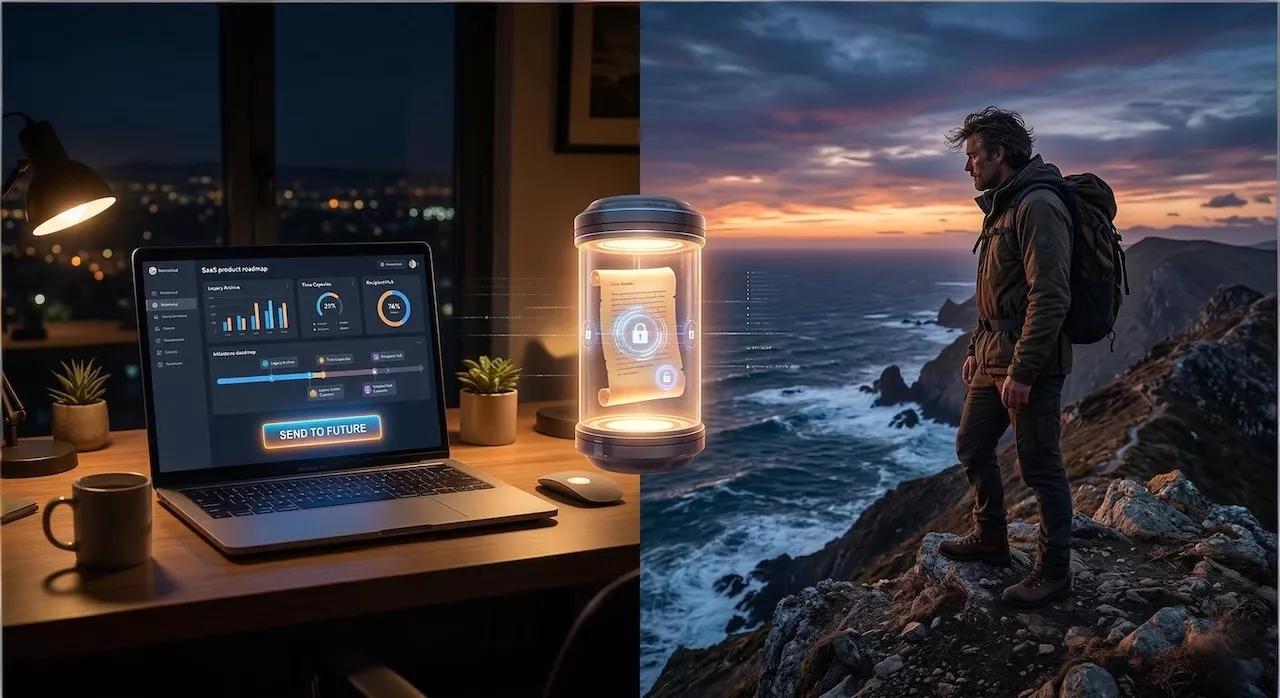
Why I Built EterMail: A Time Capsule for the People I Love Most
I’m a Product Manager who spends all week optimizing for the "immediate now." But getting lost off the grid on a mountain ridge made me realize I had zero infrastructure for the "forever." Here’s why I stopped worrying about conversion rates for a moment and built EterMail—a secure, tamper-proof digital time capsule for the people I love most.

The Most Radical Letter to Your Future Self Is a Promise to Stay Unfinished
The best letter to your future self isn't a memory—it's a mandate. Learn how writing to the version of you still working with love changes everything.

The Ice Tray at Midnight: On Grief, Domestic Minutiae, and the Quiet Work of Becoming Yourself Again
Why do the smallest habits hurt most after someone leaves? A reflection on grief, domestic minutiae, and the quiet moment healing finally begins.