The Finish Line That Never Forgets
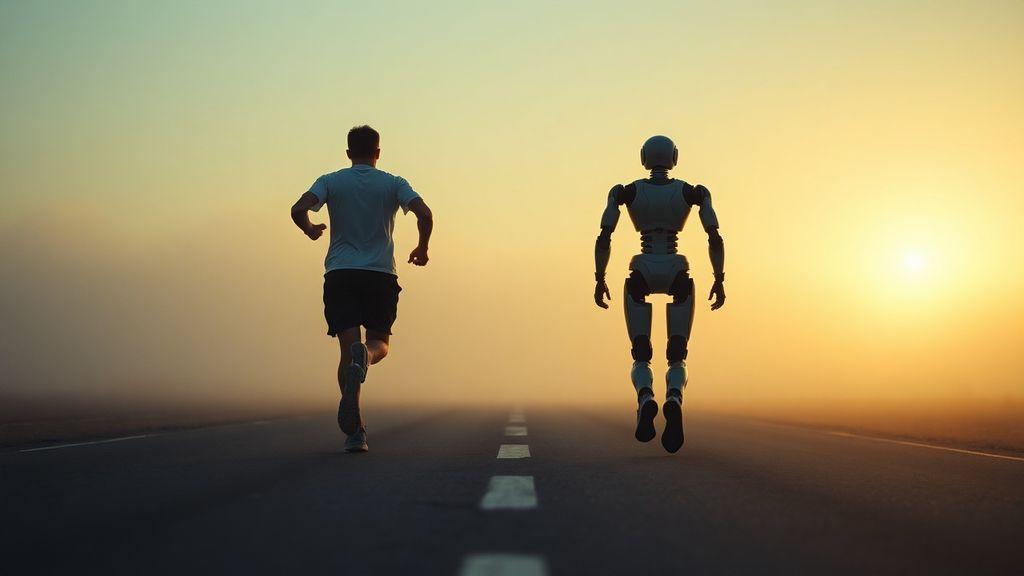
The crowd in Beijing did not gather to witness a privacy crisis. They came to see history—a humanoid robot, joints whirring with hydraulic precision, complete 21 kilometers in two hours and forty minutes. Seven minutes faster than any human competitor. Engineers wept. Investors cheered. Somewhere in the algorithm, a learning model quietly cataloged every irregularity in the robot's gait, every micro-adjustment to terrain, every heartbeat it did not have but the humans around it did.
What no one photographed was the invisible race running parallel to the physical one. The biometric sensors lining the course. The facial recognition systems verifying spectators. The fitness trackers pulsing on thousands of wrists, each one a voluntary witness to bodies in motion, uploading the architecture of human limitation to servers that do not sleep.
We have grown accustomed to celebrating mechanical triumph while ignoring the data exhaust it generates. But the same infrastructure that taught a robot to run is teaching corporations to read your body more fluently than you read yourself. And unlike a marathon, this race has no clear finish line—only an endless accumulation of moments you assumed were yours alone.
The Body as Data: When Health Becomes Permanence
Consider what you surrender when you lace up your shoes and start an app. Your cadence. Your stride length. The asymmetry between left and right footfalls that might indicate an old injury or predict a future one. Your heart's electrical signature, mapped across elevation changes and emotional states. The precise GPS coordinates of your home, your office, the hidden path through the park where you go when grief sits heavy and you do not wish to be found.
This is not abstract paranoia. In 2023, Strava's heat map inadvertently revealed the locations of military bases worldwide because soldiers ran the same routes repeatedly. The data was "anonymized." The patterns were not. Your body leaves traces in digital space with the same inevitability it leaves footprints in mud—except mud dries and cracks, and server farms in Nevada hum with perpetual climate control.
The fundamental shift is this: health data has transformed from ephemeral self-knowledge into permanent institutional memory. Your doctor might forget your resting heart rate from a decade ago. Your insurance algorithm will not. The fitness platform you abandoned in 2019 retains the architecture of your younger body, and that architecture is now training models that will evaluate your future applications for coverage, for employment, for trust.
The Asymmetry of Forgetting
Humans forget. This is not a bug but a feature—the neurological equivalent of spring cleaning, of allowing relationships to evolve beyond their worst moments, of permitting identities to outgrow their data shadows. We are designed to misremember, to soften, to reconstruct narratives that serve our becoming.
Digital systems do not forget. They compress, they replicate, they migrate across servers and jurisdictions, but the original signal persists with a fidelity that mocks human frailty. The half-marathon robot does not experience the relief of finishing; it simply stores the completion timestamp, the efficiency metrics, the comparative analysis against all previous iterations. When we embed ourselves in these systems, we subject our biological forgetting to a mechanical remembering that knows no mercy.
The Intimacy of Infrastructures
The robot's achievement was not merely mechanical. It represented the culmination of training data harvested from thousands of human runners—motion capture studios, treadmill laboratories, the accumulated telemetry of amateur athletes who believed they were simply sharing workouts with friends. The machine learned to run by studying our bodies at their most vulnerable: fatigued, determined, failing and recovering in patterns we ourselves cannot articulate.
This is the intimacy that should concern us. Not the crude surveillance of cameras and microphones, but the subtle extraction of bodily wisdom we do not consciously possess. Your smartwatch knows you are getting sick before you do. Your sleep tracker recognizes depressive episodes in your restlessness. These inferences are not medical diagnoses, but they are increasingly treated as proxies for truth by systems that make consequential decisions about your life.
We are not users of health technology. We are unpaid research subjects in the largest longitudinal study of human embodiment ever conducted. The consent forms we click through are written in the language of personal improvement, but the value flows overwhelmingly toward institutional knowledge that will outlast our participation, our awareness, perhaps our species.
The Generational Implications
What does it mean that a child born today will have their heart rate data from before birth (via maternal fitness trackers), their first steps (via nursery monitors), their growth curves (via connected scales), their puberty and injuries and recoveries—all archived with the permanence of geological strata? Previous generations could choose what to remember, what to record, what to carry forward. The default has inverted. Now we must actively intervene to forget, and the tools for such intervention are deliberately obscure, legally constrained, technically inadequate.
The half-marathon robot does not have children. But the data infrastructure that created it will archive your children's bodies with the same dispassionate thoroughness, the same absence of developmental context, the same inability to distinguish between a temporary phase and an enduring truth.
Running Toward Sovereignty: What Protection Actually Requires
Privacy is not secrecy. It is not the adolescent hoarding of shameful things. Privacy is the capacity to be imperfect without permanence, to experiment without consequence, to have a body that is yours to interpret before it becomes data to be mined. The robot's record-breaking run was possible because human runners once had this privacy—the freedom to fail, to develop idiosyncratic techniques, to carry their inefficiencies like signatures.
Protecting your digital privacy in an age of biometric tracking requires more than adjusting app settings. It demands a fundamental renegotiation of your relationship with measurement itself.
Practical Interventions
Audit your defaults. Most fitness devices collect data continuously by design. The "off" switch often disables features you value while leaving telemetry active. Understand what you are actually consenting to, not what the interface implies.
Separate your streams. The most dangerous data is correlated data. Your running route plus your heart rate plus your calendar plus your purchase history creates a portrait no single dataset reveals. Use different services, different identities, different payment methods where feasible.
Embrace strategic opacity. Not every workout needs to be logged. Not every metric requires optimization. The robot runs to improve; you might run to escape, to think, to be present in a body that is not performing for an audience of algorithms.
Demand structural accountability. Individual privacy practices are necessary but insufficient. The half-marathon was a public event with public implications. The data systems that enabled it should be subject to public scrutiny, democratic governance, and the right to be forgotten that European law recognizes and American practice resists.

The Long Race: Memory, Legacy, and Choosing What Persists
There is a deeper question beneath the technical and legal concerns. What do we want to remember? What do we want to be remembered as? The robot's half-marathon time will persist with perfect accuracy, but it carries no meaning beyond the metric. The human runners it surpassed ran with stories—grief they were outrunning, health they were reclaiming, promises they were keeping to selves they hoped to become.
I think about this tension constantly, often at hours when the distinction between human and machine memory feels thinnest. I've spent too many nights until 2 or 3 AM, screen glowing, "pair programming" with LLMs or sketching architectures for systems that might outlast me. That extreme digital solitude—just me and the cursor blinking in the dark—has given me an almost physical understanding of what it means to leave traces in systems that never sleep. I know what it feels like to want your thoughts to survive, yet to fear what happens when they survive outside your control. The loneliness of that glow is real. But so is the deeper loneliness of knowing your data lives everywhere and nowhere, readable by entities you'll never meet.
This is where the philosophical and the practical converge. The race to protect your digital privacy is ultimately a race to preserve narrative authority over your own life. The data systems want to reduce you to patterns: predictable, optimizable, monetizable. You are entitled to remain irreducible, to keep portions of your experience in the analog warmth of human memory, imperfect and precious precisely because it is not shared.
The best way to fight forgetting isn't taking another screenshot; it's setting an alarm for the future. By using EterMail to set a delivery date 5 years from now, you completely free yourself from the anxiety of the present. You write your body as you know it today—the injuries, the recoveries, the private vocabulary of your own motion—and trust it to arrive when that version of you needs to be remembered, not mined. I built this because I wanted something that guards the bridge between who I am at 2 AM and who I might become at forty, fifty, sixty. A letter to your future self, encrypted and time-locked, preserves your voice across years without exposing it to the continuous extraction that defines contemporary digital life. The platform does not learn from your content; it simply keeps it, faithfully, until the moment you designated. This is privacy not as absence but as patience—not the refusal to communicate, but the insistence on communicating on human terms, across human timescales.
The robot will run faster next year. The year after, perhaps faster still. Its improvements are linear, cumulative, irreversible. Your relationship with your body need not be. You are allowed to slow down, to skip a day, to run without recording, to carry your inefficiencies like the private vocabulary they are. The marathon that matters is not against machines or other humans. It is the lifelong practice of remaining the primary author of your own embodiment, in a world that would prefer to write you in data it controls.
The finish line is not where the race ends. It is where you choose, again, what to remember and what to release.
Your body generates data with every heartbeat. What you do with that permanence—what you protect, what you share, what you entrust to time-locked silence—is the only record that will outlast the algorithms. Start writing your future on your own terms.
What is EterMail?
EterMail is a revolutionary time capsule service that allows you to send messages, photos, and videos to the future (up to 30 years). Seal your memories and thoughts today, and they'll be delivered when the time is right.
Time Capsule
Send messages up to 30 years in the future
Rich Media
Text, photos, and videos supported
Secure & Private
Your memories are safely encrypted
EterMail Team
We're the team behind EterMail, dedicated to helping you preserve and share timeless messages with your loved ones. Our mission is to make it easy to express your love, share your wisdom, and create lasting connections that transcend time.
Frequently Asked Questions about Digital Privacy & Security
How can I protect my biometric data from being collected without my knowledge?
What are the long-term risks of sharing fitness data on social platforms?
Can I request deletion of my health data from companies that have collected it?
Related Articles
Why I Built EterMail: A Time Capsule for the People I Love Most
I’m a Product Manager who spends all week optimizing for the "immediate now." But getting lost off the grid on a mountain ridge made me realize I had zero infrastructure for the "forever." Here’s why I stopped worrying about conversion rates for a moment and built EterMail—a secure, tamper-proof digital time capsule for the people I love most.

The Most Radical Letter to Your Future Self Is a Promise to Stay Unfinished
The best letter to your future self isn't a memory—it's a mandate. Learn how writing to the version of you still working with love changes everything.
The Ice Tray at Midnight: On Grief, Domestic Minutiae, and the Quiet Work of Becoming Yourself Again
Why do the smallest habits hurt most after someone leaves? A reflection on grief, domestic minutiae, and the quiet moment healing finally begins.