The Baby Book Lie
My daughter's first word was not "mama." It was "light," spoken while pointing at the fixture above her changing table, her small finger extended with the gravity of a prophet. I recorded "mama" in the baby book anyway. The book had a designated line for this moment, and I had waited eleven months for something that fit the narrative I'd already composed in hospital waiting rooms and 3 AM feedings. "Light" was too abstract, too lonely, too much like her father who spoke in observations rather than endearments.
This is how it begins. Not with malice. With love that cannot bear the messiness of truth.
Every parent becomes an unauthorized biographer. We document in real time, selecting scenes, compressing timelines, elevating minor characters, and—most critically—editing ourselves out of the painful chapters. The baby book becomes a curated exhibition. The holiday card narrates a family that never cried on Santa's lap. The divorce timeline, when it must be shared, arrives over macaroni and cheese, broken into digestible episodes with clear moral resolutions. We are not liars, exactly. We are translators, converting the raw footage of existence into something our children can survive knowing.
But survival, I am learning, is not the same as honesty. And honesty, I am terrified to discover, may be the only inheritance that outlasts us.
The Origin Story We Cannot Help But Construct
Psychologists call it "narrative identity"—the stories we tell ourselves about who we are, stitched from memory's unreliable fabric. For children, this stitching is initially outsourced. Parents provide the first patterns, the foundational myths that will later be tried on, altered, sometimes violently rejected.
Consider what we preserve. The ultrasound photo, already a selection—this angle, not that shadow. The birth story, rehearsed and polished, with complications sanded down to "a long labor, but worth it." The first day of school photograph, taken after the tears were wiped, the stomachache soothed with a promise of pickup. We are not documenting childhood. We are constructing it, frame by frame, with ourselves as both cinematographer and reluctant supporting character.
And what we omit forms its own architecture. The argument whispered behind bedroom doors. The financial panic that manifested as sudden frugality. The depression that made some Saturdays feel like underwater survival. These become negative space, visible only in retrospect, in the child's eventual recognition that certain rooms in the house were always locked.
I think of my own mother, how she spoke of my early years as "blissful," a word that never matched my body's memory of tension, of walking on the soft edge of her unspoken exhaustion. Only in my thirties did I find her journal from that period, pages of grief and isolation she had translated into dinner table cheerfulness. She had made me the hero of a story that was slowly drowning her. I was grateful and furious in equal measure—grateful for the protection, furious for the loneliness of our mutual performance.
When They Discover the First Draft
The reckoning arrives differently for each family. Sometimes it's a photograph stumbled upon in a moving box, a face younger and more desperate than the parent they've known. Sometimes it's a cousin's careless story at a wedding, a reference to "that year" that opens a door previously wallpapered over. Sometimes it's simply the accumulated weight of inconsistencies—the timeline that doesn't quite align, the explanation that satisfies a seven-year-old but insults a seventeen-year-old's intelligence.
My daughter found my old emails last year, archived on a laptop I'd forgotten. She was sixteen, technically adept, bored in the way of teenagers who suspect their parents' lives might contain something more interesting than presented. She read exchanges between her father and me from the year before our separation, the careful choreography of two people pretending for an audience of one small child. The performance we'd maintained, she discovered, had been scripted, rehearsed, exhausting.
"Why didn't you just tell me?" she asked. Not angry, which would have been easier. Wounded in a way I recognized from my own discovery of my mother's journal. The wound of learning that love sometimes meant distance, that protection required a kind of deception we would now both carry.
I had no adequate answer. The truth—that I had wanted her childhood to contain at least one room without conflict, even if that room was fictional—sounded like cowardice dressed in maternal sacrifice. The deeper truth—that I could not bear to be the villain in her story, even temporarily—sounded worse.

The Confession We Owe Them
What I am trying to learn, slowly, with the clumsiness of someone who has performed competence for too long, is that confession is not the same as burdening. That honesty about our limitations, our fears, our moments of failure, does not diminish a child's security—it expands their understanding of what security can contain.
This requires a different kind of storytelling. Not the edited highlights reel, but the director's commentary. The acknowledgment that yes, we chose what to show you. Yes, we were protecting ourselves as much as you. Yes, love sometimes manifested as control over your narrative because we were terrified of what unfiltered truth might do to all of us.
I have started writing letters my daughter will receive later—not as replacements for conversation, but as evidence that I was thinking, struggling, becoming, even when I appeared merely parental. These are not the polished accounts of the baby book. They contain the first word that was actually "light." They contain the morning I sat in the car outside her school, unable to enter, paralyzed by a depression I had named "tired." They contain the genuine pride and genuine envy of watching her become someone I might have been, had I started my own story with more honest pages.
There's a particular loneliness to writing these letters. I often find myself working on them late at night, after the house has gone quiet, the kind of digital solitude that reminds me of my friend River—an entrepreneur who spends his own midnight hours "pair programming" with AI systems, mapping architectures until 2 or 3 AM. He once told me that this extreme solitude, staring at a glowing screen while the world sleeps, gave him a strange resonance with "dialogues across time." I didn't understand him then. I do now. Writing to a future version of my daughter, someone I may not live to meet, feels like the most human and most impossible conversation I've ever attempted.
The best way to fight forgetting isn't taking another screenshot; it's setting an alarm for the future. By using EterMail to schedule these letters for delivery years from now—when she is thirty, forty, fifty, at moments I cannot predict but can imagine—I completely free myself from the anxiety of the present. A letter after my death, perhaps, explaining the divorce in terms I could not manage while living. A letter on her own child's first birthday, acknowledging the baby book impulse, the editorial urge, the love that both enables and distorts. A letter that says: I was not the hero of your story. I was the ghostwriter, afraid of my own byline.
The Legacy of Imperfect Truth
We will not get this right. The impulse to protect, to curate, to elevate our children into protagonists of manageable narratives—these instincts are too deeply wired, too genuinely loving, to fully excise. What we can offer instead is transparency about the editing process itself. The acknowledgment that every story has cuts, that every memory is a collaboration between what happened and what we needed to have happened.
My daughter and I now have a phrase: "first draft." When I catch myself smoothing a family story, she raises an eyebrow. When she presents a version of her adolescence that omits her own struggles, I return the gesture. We are learning to be each other's fact-checkers, not with hostility, but with the shared recognition that origin stories are living documents, revised by every reading.
The baby book remains on her shelf, "mama" still recorded as first word. She knows the truth now; we have laughed about it, how both words were true in their way. She was pointing at light. I was reaching for connection. Neither of us was wrong. Neither account was complete.
This, perhaps, is the most honest legacy I can leave her: not a corrected record, but a methodology. The willingness to hold multiple drafts. The courage to let her own bruised memory fact-check mine. The understanding that love, at its most enduring, is not the story we tell but the conversation we keep having about its inevitable revisions.
What is EterMail?
EterMail is a revolutionary time capsule service that allows you to send messages, photos, and videos to the future (up to 30 years). Seal your memories and thoughts today, and they'll be delivered when the time is right.
Time Capsule
Send messages up to 30 years in the future
Rich Media
Text, photos, and videos supported
Secure & Private
Your memories are safely encrypted
EterMail Team
We're the team behind EterMail, dedicated to helping you preserve and share timeless messages with your loved ones. Our mission is to make it easy to express your love, share your wisdom, and create lasting connections that transcend time.
Frequently Asked Questions about For Our Children
How do I write an honest letter to my child without burdening them with my struggles?
What should I include in a legacy letter for my children to read later?
How do I reconcile the stories I told my children with the truth they're now old enough to hear?
Related Articles
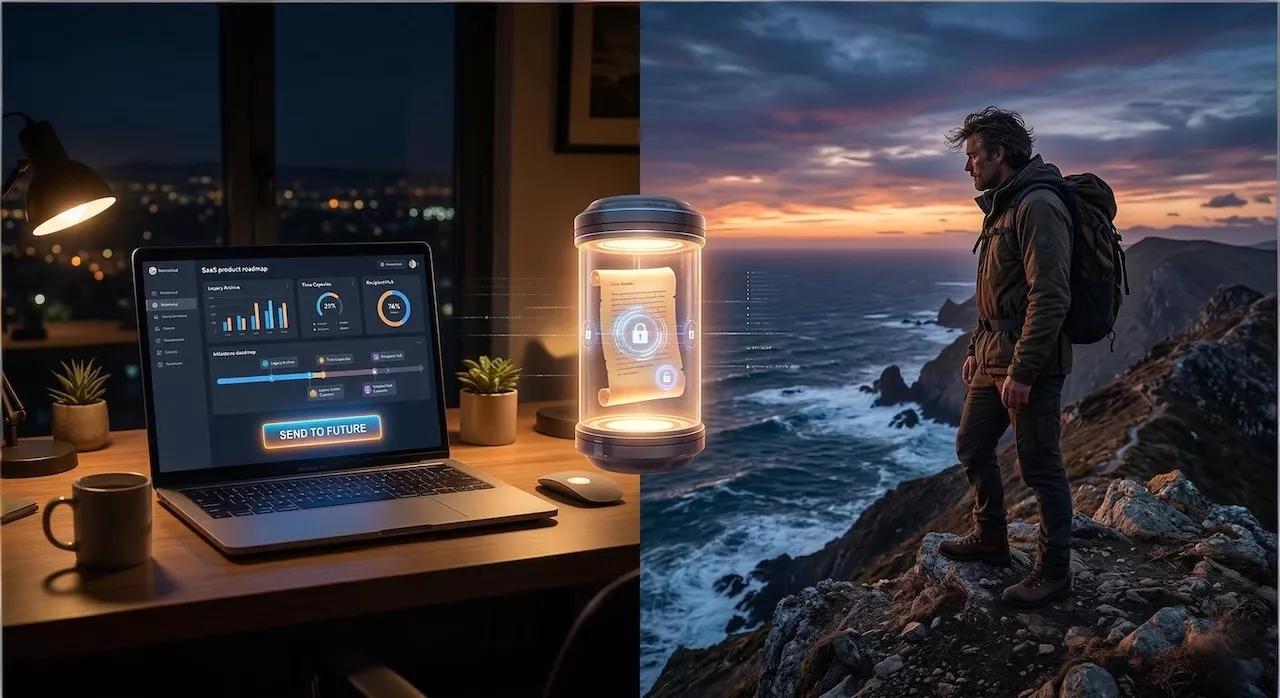
Why I Built EterMail: A Time Capsule for the People I Love Most
I’m a Product Manager who spends all week optimizing for the "immediate now." But getting lost off the grid on a mountain ridge made me realize I had zero infrastructure for the "forever." Here’s why I stopped worrying about conversion rates for a moment and built EterMail—a secure, tamper-proof digital time capsule for the people I love most.
The Most Radical Letter to Your Future Self Is a Promise to Stay Unfinished
The best letter to your future self isn't a memory—it's a mandate. Learn how writing to the version of you still working with love changes everything.
The Ice Tray at Midnight: On Grief, Domestic Minutiae, and the Quiet Work of Becoming Yourself Again
Why do the smallest habits hurt most after someone leaves? A reflection on grief, domestic minutiae, and the quiet moment healing finally begins.