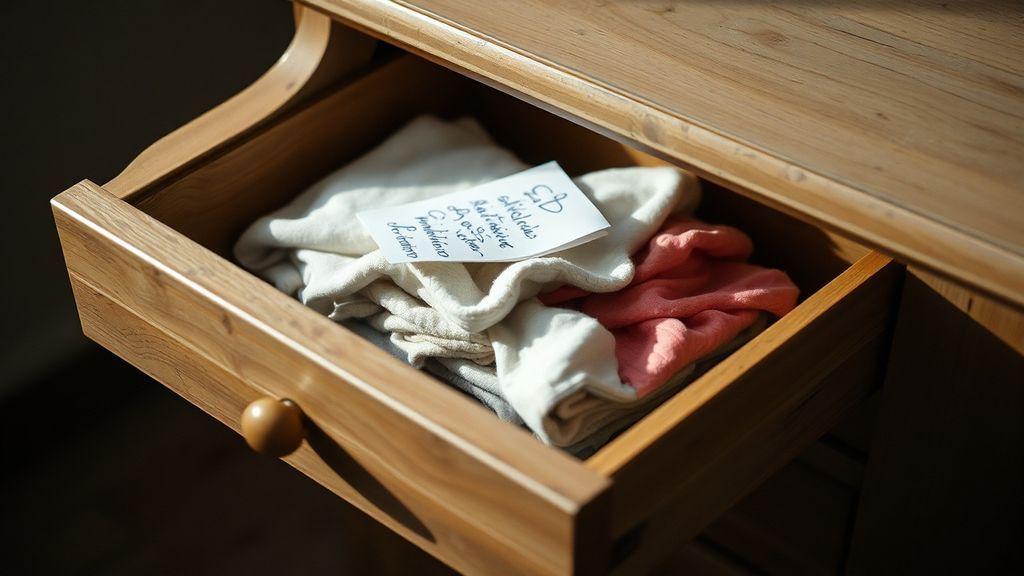
The Faded Sweatshirt on the Laundry Line
There is a sweatshirt in my drawer that I have no business still owning. The cuffs are frayed to threads. The navy has gone the color of dishwater. Somewhere on the left shoulder, a faded silkscreen commemorates a concert my daughter attended at twelve—some boy band whose names I never learned, whose songs I could not hum if my life depended on it. She outgrew the music by fourteen. She outgrew me, in the way daughters do, not long after. And still I wear this thing to mow the lawn. To fetch the mail in rain. To stand in the grocery store aisle staring at cereal boxes I no longer need to buy because no one in my house eats cereal anymore.
I tell myself it is comfortable. That the fabric has softened to something irreplaceable. This is true, but it is not the truth.
The truth is that wearing it, I become a kind of museum. A temporary exhibition of a self I no longer inhabit but cannot bear to decommission. The docent has gone home. The lights are dimmed. Yet here I stand, roped off from my own present, guarding artifacts that no ticket-holder will ever request to see.
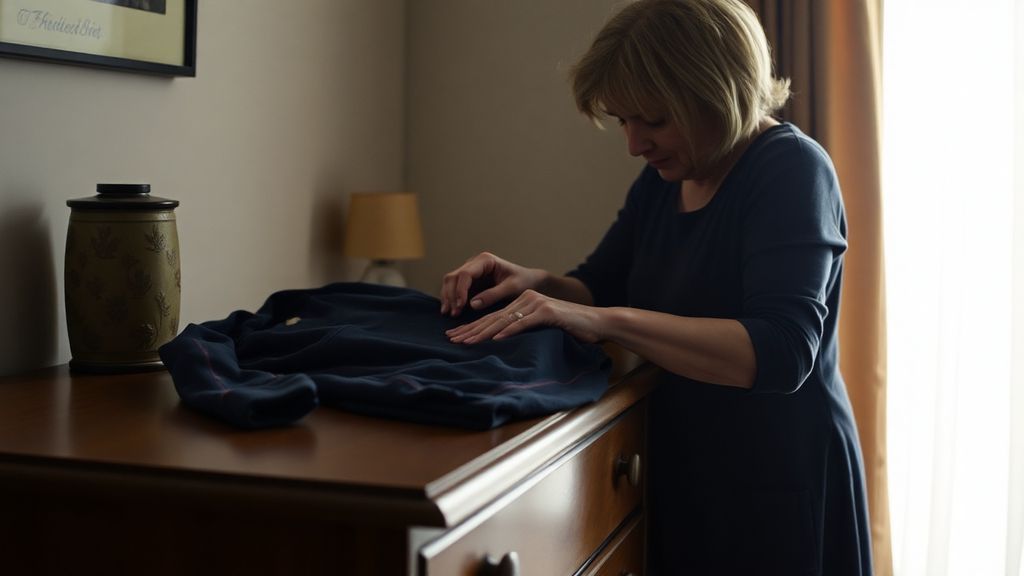
The Cartography of Stored Warmth
We do not talk enough about how parenting rewrites the body's geography. The places we hold tension change. The hands develop a memory for braiding hair that will eventually be cut and donated, for tying shoes that will later be tied by other hands, for reaching toward a bedroom door we no longer open without knocking. The body becomes a map of services rendered and then abruptly discontinued, a territory whose usefulness has expired but whose contours remain memorized by muscle and nerve.
I know a man who still carries tissues in every coat pocket. His son is twenty-seven, lives in another country, has a beard and a mortgage and a therapist he found himself. Yet this father—this perfectly rational engineer with spreadsheets for his spreadsheets—cannot stop stuffing his pockets with tissues. "Habit," he says, shrugging. But I have seen him reach for one in a restaurant, startled to find it there, and pause with his hand suspended in that gesture of readiness, that posture of protection, before slowly withdrawing empty fingers.
The tissue is not for him. The tissue has never been for him. The tissue is a message in a bottle sent to a shore that has eroded.
We become, as parents, these strange living archives. We curate exhibits without visitors. We maintain temperature control for collections no researcher will request. The embroidery floss we use to mend holey socks—floss abandoned by children who moved on to acrylic paints, then to digital tablets, then to apartments where they buy new socks when old ones fail—this floss becomes a medium of continuity. Each stitch says: I am still here. I am still doing this. The world in which you needed me has not entirely ended; I have simply moved it indoors, underground, into the climate-controlled basement of my own persistence.
The Unremarked Laundering
And then, some Tuesday, we wash the sweatshirt with the ordinary load. We fold it without ceremony. We place it in the donation bag or the rag bin or simply the back of the closet behind the winter coats, and only later—sometimes days later, sometimes in the hollow of 3 AM—do we realize what we have done.
The body underneath has been cold for years. We have been keeping warm a corpse dressed in our own skin.
This is not morbidity. This is the honest archaeology of attachment. We excavate ourselves and find strata of devotion so densely packed they have become indistinguishable from identity. Who am I, if not the person who remembers your fever temperatures? Who am I, if not the one who knows which stuffed animal required refrigeration after injuries, which book required three readings exactly, which song hummed at precisely the wrong tempo would restart the entire bedtime sequence?
The courage it takes to fold what no longer fits is not the courage of destruction. It is the courage of description—of finally naming what these garments meant, what services they performed, what love they carried, so that the love itself might survive the medium that carried it.
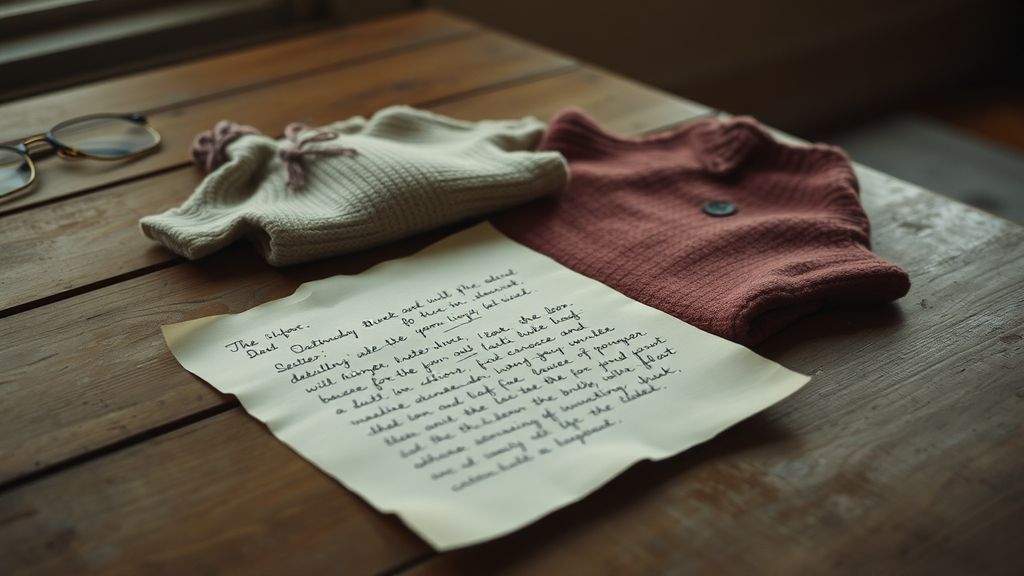
Writing What Outlasts the Fabric
I have started writing letters I do not send. Not because I lack addresses—my daughter texts me memes now, a language of proximity I am still learning to read—but because some communications require a different temporality. The text message demands immediate digestion. The phone call unfolds in real-time, vulnerable to interruption, to the doorbell, to the way her voice tightens when she has somewhere else to be.
But a letter. A letter can wait. A letter can be opened in a season unrelated to its composition. A letter can be read in a voice the reader does not recognize as mine because time will have changed us both by then.
This is the peculiar gift of writing to the future: it acknowledges that the person who receives our words will not be the person we imagine. The mother I am when I write is not the mother she will remember. The daughter she is when she receives these pages—if she receives them; if the technology persists; if the platform survives; if the company does not dissolve; if the encryption holds; if the servers do not flood—this daughter will have her own faded garments, her own pocketed tissues, her own unremarked launderings she has not yet learned to mourn.
The Technology of Persistent Love
We are, my generation, the first to parent through digital transformation. We photographed our children on film, then on early digital cameras with their catastrophic color reproduction, then on phones we upgraded annually, scattering their images across platforms that no longer exist, formats no longer supported, clouds that evaporated when companies merged or failed or simply changed their terms of service.
The impermanence haunts us differently than it haunted our parents. They lost photographs to house fires, to floods, to the gradual chemical decay of Polaroid emulsion. We lose them to business decisions. To the shuttering of services we trusted with our most irreplaceable data. To the password we cannot recover, the account we cannot access, the platform that seemed eternal because it dominated our attention for eighteen months of a child's early life.
What remains when the medium fails is intention. The desire to preserve. The act of reaching forward through time with something more durable than memory, more intentional than accident, more legible than the stories we tell at Thanksgiving that gradually replace the events they describe.
This is why I write now with tools designed for persistence. Not because I trust any technology absolutely—entropy claims all archives eventually—but because I can choose platforms that share my values: encryption that treats my daughter's future grief as private; scheduling that releases words only when she is old enough to need them, not when I am desperate to be needed; formats designed to outlast my own capacity to maintain them.

The Exhibition Reopens
I gave the sweatshirt away last spring. Not the concert sweatshirt—that remains, folded now, in a box labeled with a date I will not explain to anyone who finds it after me. But others. The socks. The coats with their permanent tissue shadows in the pockets. The shirts I wore to school conferences, to science fairs, to emergency room visits at 2 AM that turned out to be ear infections and not, as I had feared in the car, something that would require me to learn the names of pediatric oncologists.
What I could not give away, I described. The weight of the fabric. The particular sound of her voice when she recognized the band's first chord. The way she grabbed my hand without looking, confident I would be there, and was, and am, even now, even in this different configuration where hand-holding has been replaced by other gestures, other proofs.
The museum does not close. It transforms. The exhibits become portable. The docent becomes a voice that can be carried in a pocket, opened in a moment of need I cannot predict, released on a schedule I will not control. I am learning, slowly, to curate not for display but for discovery. To trust that what I have made will find her when she is looking for it, not when I am looking to be found.
The Body Underneath
The cold body, I have come to understand, is not dead. It is previous. It is a self that served its function and was not discarded but transcended. I do not mow the lawn in the sweatshirt anymore. But I remember the person who did. I write to her sometimes, in the letters I schedule for my daughter's future. I tell her: You were necessary. You were not foolish. The warmth you stored was real, even when unobserved. The museum you made was not empty; it was simply ahead of its time, waiting for a visitor who had not yet learned she needed to return.
And I write to the woman I will become, the one who may finally launder the sweatshirt without grief, who may find in its absence not loss but space. Space for what? I do not know. That is the condition of writing forward. We address strangers, including our future selves, including the children who will open these messages in bodies we cannot imagine, carrying griefs we did not cause and joys we did not predict.
The letter does not demand to be read. It simply persists, an act of faith in the continuity of care. The platform schedules its release. The encryption holds. The servers, we trust, remain. And somewhere in the future, a woman who was once a girl at a concert reaches for something in a pocket and finds, instead of a tissue, a message from before she knew she would need it.
This is the cartography we make. Not of places, but of when. Not of geography, but of devotion across the distances time invents between those who have loved each other best.
Frequently Asked Questions
What should I write in a letter to my adult child?
Write what you observed that they could not observe themselves—the specific way they laughed at seven, the courage they showed without knowing it, the person you saw them becoming before they could see it. Avoid advice; they will have outgrown your specific prescriptions. Offer instead your witness, which becomes more valuable as their own memory of childhood fragments.
How do I preserve memories without becoming trapped by them?
The distinction lies in active versus passive curation. Passively, we become museums no one visits, defined by preservation alone. Actively, we document with intention—writing, selecting, scheduling—then release our attachment to the objects themselves. The memory preserved in description can survive the loss of the object; the object hoarded without description rarely survives our own mortality.
Why do parents struggle to let go of children's belongings?
These garments are prosthetic identities. They extend the period of parental usefulness, the era when our bodies served their bodies directly. Letting go requires acknowledging not just their independence but our own reduced necessity—a form of ego death we rarely name but universally experience. The struggle is not sentimentality but survival: we are learning to recognize ourselves without the functions that once defined us.
What is EterMail?
EterMail is a revolutionary time capsule service that allows you to send messages, photos, and videos to the future (up to 30 years). Seal your memories and thoughts today, and they'll be delivered when the time is right.
Time Capsule
Send messages up to 30 years in the future
Rich Media
Text, photos, and videos supported
Secure & Private
Your memories are safely encrypted
EterMail Team
We're the team behind EterMail, dedicated to helping you preserve and share timeless messages with your loved ones. Our mission is to make it easy to express your love, share your wisdom, and create lasting connections that transcend time.
Frequently Asked Questions about For Our Children
What should I write in a letter to my adult child?
How do I preserve memories without becoming trapped by them?
Why do parents struggle to let go of children's belongings?
Related Articles
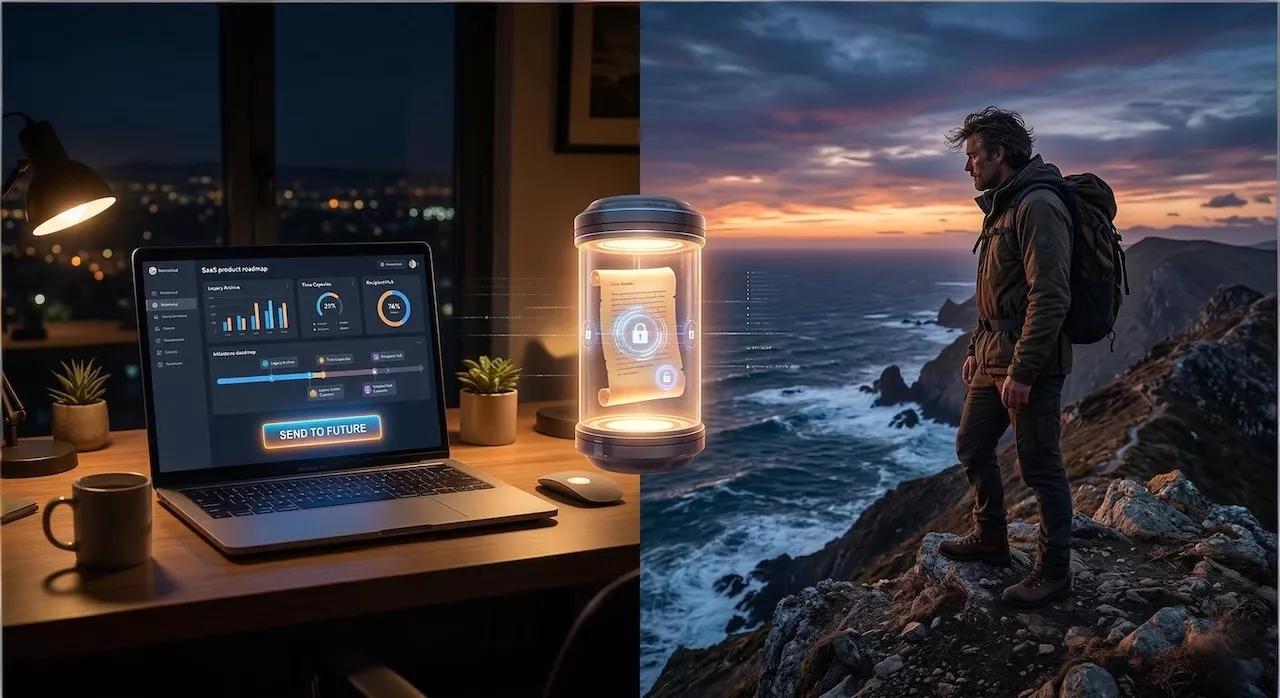
Why I Built EterMail: A Time Capsule for the People I Love Most
I’m a Product Manager who spends all week optimizing for the "immediate now." But getting lost off the grid on a mountain ridge made me realize I had zero infrastructure for the "forever." Here’s why I stopped worrying about conversion rates for a moment and built EterMail—a secure, tamper-proof digital time capsule for the people I love most.
The Most Radical Letter to Your Future Self Is a Promise to Stay Unfinished
The best letter to your future self isn't a memory—it's a mandate. Learn how writing to the version of you still working with love changes everything.
The Ice Tray at Midnight: On Grief, Domestic Minutiae, and the Quiet Work of Becoming Yourself Again
Why do the smallest habits hurt most after someone leaves? A reflection on grief, domestic minutiae, and the quiet moment healing finally begins.