The Drawer That Became a Shrine
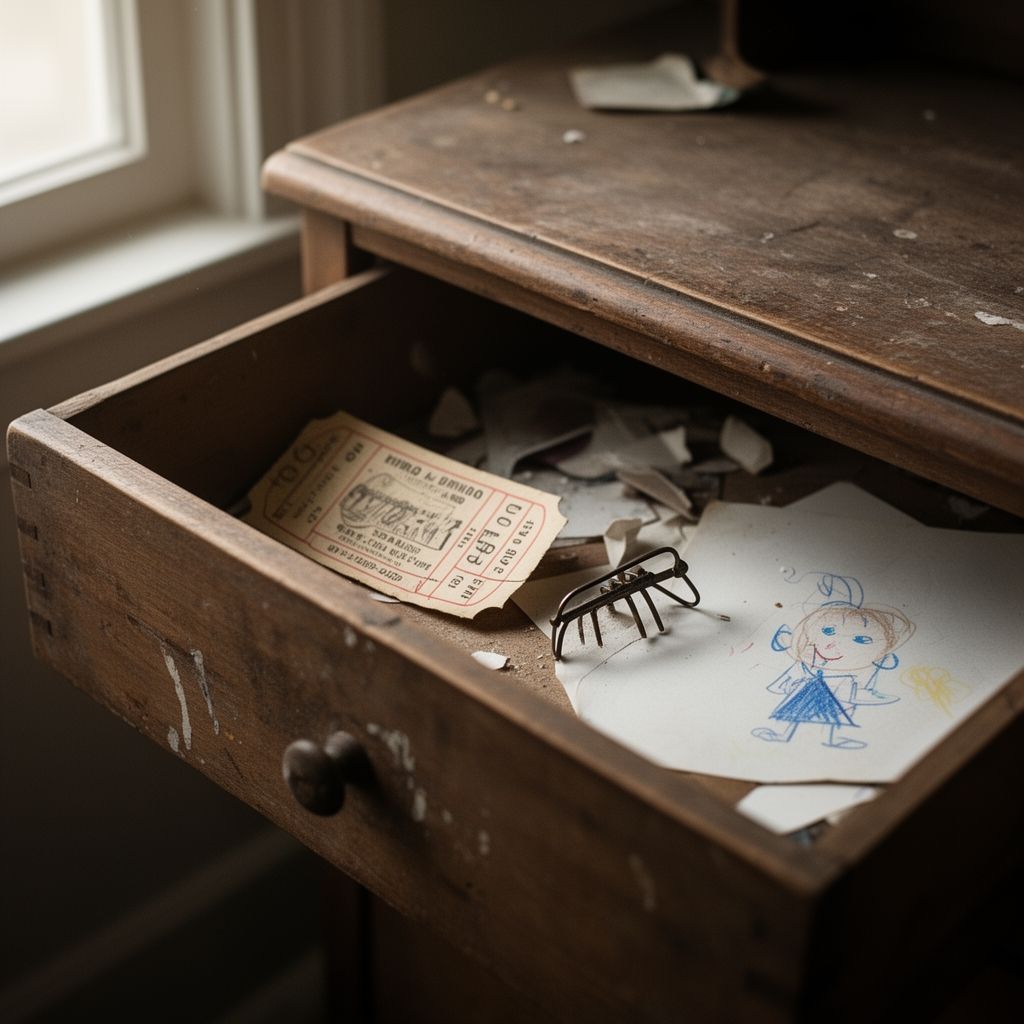
There is a drawer in my mother's house that no one is allowed to open. Not forbidden, exactly—just understood. Inside: a single earring from a set lost in 1987, a pressed corsage the color of dust, my brother's first tooth in a plastic baggie with the date written in fading ballpoint. She has never shown me these things. I discovered them accidentally, age twelve, searching for batteries.
I closed the drawer slowly. Felt something shift in my chest that I couldn't name.
We are all archaeologists of the mundane, excavating our own lives for artifacts worthy of inheritance. The movie ticket stub from a film we barely remember. The bracelet that cracked the night of the argument. A note in handwriting we no longer recognize as our own. We save them for our children, these objects—except our children never asked. Never knew to ask. And in this quiet outsourcing of memory, we may be leaving not treasure, but weight.
The Theology of the Unremarkable
Consider the physics of parental saving. A child draws a hundred drawings. Ninety-nine enter the recycling bin with the quiet efficiency of domestic life. One—perhaps the one where the family resembles actual humans with limbs attached to torsos—earns refrigerator real estate, then a folder, then a plastic bin in the basement marked with the child's name and year.
But who decided? The child has moved on. The child is now thirty-seven and designing actual buildings, or fixing actual people, or simply surviving. The drawing was never meant to outlast the afternoon. Yet here it persists, yellowing, waiting for a future curation that may never come.
My friend Elena recently spent a weekend clearing her father's apartment after his death. He had saved everything. Every card she sent from summer camp. Every report card. A rock she gave him at age six, which he had labeled with her name and the date in his engineer's precise hand. She sat on his bed and wept—not for him, she told me, but for the terrible intimacy of his attention. The weight of being witnessed so completely. The burden of having to carry that witnessing forward.
"I threw most of it away," she said. "I felt like I was killing him twice."
The Digital Shadow and the New Archive
Our parents had basements. Attics. The physical constraint of square footage imposed a natural selection on memory. We have cloud storage. External hard drives. The infinite scroll of digital accumulation where nothing must be discarded because nothing takes up space.
The modern parent creates terabytes of evidence. The first ultrasound. The first steps, filmed from three angles. The first day of school, documented with the urgency of war correspondence. We are not preserving moments; we are producing them. The camera precedes the experience. The documentation replaces the memory.
And still we tell ourselves: They will want this someday.
But what if they won't? What if the most loving act is not comprehensive preservation but curated disappearance? The radical honesty of admitting that some moments were only ever meant to be ours, that our children's inheritance need not include every frame of their becoming?
The Letter as Intention, Not Accident
There is another way. One that requires more courage than the passive accumulation of objects.
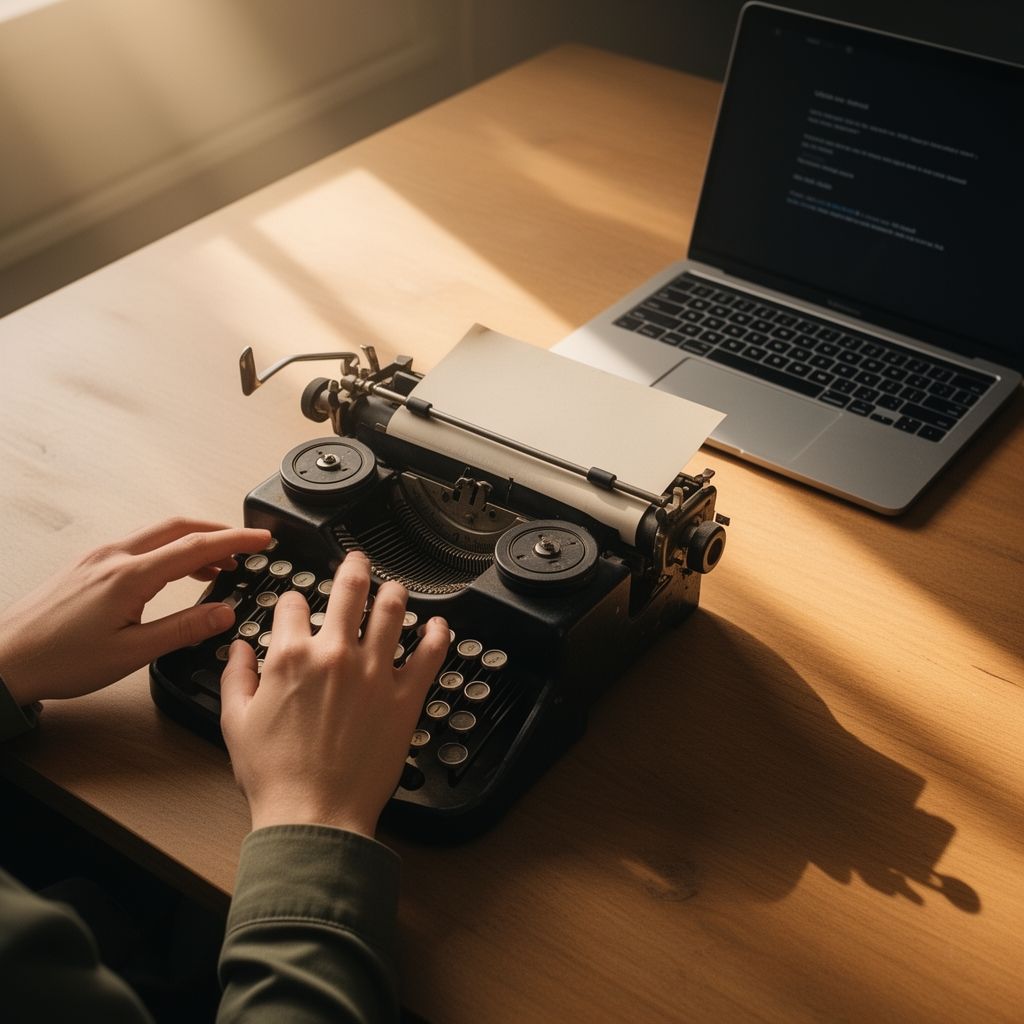
My grandmother left me nothing physical except a recipe for pound cake and a single letter written the year before her death. The recipe is stained, illegible in places. The letter—typed on her ancient Smith-Corona, corrected with white-out—describes a morning in 1952 when she woke before dawn and walked to the beach alone. She does not explain why. She does not connect this to my life, my challenges, my future. She simply witnesses herself, briefly, and offers that witnessing to me.
I have read it perhaps twenty times. I will read it again when she has been dead longer than she was alive. The letter does not demand curation. It does not require me to store, organize, or display. It exists in time—her time, my time, the time between us.
This is the distinction that matters. The junk drawer accumulates by accident, by avoidance, by the inability to let go. The letter—or the intentional message, the chosen communication—accumulates by design. It carries not the weight of everything, but the weight of selection. Of someone choosing what mattered enough to transmit.
The Builder's Dilemma
I spend most nights alone with a screen, "pair programming" with various LLMs until 2 or 3 AM, mapping out architectures for systems that will outlast my attention span. This extreme digital solitude has given me a strange relationship with time—how it compresses in front of code, how it expands when you're waiting for something that hasn't happened yet. I build tools for a living, yet I've come to distrust the impulse to preserve everything simply because we can.
The irony isn't lost on me. I'm a serial entrepreneur who has shipped products across e-commerce, games, and now SaaS. My days are hand-to-hand combat with massive codebases, complex APIs, cold server deployments. I know how to build with the most hardcore tech stacks. Yet the longer I work, the more I'm convinced that technology must ultimately serve genuine, soft human nature—not replace it with infinite storage.
There's a fantasy I return to, borrowed from too many late-night viewings of The Matrix: the desire to build bridges between physical and digital, to create spaces where consciousness might persist across time without losing its humanity. Not uploading everything. Uploading something. Something chosen.
This is the space I found myself building toward. Not comprehensive archival. Not the infinite cloud. But deliberate transmission—messages sent across time with intention rather than accident.
The Architecture of Intentional Memory
Time shifts meaning. A message sent to a child on their eighteenth birthday, written when they were six, carries different weight than the same words spoken in the moment. The distance creates perspective. The delay creates intention. The child receives not your present self, with all its exhaustion and distraction, but your past self, who chose to reach across time with something specific.
I see people struggle with this choice. The temptation to include everything—to attach photos, documents, the digital equivalent of that junk drawer—fights against the discipline of selection. The most powerful messages I've witnessed are often the shortest. A father to his future daughter: I am afraid I will not know you. This is my attempt to begin anyway. A mother to her son at thirty: The thing I want you to remember is not in this letter. It is that I wrote it.
The best way to fight forgetting isn't taking another screenshot; it's setting an alarm for the future. By using EterMail to set a delivery date 5 years from now, you completely free yourself from the anxiety of the present. You stop hoarding and start choosing.
The Ethics of Letting Go
I am not arguing for minimalism as moral superiority. The saved objects carry real meaning—just not always the meaning we assign. My mother's drawer, I have come to understand, was never for me. It was for her. The keeping was the ritual. The accumulation was the practice of love in a language she could not otherwise speak.
But the ethical question remains: At what point does our memory-keeping become their burden? When does our need to be remembered exceed their capacity to remember?
The honest answer may be: always. Inheritance is inherently asymmetrical. We cannot know what our children will need, what they will cherish, what they will discard with guilt and relief. We can only know our own intentions in the making.
Perhaps the kindest practice is to make some things temporary by design. To write letters that expire. To create messages meant for specific moments, not eternal storage. To trust that our children will generate their own archives, their own junk drawers, their own complicated relationships with what remains.
The Disappearing as Gift
I have started a practice I do not fully understand. Each year, on my daughter's birthday, I write her a letter and schedule it for delivery when she turns twenty-five. I do not keep copies. The platform keeps nothing I do not explicitly save. In ten years, I will have written fifteen letters she has not yet read. In twenty years, twenty-five. The accumulation exists only in future time.
This is my attempt at ethical memory. Not the comprehensive preservation of everything, but the selective transmission of something. The acknowledgment that I will not be there to curate her understanding of me. The trust that what matters will survive, and what does not will properly disappear.
My mother still has her drawer. I still do not open it. But I have begun my own—digital, scheduled, intentional—and I hope it serves a different function. Not the weight of everything saved, but the weight of something chosen. The archaeology not of accident, but of design.
The most honest gift we can leave our children may be the space to forget us properly. To mourn without inventory. To remember without curating. To discover, in their own time, that we loved them enough to let some of ourselves disappear.
What is EterMail?
EterMail is a revolutionary time capsule service that allows you to send messages, photos, and videos to the future (up to 30 years). Seal your memories and thoughts today, and they'll be delivered when the time is right.
Time Capsule
Send messages up to 30 years in the future
Rich Media
Text, photos, and videos supported
Secure & Private
Your memories are safely encrypted
EterMail Team
We're the team behind EterMail, dedicated to helping you preserve and share timeless messages with your loved ones. Our mission is to make it easy to express your love, share your wisdom, and create lasting connections that transcend time.
Related Articles
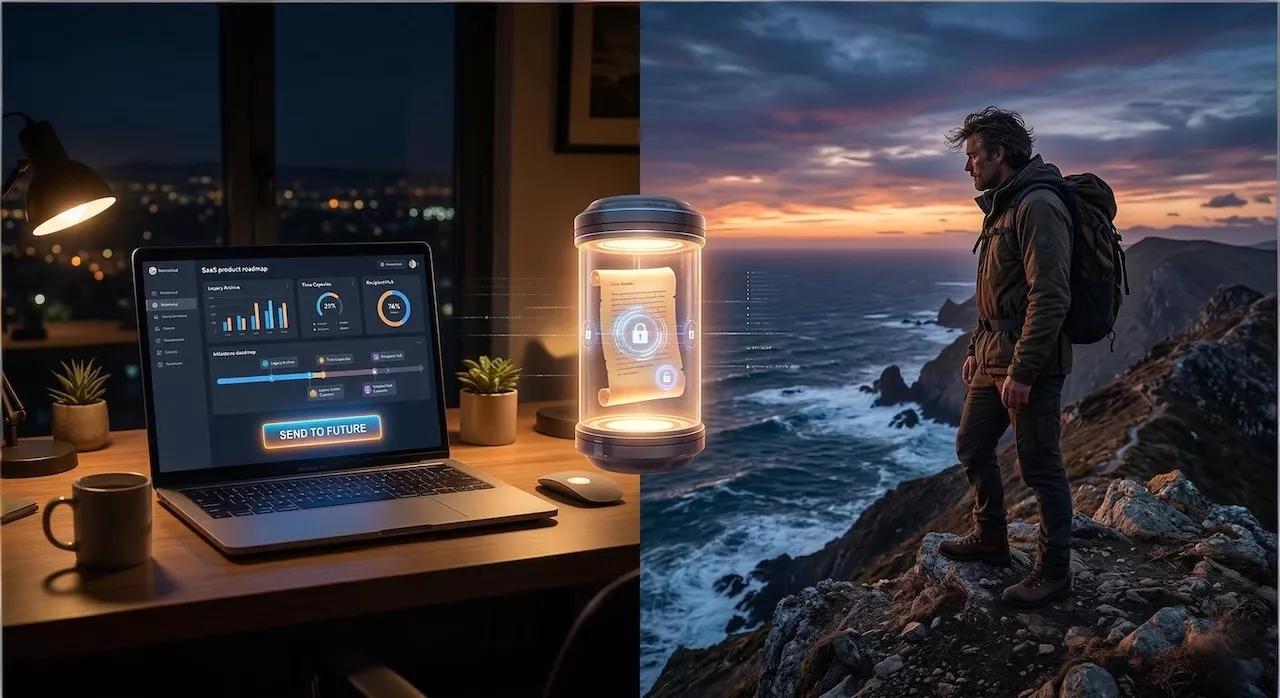
Why I Built EterMail: A Time Capsule for the People I Love Most
I’m a Product Manager who spends all week optimizing for the "immediate now." But getting lost off the grid on a mountain ridge made me realize I had zero infrastructure for the "forever." Here’s why I stopped worrying about conversion rates for a moment and built EterMail—a secure, tamper-proof digital time capsule for the people I love most.
The Most Radical Letter to Your Future Self Is a Promise to Stay Unfinished
The best letter to your future self isn't a memory—it's a mandate. Learn how writing to the version of you still working with love changes everything.
The Ice Tray at Midnight: On Grief, Domestic Minutiae, and the Quiet Work of Becoming Yourself Again
Why do the smallest habits hurt most after someone leaves? A reflection on grief, domestic minutiae, and the quiet moment healing finally begins.