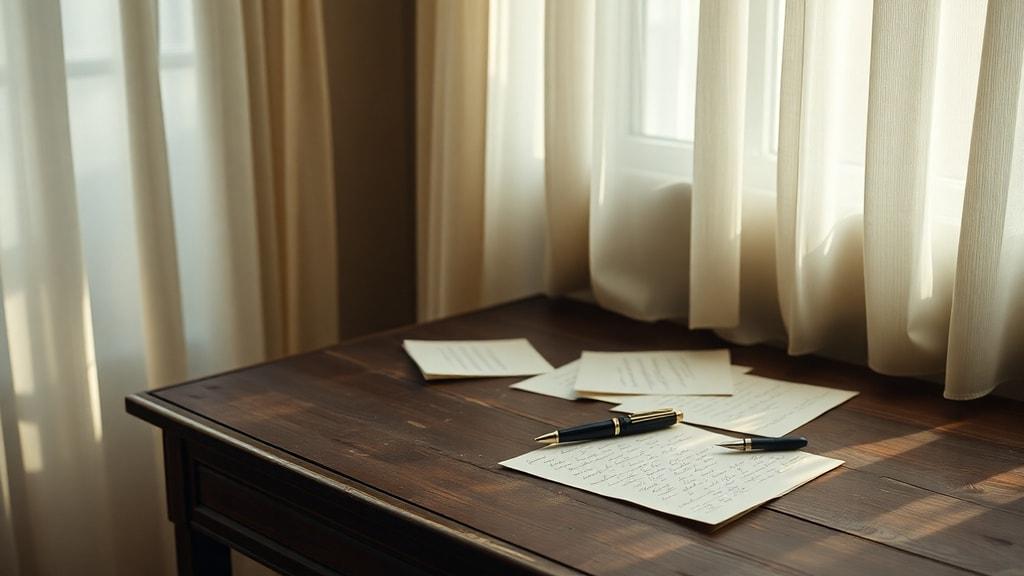
There is a particular drawer in my mother's house that still holds the evidence. Pages torn from spiral notebooks, margins of utility bills, the backs of envelopes addressed to people who no longer live at those addresses. Each one carries the same word written dozens of times, the letters shifting slightly with every iteration: my father's last name, practiced in her careful cursive before she ever signed it on a marriage certificate. The loops grew more confident. The capital M settled into a shape she would use for forty years. She was rehearsing a future she believed in enough to commit to paper, again and again, until her hand believed it too.
We do not often think of handwriting as prophecy. Yet hidden in the mundane archaeology of our lives—the grocery lists, the appointment reminders, the signatures on documents we barely read—lie rehearsals of futures we are still learning to inhabit. The name we write before it is legally ours. The voice we practice for a child who has not yet learned to read. The careful block letters of a caregiver we have not yet become, spelling out medications and meal times with a precision that belies our fear.
The Graphite Archaeology of Becoming
The Signature We Rehearse
Every major transition in adult life seems to require a new signature. The first time you write your married name, the letters feel borrowed, costume-like. Your hand hesitates between the first and second syllables. The descender on the y catches where it never caught before. You are not merely learning to write; you are teaching your muscles to recognize a self that does not yet feel entirely real.
I have seen friends practice their new signatures for hours before a wedding, before a legal name change, before adopting a professional pseudonym. They are not being vain. They are performing a ritual older than the ceremony itself: the bodily incorporation of a new identity. The hand must know before the heart fully believes. Each repetition is a small act of faith, a prediction committed to muscle memory that this future self will one day feel inevitable.
The signatures that survive in family archives tell stories their owners never intended. My grandmother's maiden name signature, preserved in a high school yearbook, shows a girl who dotted her i's with small circles. Her married signature, forty years later, has straightened into something efficient and unadorned. The transformation is not merely stylistic. It is the physical record of a life that reshaped her, loop by loop, into someone who no longer needed the small rebellions of youth.
The Voice We Practice for Those Who Cannot Yet Hear
Long before I became anyone's parent, I found myself writing letters I had no recipient for. Not the dramatic unsent letters of romantic disappointment, but something quieter: notes explaining why the sky is blue, why people cry at weddings, why some dogs are afraid of thunder. I wrote them on commuter trains, in waiting rooms, in the margins of work meetings. The handwriting was different from my usual scrawl—slower, more legible, as if I were already accounting for eyes that would struggle to decode it.
This is the strange anticipatory work of becoming. We practice voices for roles we have not yet assumed, writing in the conditional tense of a future that may never arrive. The letters to unborn children, the advice for a daughter's first heartbreak, the explanation of inheritance to a son who does not yet understand mortality—these are not merely sentimental exercises. They are cognitive rehearsals, ways of inhabiting a self we are not yet certain we can become.
The Margins as Territory of the Possible
The Grocery List as Autobiography
Consider the ordinary grocery list, that most disposable of documents. Yet even here, we predict futures. The list written in the trembling hand of a new caregiver, every item spelled out with unnecessary precision—"2% milk, not whole"—reveals someone still learning the preferences of a person they love. The list written in haste, abbreviations and shorthand known only to the writer, speaks of long intimacy, of futures so thoroughly shared they require minimal translation.
I have kept lists from periods of my life I would otherwise struggle to reconstruct. The list that includes "ginger tea, nausea" marks a pregnancy I have otherwise buried in selective memory. The list with "whiskey, condolence card" records a grief I never journaled about directly. These are predictions of a different order: not what we will become, but what we will need, what we will survive, what we will consume in order to continue being.
The Cursive of Caregiving
There is a particular handwriting that emerges under the pressure of caring for someone declining. I first noticed it in my own lists during my father's illness: the letters grew more deliberate, more separated, as if clarity had become a moral imperative. I was writing for a future self who would be exhausted, who would need to read these notes without cognitive effort. I was also, unconsciously, writing for a future in which I might need to hand these instructions to someone else, to translate my intimate knowledge into a language strangers could follow.
The handwriting of caregiving is a prediction of delegation, of mortality, of the moment when our intimate knowledge must become shareable. It is never as elegant as our personal script. It is more functional, more exposed. And in that exposure, it reveals something true about the futures we resist imagining: we practice our own replacement in every careful letter we form for another's eyes.
When the Hand Finally Believes
The Moment of Unflinching Recognition
There comes a moment, if we are fortunate, when the rehearsed future becomes the lived present. The signature we practiced no longer feels borrowed. The voice we wrote in for a child now speaks naturally, without the self-consciousness of performance. The handwriting settles into something we no longer notice, which is perhaps the truest sign of integration: when the prophecy has become so thoroughly realized that we forget it was ever prediction.
I think of this when I see my own name written now, the married version, the professional version, the version I use when signing books. The hesitation is gone. The hand moves with the efficiency of long practice. Yet I can still find, in old notebooks, the earlier attempts—the versions that were trying too hard, that were still negotiating with a self they were not sure deserved to exist. The contrast is not embarrassing. It is evidence of becoming, the graphite record of a transformation that felt, at the time, like it might never complete itself.
The Letters We Schedule for Futures We May Not Witness
This is where the practice of handwriting meets its most profound application. We write not only for futures we hope to inhabit, but for futures we may not survive to see. The letter to a child on their eighteenth birthday, composed when they are still learning to read. The message to a spouse for a tenth anniversary, written in the first year of marriage when the future still feels unlimited. The wisdom we compress into paragraphs for a next generation we will not meet.
These are not merely sentimental gestures. They are acts of temporal architecture, structures we build across time that do not require our presence to complete. The handwriting that practices these messages is doing something remarkable: it is creating continuity independent of biological survival, a thread of consciousness that persists without the consciousness that originated it.
I know this impulse intimately. For years I sat alone at 2 AM, pair-programming with LLMs or sketching architectures by screen-glow, chasing a wild fantasy that has never left me since I first watched The Matrix as a teenager: the dream of building a bridge between the physical and digital worlds, of creating spaces where human consciousness could persist and travel beyond the limits of biology. That obsession with "dialogues across time"—with conversations that outlast the speaker—led me to build EterMail. Because I know that a letter written to the future needs to be guarded even more fiercely than a bank password. The encryption I obsessed over, the server redundancy I fought for in deployment after deployment, all of it serves the same human impulse that drove my mother to practice her married name: the need to make promises across time that our later selves, or someone else entirely, will be held to.
The Final Unflinching
To write your own name without flinching at the person who holds the pen—this is the quiet triumph that accumulates across decades of rehearsal. The first attempts are always awkward. The letters too careful or too rushed, the spacing uncertain, the identity being claimed still provisional. But with repetition, with the accumulated evidence of having survived the transitions we practiced for, the hand settles. The signature becomes natural. The voice finds its register.
What we leave behind, in the drawers and margins and scheduled messages of our lives, is not merely the record of who we were. It is the archaeology of who we were learning to become, the graphite evidence of futures we rehearsed into reality. The prediction that became true not because we foresaw it accurately, but because we wrote ourselves toward it with sufficient persistence that the writing, eventually, became indistinguishable from the living.
The hand that practiced my mother's married name for those long months before her wedding is the same hand that, decades later, wrote me letters I still cannot read without weeping. The prophecy completed itself. The rehearsal became the performance. And somewhere in the accumulated evidence of all that handwriting, there remains the trace of a person who believed in a future enough to write her way into it, one uncertain letter at a time.
<
What is EterMail?
EterMail is a revolutionary time capsule service that allows you to send messages, photos, and videos to the future (up to 30 years). Seal your memories and thoughts today, and they'll be delivered when the time is right.
Time Capsule
Send messages up to 30 years in the future
Rich Media
Text, photos, and videos supported
Secure & Private
Your memories are safely encrypted
EterMail Team
We're the team behind EterMail, dedicated to helping you preserve and share timeless messages with your loved ones. Our mission is to make it easy to express your love, share your wisdom, and create lasting connections that transcend time.
Frequently Asked Questions about Future Predictions
What should I include in a letter to my future self?
How do handwritten messages differ from digital ones in emotional impact?
Why do we practice writing names or voices before we feel ready to claim them?
Related Articles
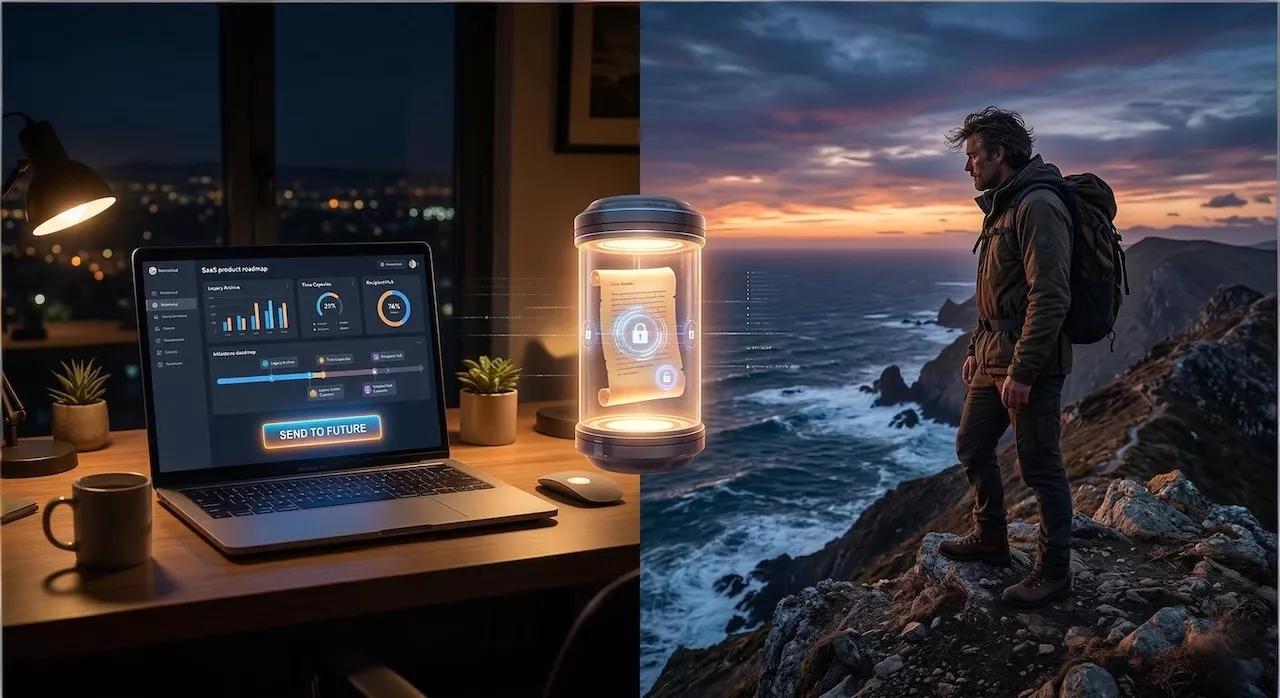
Why I Built EterMail: A Time Capsule for the People I Love Most
I’m a Product Manager who spends all week optimizing for the "immediate now." But getting lost off the grid on a mountain ridge made me realize I had zero infrastructure for the "forever." Here’s why I stopped worrying about conversion rates for a moment and built EterMail—a secure, tamper-proof digital time capsule for the people I love most.
The Most Radical Letter to Your Future Self Is a Promise to Stay Unfinished
The best letter to your future self isn't a memory—it's a mandate. Learn how writing to the version of you still working with love changes everything.
The Ice Tray at Midnight: On Grief, Domestic Minutiae, and the Quiet Work of Becoming Yourself Again
Why do the smallest habits hurt most after someone leaves? A reflection on grief, domestic minutiae, and the quiet moment healing finally begins.