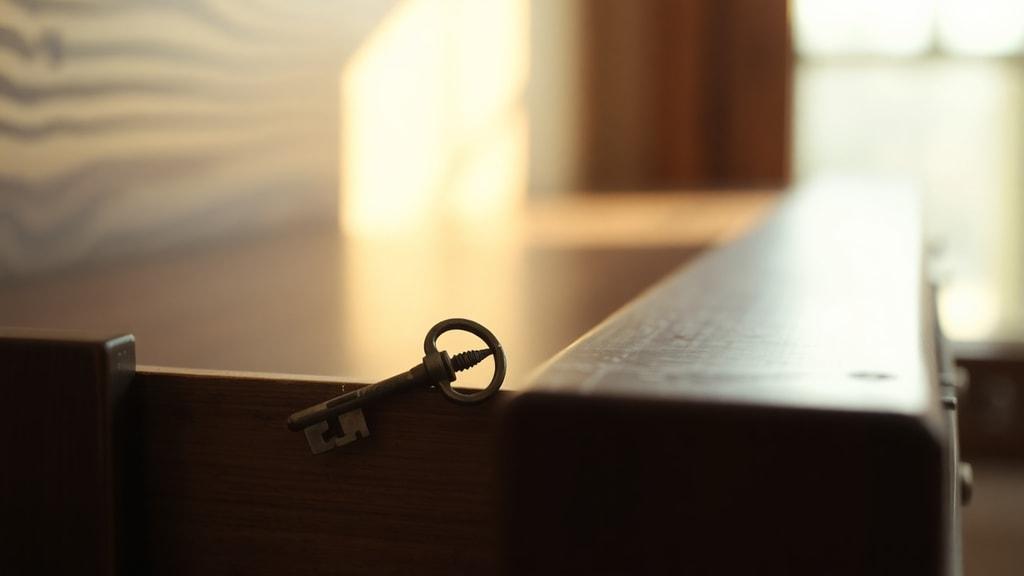
The Drawer of Possible Entrances
There is a drawer in every home that holds the archaeology of futures once believed. I found mine last October while searching for a working flashlight during a blackout. My hand closed around cold brass, then another, then something aluminum and unfamiliar. When the power returned, I spread them across the kitchen table like a cartographer mapping territories I no longer possessed.
A key to my sister's apartment in Chicago, cut in 2019, the year she swore she'd never leave. The teeth still sharp, still mathematically capable of lifting her deadbolt, though she moved to Portland in 2021 and the new tenant changed the locks within a week.
A skeleton key from my grandmother's house in Vermont, sold to strangers after her funeral, the kind of key that once opened every interior door because privacy was a luxury the farmhouse didn't afford. I kept it because she kept it, because keeping it meant some part of the house's logic still belonged to me.
And the small silver copy I had made for someone who returned it in a padded envelope six months later, the note inside saying only I thought you should have this back, as if the key itself were an accusation, or an apology, or both.

The Mathematics of Trust
Every duplicated key is a prediction rendered in metal. We do not cut copies for people we doubt. The act itself is a small prophecy: you will still be here, you will still be welcome, this arrangement will persist long enough to justify the expense and the ceremony of handing it over.
The locksmith doesn't ask questions. They simply measure the original against blank metal, trace the pattern of peaks and valleys, and produce a functional replica. But they are also, in their mechanical way, manufacturing evidence of our optimism. Each key is a physical wager against the future's instability.
I think of this when I consider the digital equivalents we create now—the shared passwords, the emergency contacts, the location sharing left on after relationships end, the cloud storage folders we forget to revoke. These are keys too, invisible but no less predictive. We grant access because we cannot imagine the moment we will need to rescind it.
The difference is that digital keys leave no weight in our palms. They don't accumulate in ceramic bowls on entry tables, don't rattle softly when we move homes, don't catch the afternoon light in ways that make us pause and remember. The physical key insists on being witnessed. It demands we confront the gap between what we predicted and what arrived.
When the Lock Outlives the Permission
My friend Elena kept her ex-husband's key for eleven years. Not because she wanted re-entry—she had bought him out of the house, had renovated every room he ever occupied—but because the key itself had become something else. "It proved I wasn't wrong to give it," she told me. "The wrongness came later. The giving was correct at the time."
This is the particular cruelty of kept keys. They are innocent artifacts of guilty futures. The metal didn't mislead us. Our predictions did. And yet we punish the key by keeping it, by letting it grow tarnished in the dark, by occasionally testing it against locks that have changed or doors that no longer exist.
I have done this. I have held my sister's Chicago key to my own apartment door, knowing it would fail, wanting to confirm that failure. There is a strange comfort in the mechanical impossibility, the way the teeth catch and stop, the way the cylinder refuses to turn. It is the physical world confirming what we struggle to accept emotionally: that permission, once given, can be fully and finally revoked.

The Inheritance of Access
The unlabeled skeleton key from my grandmother's house presents a different problem. There is no lock to test it against, no person to return it to, no relationship to mourn or renegotiate. It is pure potential without destination, a key that opens something that no longer exists in a location I no longer own.
And yet I cannot discard it. This is not mere sentiment. The key represents a transfer of access across generations, the way my grandmother's mother gave her keys to the farmhouse, the way those keys represented the family's foothold in a particular geography, a particular economic possibility, a particular way of being in the world.
When we inherit keys without context, we inherit the shape of futures our ancestors imagined. The skeleton key doesn't fit my life in any literal sense. I live in a rental with keypad entry. But it fits something else—the part of me that wants to believe in continuity, in the possibility that what we build and grant access to might outlast our own occupancy.
This is where digital legacy intersects with physical inheritance in ways we are only beginning to understand. The passwords we don't share, the accounts we don't document, the encrypted messages that die with our devices—these are invisible keys that our descendants will never find in drawers. The skeleton key at least announces itself. The digital key simply disappears, leaving no evidence that permission was ever granted or that futures were ever predicted.
The Ceremony of Keeping and Release
I have developed rituals around these objects. Every January, I spread the keys across the same kitchen table and name what each one was meant to open. I say the names aloud—Lincoln Park, third floor, 2019; Vermont farmhouse, interior east, before the sale; his apartment, the one with the cat who hated me—and I note which locks have changed, which buildings have been demolished, which permissions have been explicitly or implicitly withdrawn.
Then I return them to the drawer. Not all of them. Some years I release one. The key to the summer sublet in 2015, the roommate who left without forwarding address, the lock that was certainly changed within days. I carry it to the river and drop it in, watching the silver flash once before sinking. The ceremony matters because the prediction mattered. We dignify our wrong forecasts by acknowledging them, by giving them proper burial.

Writing Futures We Can Still Enter
The keys we keep teach us something about the temporality of trust. We are always predicting, always manufacturing evidence of futures we want to believe in. The question is whether we can become more conscious of this process, more deliberate in what we predict and how we prepare for the possibility that our predictions will fail.
I've spent enough late nights alone with glowing screens—mapping architectures, wrestling with LLMs, chasing that strange resonance between human intention and machine execution—to know that digital solitude has its own texture of loneliness. But it also taught me something: the most profound human exchanges happen across gaps we cannot bridge in real time. A letter written at 2 AM to someone who will read it years later is a dialogue across time, a way of being present without requiring presence.
This is where I have found unexpected utility in the practice of future-facing correspondence. Not the casual text or the email that will be buried in archives, but the deliberate letter composed to a specific future self or specific future recipient, scheduled to arrive when the prediction has either fulfilled or dissolved itself. The letter to my sister, written in 2019, scheduled for her thirtieth birthday in 2024, arrived without my remembering I had written it. It predicted our closeness, our continued cohabitation in the same city, our weekly breakfasts. It was wrong in its specifics. But it was right in something larger—the desire for connection, the willingness to predict its continuation, the courage to be witnessed in that prediction.
The best way to fight forgetting isn't taking another screenshot; it's setting an alarm for the future. By using EterMail to set a delivery date five years from now, you completely free yourself from the anxiety of the present. You write the letter, you set the date, and then you let go—knowing that your future self, or your future loved one, will receive it regardless of what changes in between. The platform was built from my own obsession with this problem: how to make predictions in language that can survive the erosion of memory, the chaos of inbox zero, the simple human failure to follow through. I wanted something that would outlast my own discipline, my own optimism, my own tendency to start rituals and abandon them.
The difference is that a letter can accommodate its own wrongness. It can say I don't know if this will reach you in the circumstances I imagine, can build uncertainty into its architecture, can be read with compassion for the predictor rather than judgment of the prediction. The key offers no such flexibility. It either turns or it doesn't. The letter offers the possibility of being understood across the distance between what we predicted and what arrived.
The Permission We Grant Ourselves
I still have the drawer. I still have the keys, most of them, though the collection grows slower now. I am more cautious in what I predict, more aware of the weight of metal in my palm when I hand it over. But I have not stopped. To stop predicting, to stop granting access, to stop manufacturing the evidence of trust—this would be its own kind of death, a pre-emptive locking of doors against futures that might still arrive as imagined.
The key that opens nothing you still have permission to enter is not a failure. It is a record of having been open, of having once believed that openness was sustainable, that the future would honor the access you granted. We keep these objects not because we are stuck in the past, but because we are honoring the self who was brave enough to predict, who was willing to be wrong in the specific ways that only love and trust make possible.
The drawer will outlast me. Someone will find these keys and wonder at their purposes, their destinations, the locks they once commanded. They will be wrong in their guesses, as I have been wrong in mine. But they will hold the same evidence I hold: that someone once trusted enough to make a copy, to hand it over, to predict that the door would stay open, that the welcome would persist, that the future would be worth entering together.
Some of the doors did stay open. Some of the welcomes did persist. The keys to those are in use, worn smooth by daily turning, too ordinary to keep in drawers. We only archive the exceptions, the permissions withdrawn, the predictions that time dissolved. This is not a tragedy. This is the museum of our courage, the evidence that we were willing to be wrong in the particular ways that only hope makes possible.
And when I write now—letters to my future self, messages to my niece on her eighteenth birthday, words to a partner I cannot yet imagine—I am making different kinds of keys. They weigh nothing. They cannot be tested against locks. But they carry the same prediction, the same vulnerability, the same brave manufacturing of evidence that the future will be worth entering, and that we will still have permission to enter it when it arrives.
What is EterMail?
EterMail is a revolutionary time capsule service that allows you to send messages, photos, and videos to the future (up to 30 years). Seal your memories and thoughts today, and they'll be delivered when the time is right.
Time Capsule
Send messages up to 30 years in the future
Rich Media
Text, photos, and videos supported
Secure & Private
Your memories are safely encrypted
EterMail Team
We're the team behind EterMail, dedicated to helping you preserve and share timeless messages with your loved ones. Our mission is to make it easy to express your love, share your wisdom, and create lasting connections that transcend time.
Frequently Asked Questions about Future Predictions
Why do we keep objects that remind us of failed relationships or lost futures?
How can writing letters to my future self help me process uncertainty?
What should I consider when making long-term predictions about my life?
Related Articles
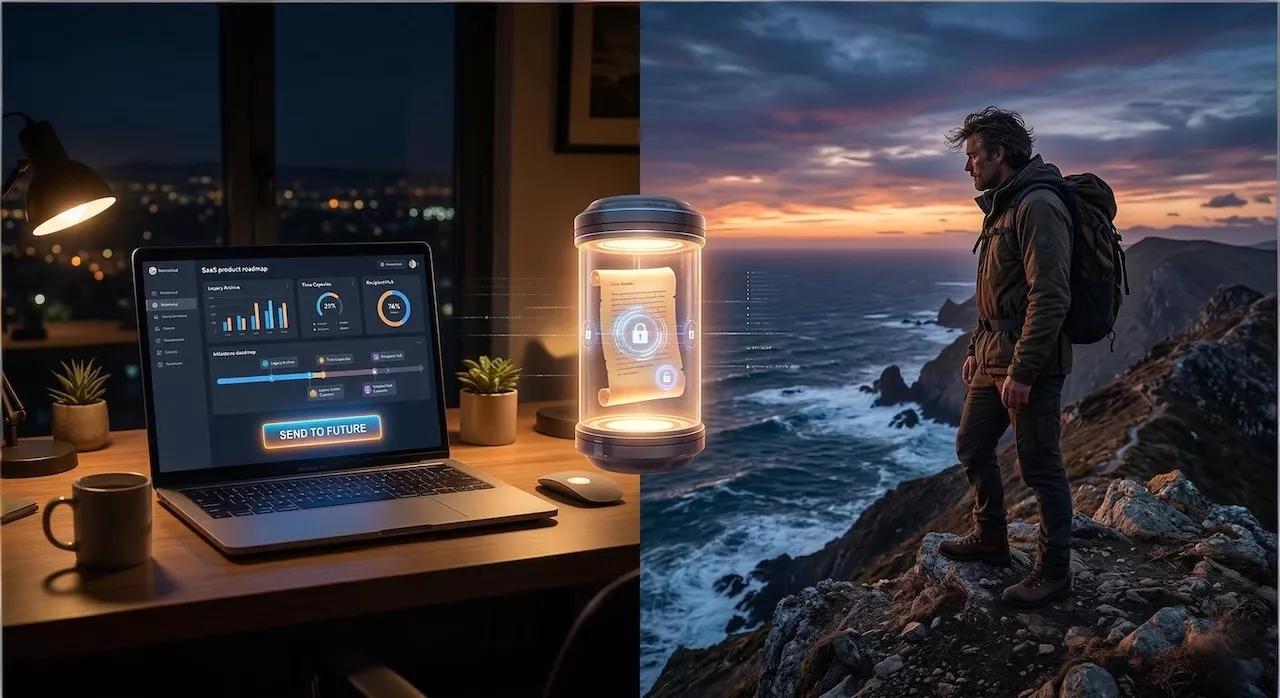
Why I Built EterMail: A Time Capsule for the People I Love Most
I’m a Product Manager who spends all week optimizing for the "immediate now." But getting lost off the grid on a mountain ridge made me realize I had zero infrastructure for the "forever." Here’s why I stopped worrying about conversion rates for a moment and built EterMail—a secure, tamper-proof digital time capsule for the people I love most.
The Most Radical Letter to Your Future Self Is a Promise to Stay Unfinished
The best letter to your future self isn't a memory—it's a mandate. Learn how writing to the version of you still working with love changes everything.
The Ice Tray at Midnight: On Grief, Domestic Minutiae, and the Quiet Work of Becoming Yourself Again
Why do the smallest habits hurt most after someone leaves? A reflection on grief, domestic minutiae, and the quiet moment healing finally begins.