
The Birthday Gift That Arrived Three Months Late
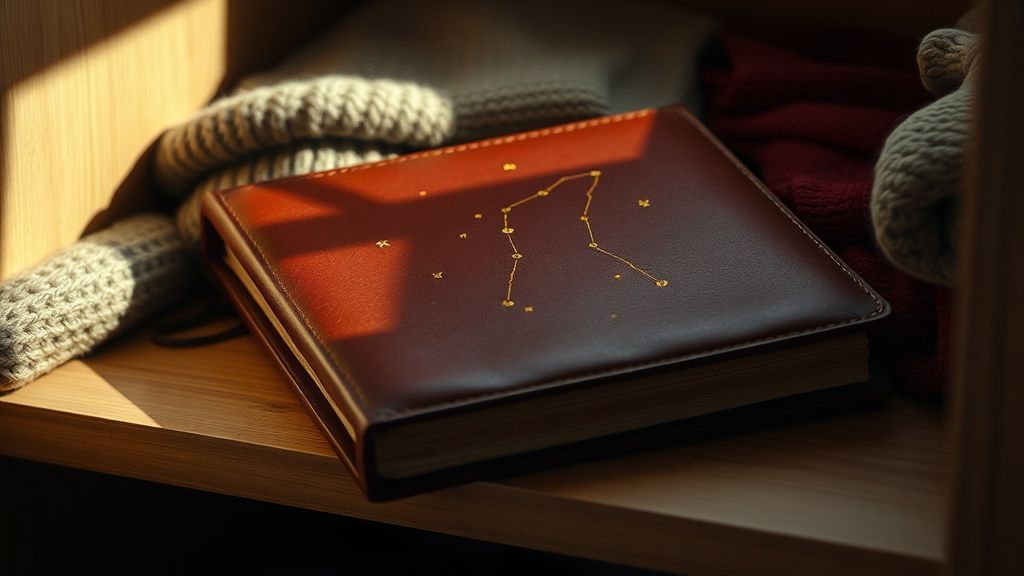
She found it in the back of her closet in October: a leather-bound journal, embossed with a constellation map, bought in July for a birthday that wouldn't come until December. The recipient had been her partner of four years, a man who had spent the previous spring photographing the night sky with borrowed equipment, who had talked about dark-sky preserves the way others discuss beach resorts. She had ordered the journal during a lunch break, imagining him filling its pages with exposure times and location coordinates, imagining herself finding it years later on a shelf they would share.
By September, he had sold the camera. By October, he had moved out. The journal remained unopened, its wrapping still crisp, a future she had constructed alone now taking up physical space in her one-bedroom apartment.
We are all amateur futurists when we love someone. We forecast their desires, their trajectories, their secret selves still emerging. We make investments—in objects, in plans, in emotional architecture—based on predictions that feel less like guesses than like observations of something already in motion. The tragedy is not that we get these predictions wrong. The tragedy is how long we continue building after the foundation has shifted.
The Archaeology of Abandoned Tomorrows
Every misfired prediction leaves evidence. The relationship counselor I spoke with last winter described them as "future debris"—the material traces of a shared tomorrow that only one person was still constructing. She keeps a file of examples from her practice: the couple who renovated their kitchen around a bread-making hobby that ended with the sourdough starter's death; the parents who funded graduate school for a career their child abandoned after one semester; the woman who learned Italian for a retirement in Tuscany that her husband had stopped mentioning sometime in 2019.
These debris fields accumulate in specific locations. Credit card statements become geological records of misaligned intention. Browser tabs persist as shrines to research conducted in the plural. Saved vacation rentals, wish-listed furniture, the Netflix queue curated for two—these digital artifacts outlast the emotional agreements that created them. We become curators of museums no one visits, docents explaining exhibits to empty rooms.
The financial cost is calculable. The psychological cost is something else entirely. Each piece of future debris represents a micro-investment of self, a small wager on a continuity that proved temporary. To discard the Italian phrasebook feels like discarding the self who believed she would need it. To cancel the reservation feels like admitting the conversation about going never actually happened, or happened in a language one of you had already stopped speaking.
The Asymmetry of Shared Dreams
What makes these misfired predictions so particularly disorienting is their fundamental asymmetry. Rarely do two people abandon a shared future simultaneously, with identical velocity and identical grief. More commonly, one person's forecast begins diverging in increments too small to announce: the hobby that becomes occasional, then theoretical, then forgotten; the retirement destination mentioned with decreasing specificity until it becomes "somewhere warm," then simply silence.
The other person continues building. They purchase the journal, bookmark the rental, contribute to the account. They are not foolish. They are faithful to a pattern that once felt mutual, updating their predictions with the most recent data, which happens to be the data their partner last provided. They are, in essence, maintaining a database that the other person has already migrated away from.
This asymmetry produces a particular quality of loneliness: the loneliness of being the last one to inhabit a future. The partner who has already moved on—emotionally, practically, sometimes physically—experiences a different loneliness, the guilt of undisclosed divergence, the exhaustion of maintaining a performance of shared intention. Both are trapped in predictions that have become performances, scripts written for audiences that have stopped attending.

The Cost of Clearing the Cache
There comes a moment—usually recognized only in retrospect—when maintenance of the shared prediction becomes unsustainable. The journal is discovered in the closet. The browser tabs, once numbering in the dozens, are closed in a single afternoon of something between productivity and grief. The account is renamed, or closed, or simply left to atrophy.
This clearing is not neutral administrative work. It is a form of mourning, often unacknowledged because its object was never fully real. We have rituals for ended relationships, for deaths, for visible losses. We lack rituals for the dissolution of futures that existed primarily in projection. The Italian you learned for a conversation that won't happen has no funeral. The constellation journal has no eulogy beyond your own recognition, opening the closet, of what it was meant to become.
Some people delay this clearing indefinitely. The future debris becomes permanent installation, a kind of emotional hoarding. The browser tabs migrate to new computers. The saved items accumulate across platforms. This preservation is not hope, exactly, though it can resemble hope from certain angles. It is more accurately a failure to update the self-concept, a persistence of the person who made the prediction even as the prediction's subject has become unrecognizable.
Learning to Forecast Differently
The alternative to prediction is not cynicism or withdrawal. It is a more provisional, more communicative form of future-building: one that checks in with greater frequency, that treats forecasts as collaborative documents rather than individual projections, that builds in revision as feature rather than failure.
This is where the practice of writing to futures—one's own, shared, or anticipated—becomes something more than sentimental exercise. To compose a letter to a future self, or to schedule a message for a future anniversary, is to make prediction explicit and therefore examinable. It is to say: this is what I believe now, this is what I project, knowing that belief and projection are temporary arrangements subject to negotiation and change.
The value lies not in accuracy but in the act of articulation. A letter to your future self in ten years, composed with current information, becomes a document against which to measure transformation—not to judge it as deviation or failure, but to understand it as the probable outcome of living. A message scheduled for a future anniversary, written in the present tense of commitment, becomes either a beautiful arrival or a necessary prompt for conversation about whether the commitment still describes your shared reality.

The Letters We Write to Futures That May Not Include Us
There is a particular courage in composing messages for futures you cannot guarantee. To write to a child who may grow into someone you don't recognize, or to a partner whose continuity you cannot assume, or to a self who will have survived experiences you cannot yet imagine—this is to engage with prediction honestly, as speculation rather than prophecy.
I know this tension intimately. Most nights I'm still at my desk until 2 or 3 AM, "pair programming" with LLMs or sketching architectures by the glow of three monitors, building systems that will outlast the specific version of me who designed them. That extreme digital solitude—hours alone with code that will eventually run without me—has given me a strange, almost physical understanding of what it means to send something forward into time, uncertain who will receive it. The outdoor weekends I steal back from those nights, hiking steep trails or surfing until my shoulders burn, keep reminding me that the present moment is unrepeatable, that any bridge we build to the future must honor the fragility of now.
The platforms that enable this practice, that allow messages to be composed and delivered across years or decades, are not merely technological utilities. They are architectures for a particular kind of ethical relationship with time. They ask: what would you say if you knew you couldn't revise in real-time? What would you commit to paper, to encryption, to scheduled delivery, that forces you to own your present predictions without the safety of continuous editing?
This is not about preserving a static self or relationship. It is about creating evidence of your forecasting process, making visible the predictions you made and the reasons you made them. The constellation journal, had it been accompanied by a note—"I bought this because you seemed so alive when you talked about the stars, and I wanted to honor that aliveness"—would have been something different. Still perhaps unused, still perhaps painful to discover, but carrying explicit information about the prediction's basis rather than leaving the survivor to reconstruct intention from material evidence alone.
The Generosity of Revised Forecasts
The most difficult practice, and perhaps the most necessary, is learning to revise predictions about others with something approaching generosity. To recognize that your partner's abandonment of astronomy is not abandonment of you, even if it disrupts the future you had constructed. To understand that your child's change of direction represents their own emerging forecasting capacity, their own right to build and discard and rebuild.
This generosity extends, finally, to oneself: the permission to have been wrong, to have invested in futures that didn't materialize, to have cleared caches that contained genuine hope. The journal in the closet is not evidence of foolishness. It is evidence of having believed in someone else's becoming, which remains among the more beautiful human capacities even when it misfires.
The best way to fight forgetting isn't taking another screenshot; it's setting an alarm for the future. When I built EterMail, I kept returning to those 3 AM sessions, imagining someone else alone at their desk, wanting to send something forward but afraid it would be lost, intercepted, or simply forgotten in some database migration. That's why I obsessed over end-to-end encryption and extreme server redundancy. Because I know that a letter written to the future needs to be guarded even more fiercely than a bank password. By using EterMail to set a delivery date five years from now, you completely free yourself from the anxiety of the present—you've made the prediction explicit, you've done the work of articulation, and you can let it go, knowing it will arrive exactly when it should.
We do not stop predicting. We cannot, and we should not want to. But we might learn to predict with lighter hands, to build futures that can be dismantled without demolition, to leave messages across time that acknowledge their own provisionality. The letter that arrives in five years saying "this is what I hoped for you, knowing I might be wrong" carries a different weight than the journal that arrives without explanation, its blank pages accusing in their emptiness.
The clearing of caches, when it comes, might then be recognized as what it is: not the erasure of failed prediction, but the making of space for new ones, more collaboratively composed, more honestly communicated, more alive to the fundamental uncertainty that makes any future worth building.
What is EterMail?
EterMail is a revolutionary time capsule service that allows you to send messages, photos, and videos to the future (up to 30 years). Seal your memories and thoughts today, and they'll be delivered when the time is right.
Time Capsule
Send messages up to 30 years in the future
Rich Media
Text, photos, and videos supported
Secure & Private
Your memories are safely encrypted
EterMail Team
We're the team behind EterMail, dedicated to helping you preserve and share timeless messages with your loved ones. Our mission is to make it easy to express your love, share your wisdom, and create lasting connections that transcend time.
Frequently Asked Questions about Future Predictions
Why do we keep making future predictions about relationships that are already changing?
How can I process the grief of a future that won't happen with someone I love?
What should I include when writing to a future version of a relationship I can't guarantee?
Related Articles
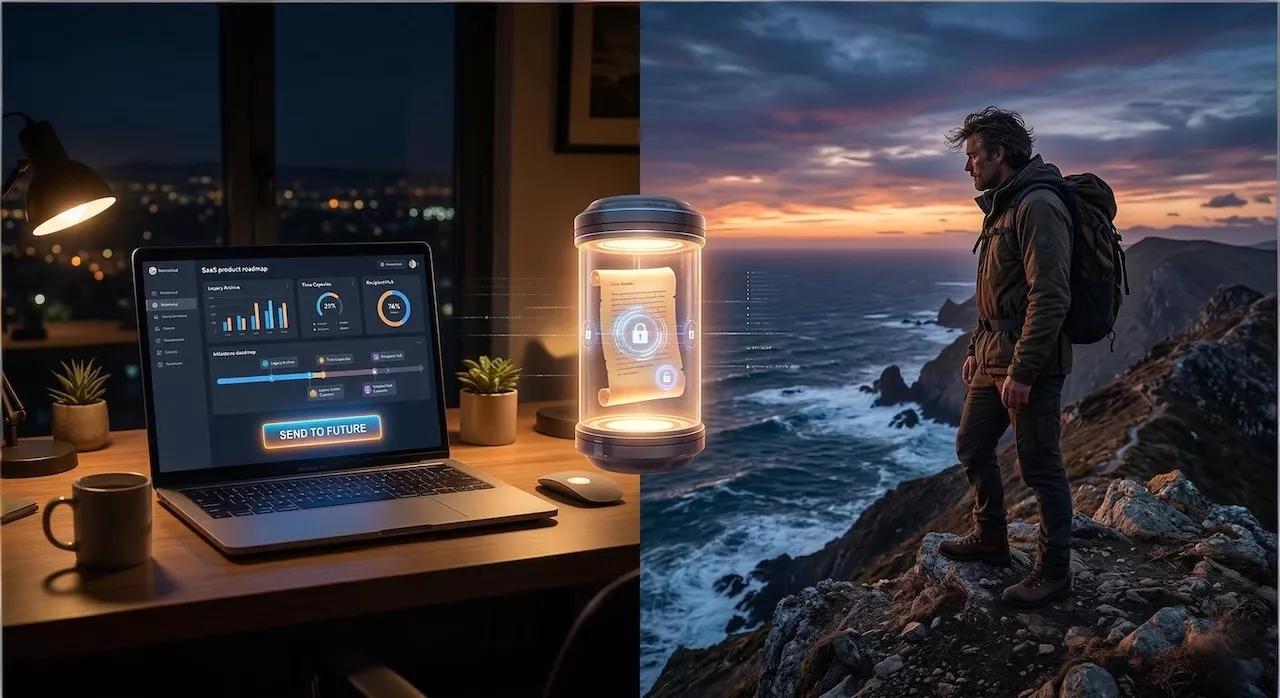
Why I Built EterMail: A Time Capsule for the People I Love Most
I’m a Product Manager who spends all week optimizing for the "immediate now." But getting lost off the grid on a mountain ridge made me realize I had zero infrastructure for the "forever." Here’s why I stopped worrying about conversion rates for a moment and built EterMail—a secure, tamper-proof digital time capsule for the people I love most.

The Most Radical Letter to Your Future Self Is a Promise to Stay Unfinished
The best letter to your future self isn't a memory—it's a mandate. Learn how writing to the version of you still working with love changes everything.

The Ice Tray at Midnight: On Grief, Domestic Minutiae, and the Quiet Work of Becoming Yourself Again
Why do the smallest habits hurt most after someone leaves? A reflection on grief, domestic minutiae, and the quiet moment healing finally begins.