You press seven to save. Again. The automated voice confirms what you already know: this message, like the seventeen before it, will remain. You tell yourself you'll need it later. For what, exactly, you cannot name. The timestamp reads 11:47 PM, March 14, 2019. A Tuesday. You remember because you were standing in a parking garage, the concrete walls catching the echo of his voice saying I'm sorry, I promise I'll change, and you believed him because the alternative was letting go of a future you had already begun to furnish in your mind.
We are all amateur archivists of our own anticipated tomorrows. The voicemails we hoard are not mere recordings—they are wagers against time, bets placed on versions of ourselves and others that may never arrive.
The Acoustic Time Capsule No One Intends to Build
No one sets out to construct a mausoleum in their phone storage. The saved voicemail begins as something practical: a grocery list, a flight number, a dentist's address. But somewhere along the accumulation, the practice turns devotional. We begin preserving voices not for their information but for their temporal texture—the way a person sounds when they don't know they're being recorded for posterity.
The first "I love you" saved from a partner's sleepy morning voice. The birthday message from a parent whose calls you stopped returning. The drunken apology that arrived at 2 AM, slurred and sincere, which you predicted would be followed by change. Each becomes a coordinate in an emotional cartography, marking where you stood when you still believed the future was negotiable.
Research from the University of Southern California's Annenberg Innovation Lab suggests that audio recordings trigger more vivid emotional recall than photographs or text. The voice contains what linguists call "paralinguistic features"—the breath between words, the micro-tremor of held-back tears, the particular cadence of someone trying to sound braver than they feel. These elements make voicemails uniquely potent as memory artifacts, but also uniquely dangerous as instruments of prolonged hope.
The Prophecy of Repetition
There is a specific psychology to replaying a saved message. Each listen is an act of temporal trespass, crossing back into a moment when the speaker's intentions and your own expectations were still aligned. The voicemail becomes a kind of spell: if I can hear it exactly as it was, perhaps I can make what comes after match what came before.
The woman who saves her deceased mother's weekly check-in calls, playing them on anniversaries not to remember but to reinhabit a relationship that had a future. The man who keeps his ex-partner's apology on loop, the timestamp advancing in years while the promise within remains frozen. These are not merely nostalgic acts. They are predictive rituals, attempts to use the past's audio as evidence for futures the present has failed to deliver.
What we rarely acknowledge: the voicemail's power derives partly from its impermanence by design. Unlike a letter, which presumes deliberation, the voicemail captures accident—the cough, the background traffic, the unguarded moment before self-editing begins. We save them precisely because they feel stolen from time, and thus more authentic than any composed communication.
When the Archive Outlives the Relationship
The modern smartphone can store thousands of voice messages. This capacity creates a new emotional condition: archival haunting. The saved voicemails of ended relationships, estranged friendships, deceased relatives—these accumulate into an acoustic shadow life, parallel to the one we're actually living.
Consider the mathematics of attachment. A three-minute voicemail, saved for five years, represents approximately 2,628,000 minutes of potential listening that mostly goes unrealized. The message exists in a state of quantum emotional suspension: potentially accessed, rarely played, never deleted. Its power lies in availability rather than use, in the possibility of return rather than the act itself.
The technology journalist Sherry Turkle has written about how digital artifacts allow us to "present selves we no longer inhabit." The saved voicemail extends this phenomenon into the auditory realm. We become curators of our own previous anticipations, maintaining exhibits of futures that have been foreclosed.
The Deletion as Closure, or Its Impossibility
There comes, for some, the moment of pressing three to delete. The automated voice—always the same automated voice, indifferent to content—confirms the erasure. This should be simple. It rarely is.
The deletion of a saved voicemail is an act of prediction in reverse: I am declaring that this voice will not be needed, that the future it once promised is definitively closed. The difficulty of this act reveals how entangled our sense of possibility has become with these audio fragments. To delete is not merely to remove data; it is to acknowledge the failure of a prophecy we made about our own lives.
Yet many find they cannot delete, or delete only to experience what researchers term "digital phantom limb"—the reflexive reach for comfort that no longer exists. The voicemail's absence becomes its own kind of presence, a silence more articulate than the original recording.
Building Intentional Archives for Futures We Choose
If the accidental voicemail archive represents one form of temporal prediction—unplanned, often painful, frequently unresolved—there exists another possibility. What if we composed our audio legacies deliberately, speaking to futures we actively design rather than passively inherit?
The practice of recording messages for one's future self has roots in analog traditions: letters sealed for decades, time capsules buried with ceremony. Digital tools have made this practice more accessible but also, paradoxically, less intentional. We record constantly now, yet rarely with the ceremonial consciousness that marks communication across significant time.
This is where the deliberate construction of digital time capsules offers a reframe. Rather than accumulating the accidental audio of others' promises, we might compose our own predictions—not as wagers on others' change, but as commitments to our own evolution. A message to yourself at fifty, recorded at thirty, speaking not from certainty but from the courageous uncertainty of who you are still becoming.
The difference matters. The saved voicemail of another's voice traps us in their temporal frame; the composed message to our future self anchors us in our own continuity. One looks backward for evidence; the other looks forward with intention.
The Preservation Problem No One Discusses
Here is the unspoken anxiety beneath the saved voicemail collection: format obsolescence. The messages stored on current devices may not survive platform migrations, carrier changes, or the simple degradation of digital storage. Your archive of emotional coordinates is more fragile than the emotions themselves.
I know this fragility intimately. I spend my nights—too many of them until 2 or 3 AM—staring at glowing screens, building systems that outlast my own attention span. When I finally step away, I head for the steepest trails I can find, or the ocean when the swell is up. There's something about standing on a ridgeline in harsh wind, or getting held underwater by a wave I misjudged, that strips away every illusion of control the digital world sells you. Those moments teach you that what matters isn't the archive—it's the unrepeatable now, and the bridge you build between that now and some future self who might need to remember who you were.
This is exactly why I obsessed over end-to-end encryption and extreme server redundancy when building EterMail. Because I know that a letter written to the future needs to be guarded even more fiercely than a bank password. The preservation of digital memory requires active, ongoing stewardship—something few consider when pressing seven to save. The emotional investment is immediate; the technical maintenance is deferred, often until it is too late.
Toward Conscious Audio Legacy
What would it mean to treat our preserved voices with the same intention we bring to other forms of legacy? To ask, with each saved message: what future am I predicting here, and do I still consent to its possibility?
The voicemail from the person who hurt you, kept "just in case"—in case of what? Their return? Your own regression? The possibility that your judgment of their harm was mistaken? These are not neutral archival decisions. They are ongoing votes for futures that may not serve your becoming.
Conversely, the deliberate recording of your own voice at particular moments—speaking to children not yet born, to a self not yet arrived, to a partner you have not met—creates an archive of generous prediction. Not the prediction of control, but the prediction of continuity. The belief that someone worth speaking to will exist on the other end of time's passage.
The technology to preserve such messages securely, to schedule their delivery across years or decades, to encrypt them against the erosion of platforms and the entropy of forgetfulness—this exists now. The question is whether we will use it with the same emotional intelligence we bring to the accidental archives already crowding our devices.
The Final Press of Seven
You press seven to save. Again. But this time, the voice is your own, speaking to a future you cannot predict but choose to trust. The timestamp will advance. The platform may change. But the intention—to remain in conversation with who you are becoming—persists beyond any single technology, any particular voice, any saved message that once held your hope hostage.
The voicemails we keep will always map something: our attachments, our anticipations, our reluctance to let futures die. The question is whether we become conscious cartographers, or remain forever lost in territories drawn by others' voices, replaying prophecies that were never truly ours to fulfill.
What is EterMail?
EterMail is a revolutionary time capsule service that allows you to send messages, photos, and videos to the future (up to 30 years). Seal your memories and thoughts today, and they'll be delivered when the time is right.
Time Capsule
Send messages up to 30 years in the future
Rich Media
Text, photos, and videos supported
Secure & Private
Your memories are safely encrypted
EterMail Team
We're the team behind EterMail, dedicated to helping you preserve and share timeless messages with your loved ones. Our mission is to make it easy to express your love, share your wisdom, and create lasting connections that transcend time.
Frequently Asked Questions about Future Predictions
Why do people save voicemails from people who are no longer in their lives?
How can I preserve digital memories before they become inaccessible?
What psychological effects does listening to old voicemails have?
Related Articles
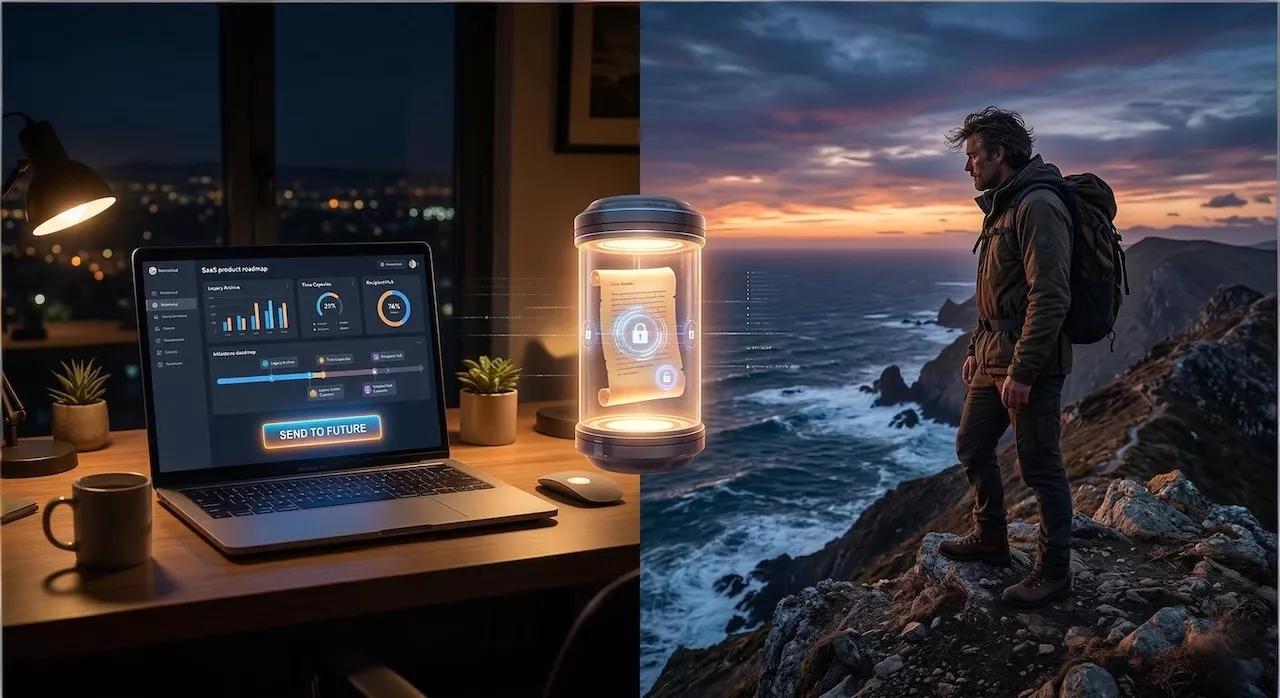
Why I Built EterMail: A Time Capsule for the People I Love Most
I’m a Product Manager who spends all week optimizing for the "immediate now." But getting lost off the grid on a mountain ridge made me realize I had zero infrastructure for the "forever." Here’s why I stopped worrying about conversion rates for a moment and built EterMail—a secure, tamper-proof digital time capsule for the people I love most.

The Most Radical Letter to Your Future Self Is a Promise to Stay Unfinished
The best letter to your future self isn't a memory—it's a mandate. Learn how writing to the version of you still working with love changes everything.
The Ice Tray at Midnight: On Grief, Domestic Minutiae, and the Quiet Work of Becoming Yourself Again
Why do the smallest habits hurt most after someone leaves? A reflection on grief, domestic minutiae, and the quiet moment healing finally begins.