
The Lectures That Arrived Too Late, and Right on Time
In the spring of 2023, a cardboard box arrived at the Viktor Frankl Institute in Vienna. Inside, nestled among water-damaged lecture notes from 1946, were the recorded transcripts of a series Frankl delivered to displaced persons in the months following his liberation from Auschwitz. The audience was composed of survivors who had lost everything—families, homes, the architecture of their former lives—and who were now being asked to imagine a future they had no language for.
Frankl's message to them was not predictive. He did not offer probabilities, trend lines, or the comforting fiction that suffering necessarily leads to wisdom. Instead, he insisted on something far more demanding: that meaning is not found but made, forged in the crucible of conscious choice. The survivor, he argued, cannot wait for the future to reveal its purpose. The future arrives blank, and the act of inscription is the work of a living, choosing mind.
This is the lecture series that algorithms were never meant to hear.

When Prediction Became a Commodity
We have, in the span of a single generation, transferred an enormous portion of our meaning-making labor to predictive systems. Netflix predicts what we will want to watch. Spotify predicts what we will want to feel. Dating apps predict who we will want to love. Career algorithms predict what we should become. The language is seductive in its promise of relief: Let us do the thinking for you. Let us shoulder the burden of becoming.
But there is a subtle violence in this exchange. When we outsource prediction, we outsource the interpretive act that follows it. We are not merely asking machines to guess what will happen; we are asking them to tell us what it will mean when it does. And meaning, Frankl understood, cannot be received passively. It must be wrestled from circumstance through the specific, unrepeatable consciousness of the person who lives it.
The deterministic futures sold to us by data models share a common assumption: that your future self is a known quantity, a profile to be optimized. Feed enough data into the system, and the system will know you better than you know yourself. This is the premise of every recommendation engine, every predictive text model, every algorithmic nudge toward a pre-charted path.
Frankl's lost lectures constitute a quiet revolution against this premise. The future, he insisted, is not a territory to be mapped but a responsibility to be assumed.
The Radical Act of Writing to Who You Will Become
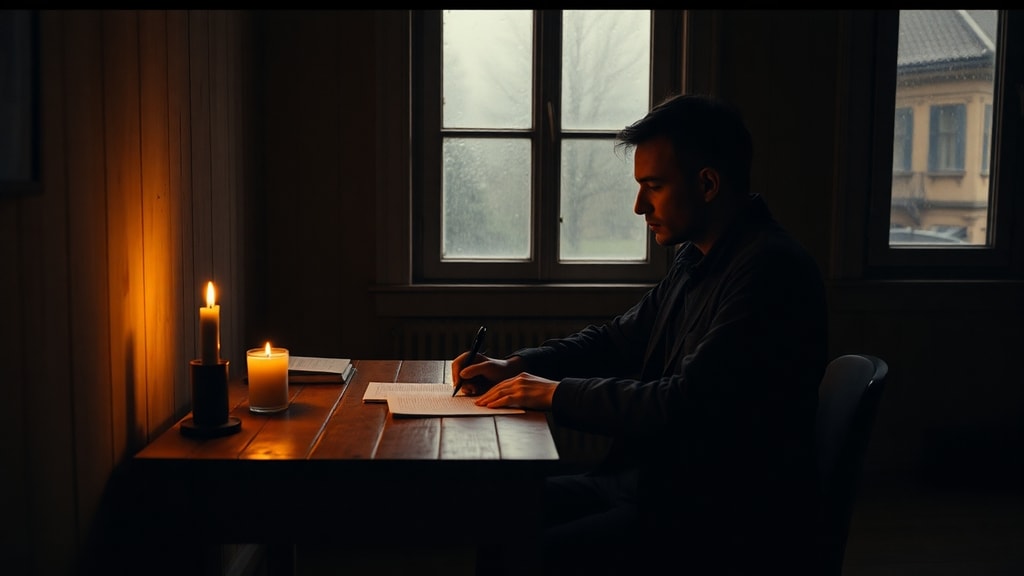
Consider what happens when you sit down to write a letter to your future self. Not a prediction. Not a set of goals or resolutions. A letter. An act of communication across time that assumes something no algorithm can assume: that the person reading it will be different from the person writing it, and that this difference matters.
You are not trying to predict who you will be. You are trying to address them. To speak across the gap of years as one consciousness to another, acknowledging that the future self who opens this letter will have experiences you cannot imagine, griefs you cannot foresee, joys that do not yet have names. You are not optimizing their path. You are bearing witness to their becoming.
This is the labor that algorithms cannot perform. They can correlate. They can project. They can identify patterns in aggregate data and offer probabilities with increasing precision. But they cannot choose. They cannot mean. They cannot sit in the particular silence of a particular evening and decide, with the full weight of mortal consciousness, that this moment matters enough to be preserved for someone who does not yet exist.
The Defiance of Conscious Interpretation
The most defiant prediction you can make now is not about what will happen. It is about who will be there to interpret it.
I predict that my own consciousness will still be required. This is the prediction that no data model wants you to make, because it is the one prediction that cannot be absorbed into the system. It insists on a remainder, a residue of human agency that refuses to be optimized away.
Frankl's logotherapy was built on this remainder. In the camps, he observed that those who survived were not necessarily the strongest or the most fortunate, but those who could locate a why—a meaning that transcended their immediate circumstances. This was not optimism. It was not prediction. It was the active, creative choice to interpret suffering as something that could be borne, something that could be made to matter.
The algorithms offer us a different bargain. They offer to remove the burden of interpretation by removing the uncertainty that makes interpretation necessary. If we can predict everything, we need not choose anything. If the path is mapped, we need not walk it with attention. But this is not freedom. It is the abandonment of the very faculty that makes us human.
The Letter as Resistance
There is a reason that totalitarian regimes have always targeted personal correspondence. The letter—physical, private, asynchronous—preserves a space of unmonitored consciousness. It is where we practice the habits of meaning-making without external validation. It is where we learn to address others as ends rather than means, to speak across time without knowing if we will be heard, to invest significance in the particular over the general.
Writing to your future self extends this resistance into temporal territory. You are claiming that your future consciousness deserves the same ethical attention you would give to another person. You are refusing to treat your future self as a data point, a profile, a predicted outcome. You are insisting that they will be a subject, an interpreter, a meaning-maker in their own right.
This is not nostalgia for analog authenticity. It is a structural defense against the colonization of interior life. The algorithms do not merely predict what we will want. They progressively narrow the field of what we can imagine wanting. Each recommendation, each predictive nudge, each optimized path is a small foreclosure of possibility. The letter to the future self reopens what has been closed. It preserves the wild, unmodeled territory of who you might become.
The Architecture of Mortal Time
Frankl's lectures to the displaced persons were delivered in a specific historical moment, but they address a permanent condition. We are all, in some sense, displaced persons. We are all trying to build lives in the aftermath of losses we did not choose, moving toward futures we cannot see, carrying the burden of consciousness in a universe that offers no guaranteed meaning.
The temptation to outsource this burden is ancient. Oracles, prophets, fortune-tellers—these are the predecessors of our predictive algorithms. What changes is not the desire but the scale. Never before has the machinery of prediction been so comprehensive, so invisible, so difficult to refuse.
The letter to your future self is a small, practicable act of refusal. It does not require you to abandon technology, to live off-grid, to reject all the genuine benefits of predictive systems. It requires only that you preserve one channel of communication that the algorithms cannot populate, cannot optimize, cannot fully understand. It requires that you continue to mean, actively and particularly, in the face of systems that would prefer you to receive meaning passively and generally.

The Question the Lectures Leave Us With
Frankl's lost lectures do not end with answers. They end with questions—questions he put to his audiences, and that we might put to ourselves.
What if the future is not something to be predicted but something to be addressed? What if the most important thing you can do for who you will become is not to plan their path but to acknowledge their existence, to speak to them as a person with their own burdens and their own choices? What if meaning is not a resource to be optimized but a responsibility to be assumed, again and again, with each act of conscious interpretation?
The algorithms will continue to improve. Their predictions will grow more precise, their recommendations more seamlessly integrated into the texture of daily life. This is not a Luddite argument against their existence. It is an argument for preserving the human remainder—the choosing, meaning-making, interpretive consciousness that cannot be replicated or replaced.
The most defiant prediction you can make is that this remainder will persist. That you will still be there, in whatever future arrives, to open the letter and to choose what it means.
The Practice of Addressing Tomorrow
I spend a lot of nights alone with a screen, mapping architectures or running code until 2 AM, and I've learned something from those hours: the digital world can simulate almost anything except the weight of a real choice made in real time. When I finally step away—when I'm hiking a steep trail or caught in surf that doesn't care about my optimizations—I remember what the raw world keeps teaching me: some moments are unrepeatable, and their value lies precisely in not being predicted.
That's the spirit I tried to build into EterMail. The best way to fight forgetting isn't taking another screenshot; it's setting an alarm for the future. By using EterMail to set a delivery date 5 years from now, you completely free yourself from the anxiety of the present. You write now, with your present consciousness, and trust the system to carry that specific, unrepeatable voice across time to the person you'll become.
There is no formula for this practice. That is precisely the point. The letter to your future self cannot be templated, optimized, or generated by predictive text. It must be written in the particularity of your present moment, with your present consciousness, addressed to a future self you cannot fully imagine.
What you choose to preserve—what you judge worth sending across time—is itself an act of meaning-making. It is a declaration that some moments deserve to be remembered not because they fit a pattern but because they happened to you, in your body, in your consciousness, in the unrepeatable specificity of your mortal life.
This is the labor that Frankl's lectures ask us to reclaim. Not the labor of prediction, which we have delegated with increasing enthusiasm. The labor of interpretation. The labor of choice. The labor of addressing the future not as a problem to be solved but as a person to be met.
The algorithms will predict. That is their function and their limitation. You will mean. That is your burden and your freedom. The letter waits to be written. The future waits to be addressed. The choice, as always, remains yours.
What is EterMail?
EterMail is a revolutionary time capsule service that allows you to send messages, photos, and videos to the future (up to 30 years). Seal your memories and thoughts today, and they'll be delivered when the time is right.
Time Capsule
Send messages up to 30 years in the future
Rich Media
Text, photos, and videos supported
Secure & Private
Your memories are safely encrypted
EterMail Team
We're the team behind EterMail, dedicated to helping you preserve and share timeless messages with your loved ones. Our mission is to make it easy to express your love, share your wisdom, and create lasting connections that transcend time.
Frequently Asked Questions about Future Predictions
How do I write a meaningful letter to my future self without knowing who I'll become?
Why do psychologists recommend writing to your future self during difficult times?
Can future writing help me make better decisions in the present?
Related Articles

Why I Built EterMail: A Time Capsule for the People I Love Most
I’m a Product Manager who spends all week optimizing for the "immediate now." But getting lost off the grid on a mountain ridge made me realize I had zero infrastructure for the "forever." Here’s why I stopped worrying about conversion rates for a moment and built EterMail—a secure, tamper-proof digital time capsule for the people I love most.

The Secret Dignity of the Unbroken Routine: What We Owe Our Future Unemployed Selves
Discover why writing letters to your future self about ordinary routines preserves the hidden dignity of competence you'll someday miss.
The Invisible Architecture of Your Working Life: How to Preserve Career Milestones Before Memory Rewrites Them
The salary you negotiated at 31. The colleague who believed in you before you believed in yourself. What will your future self remember about who you were when it mattered?