
The Mixtape in Your Drawer Knows Something You Don't
There is a Spotify playlist on my phone called "Later." It has 47 songs. I made it three years ago, after a breakup I thought would define the rest of my life. I haven't listened to it once. The algorithm doesn't remind me of it. The cover image is still the default gradient, blue fading into purple, the color of a sky you're not watching because you're looking down at your shoes.
But I cannot delete it.
This is the peculiar tyranny of music we curate for futures that haven't arrived. We become amateur prophets without recognizing the ritual. The road trip playlist assembled in February for a July that may never happen. The album saved for "when I'm finally over this." The lullaby hummed to a newborn who will one day remember your voice without remembering your face—who will, in some neurologically mysterious way, feel safe when that melody surfaces decades later in a grocery store, unable to name why their chest tightens with something like grief and something like home.
Music is not merely entertainment. It is a technology of time travel we barely recognize we wield. And the songs we choose to carry forward may be the most honest predictions we ever make about who we're becoming.
What Happens When the Needle Drops
When we listen to music we love, our brains perform a feat of prediction that would embarrass most machine learning models. The auditory cortex processes sound in milliseconds, but the reward system—ventral striatum, nucleus accumbens, that ancient circuitry of wanting and getting—fires in anticipation of what comes next. We don't just hear music. We forecast it, moment by moment, and the pleasure arrives in the gap between expectation and resolution.
Neuroscientist Daniel Levitin, in his foundational work on music and the brain, observed that this predictive coding isn't passive. Our brains generate models of what should happen next in a melody, and dopamine releases not when predictions are confirmed, but when they're violated in satisfying ways—the unexpected chord, the delayed resolution, the bridge that arrives from nowhere and somehow feels like coming home.
This mechanism scales beyond individual songs. We construct mental playlists of our futures the same way: predictive models of who we will be, what we will feel, when we will finally be ready for the art we've stockpiled. The jazz album purchased after a funeral, still in its shrink wrap. The ambient record recommended by someone we no longer speak to, waiting for "the right night." These are not procrastinations. They are neurological wagers on our own transformation—bets placed with the dopaminergic currency of hope.
Research from McGill University's Laboratory for Music Perception, Cognition, and Expertise has demonstrated that music-evoked autobiographical memories activate the prefrontal cortex with unusual intensity, creating what researchers call "flashbulb memories"—vivid, emotionally saturated recollections that feel more real than ordinary remembering. But here's what fascinates: these memories are often prospective as much as retrospective. We don't just remember who we were when we first heard a song. We remember who we expected to become while listening.
The Playlist as Prophecy: How We Curate Our Unconscious Futures
Consider the phenomenon of "saving for later." In an age of infinite streaming, this behavior makes little practical sense. Everything is available always. Yet we persist in creating temporal boundaries around our listening—ritual containers for emotions we haven't earned yet.
A friend told me about the album she bought the week she discovered she was pregnant, a collection of piano nocturnes she refused to play until her daughter's birth. For nine months, it sat on her shelf, a sonic time capsule she had constructed without understanding why. When she finally played it, during the exhausted haze of early motherhood, she wept without knowing the reason. The music had become bound to an anticipation so profound it preceded the person she would become.
We have always been time-binders, to use Alfred Korzybski's term—creatures who externalize memory, who bury letters and build monuments, who construct technologies to speak across temporal chasms. The digital time capsule is not a novelty. It is the latest iteration of a neurological imperative: the need to stabilize our fluctuating selves across time, to send signals to future consciousnesses that we once existed, that we once cared enough to predict who they might be.
The Songs That Outlive Their Listeners: Music as Emotional Inheritance
There is a particular cruelty to how music survives us. My father died with an iPod Classic in his desk drawer, its battery long dead, its contents unbacked, the playlist titles inscrutable to anyone but him. "Tuesday 2011." "For the drive back." "Don't forget." I will never know what he meant. The device sits in my own drawer now, a monument to predictions I cannot decode.
But some transmissions succeed. Research on inherited musical taste suggests that children retain emotional associations to their parents' music even when they reject the genres themselves. The classical piece played during arguments. The folk song sung while cooking. These become proprioceptive memories—felt in the body before understood by the mind, shaping future preferences through channels of association that bypass conscious choice.
This is the deeper function of musical prophecy. When we curate songs for futures we may not inhabit—letters to unborn children, playlists for anniversaries we hope to reach, albums saved for retirements that may never arrive—we are engaging in emotional estate planning of the most intimate kind. We are attempting to transmit not just taste, but temperament: a way of being in time, a rhythm of feeling, a methodology for transforming solitude into something bearable.
The Honesty of the Unplayed: Why Our Musical Hoarding Reveals True Desire
We lie constantly about what we want. We tell surveys we value security, stability, conventional success. But our unplayed music tells different stories.
The aggressive punk album saved for "when I finally quit." The ambient drone piece bookmarked for "the cabin I don't own." The love song compilation hidden in a folder called "maybe never." These are desire's unguarded archives, the predictions we make when we believe no one is watching—not even our present selves, who maintain plausible deniability about their contents.
Neuroscience offers partial explanations. The default mode network, active during mind-wandering and self-projection, shows increased connectivity when we imagine future events with emotional specificity. Music serves as a prosthetic for this imagination—affective scaffolding that allows us to construct futures we can almost feel. The song becomes a sensory anchor for a self not yet emerged, a neurological hook on which to hang an identity still forming.
This is why the deletion of an unplayed playlist can feel like murder. We are not destroying files. We are extinguishing a timeline, collapsing a wave function of possible selves into the narrower band of who we actually became. The playlist called "Later" survives on my phone not because I expect to play it, but because deleting it would require admitting that the future it predicted—the healed, transformed, finally-over-it self—has already arrived without my noticing, wearing different clothes than expected.

The Architecture of Anticipation: Building Time Capsules That Honor Our Becoming
What would it mean to take this unconscious prophecy and make it deliberate? To recognize that every song we save for a future self is a letter written in a language older than words?
The practice requires a particular quality of attention—noticing what we notice, as the phenomenologists would have it. The song that makes you pull over while driving. The album you can't play because it would mean feeling something you're not ready to feel. These are signals from a future self, transmitted backward through the strange circuitry of aesthetic response.
I've spent enough late nights alone with glowing screens to understand this hunger intimately. There's a specific loneliness to coding at 2 AM, "pair programming" with LLMs, mapping architectures while the world sleeps—an extreme digital solitude that makes you acutely aware of how much we leave unsaid across time. When I step away, I throw myself into harsh winds on mountain trails or ocean waves that strip away every illusion. The raw reality of nearly losing control teaches you to cherish unrepeatable moments. But it also teaches you how much we fail to preserve them. We take screenshots. We bookmark songs. We promise ourselves we'll remember how this felt. And then we don't.
The best way to fight forgetting isn't taking another screenshot; it's setting an alarm for the future. By using EterMail to set a delivery date 5 years from now, you completely free yourself from the anxiety of the present. The message—whether it's a playlist link, a voice memo, or the raw confession you can't say aloud today—travels forward without your constant tending. You don't have to remember to remember.
The neuroscience supports this practice. Studies on episodic future thinking show that vividly imagining future events increases motivation, improves decision-making, and strengthens the sense of continuous identity across time. Music, with its unique capacity to evoke felt futures rather than merely imagined ones, may be the most powerful tool we have for this temporal stitching.
The Song Remains, Even When We Don't
I finally played one song from the "Later" playlist last month. Not the whole thing. Just one track, selected at random. It was not what I expected. The person who added it had been someone who believed in grand romantic gestures, in suffering as purification, in the redemptive power of waiting. I recognized her without quite remembering being her.
The song sounded different than I recalled. The production seemed thinner, the vocals less wounded. But something in the bridge—some harmonic shift I couldn't name—produced the old physical response: chest tightening, breath catching, the body's archive opening to a file the mind had mislabeled.
This is what musical prophecy ultimately offers: not accurate prediction, but honest documentation of who we were when we dared to imagine who we might become. The futures we forecast through our curated songs will almost always be wrong in their specifics. But they will be true in their longing. And that longing, preserved across time, becomes a kind of inheritance—not of property, but of possibility.
The playlist remains. I have added one new song, for a future I cannot yet picture. The algorithm doesn't understand why. Neither, entirely, do I. But some part of me—the part that still believes in the neurological magic of anticipation, in the dopaminergic theology of what comes next—knows that saving it is itself a form of faith.
Not in the future. In the self who will be there to hear it.
What is EterMail?
EterMail is a revolutionary time capsule service that allows you to send messages, photos, and videos to the future (up to 30 years). Seal your memories and thoughts today, and they'll be delivered when the time is right.
Time Capsule
Send messages up to 30 years in the future
Rich Media
Text, photos, and videos supported
Secure & Private
Your memories are safely encrypted
EterMail Team
We're the team behind EterMail, dedicated to helping you preserve and share timeless messages with your loved ones. Our mission is to make it easy to express your love, share your wisdom, and create lasting connections that transcend time.
Frequently Asked Questions about Future Predictions
Why do songs trigger such vivid memories of who I used to be?
How can I use music to better understand what I actually want for my future?
Is there scientific evidence that imagining my future self improves my actual decisions?
Related Articles
Why I Built EterMail: A Time Capsule for the People I Love Most
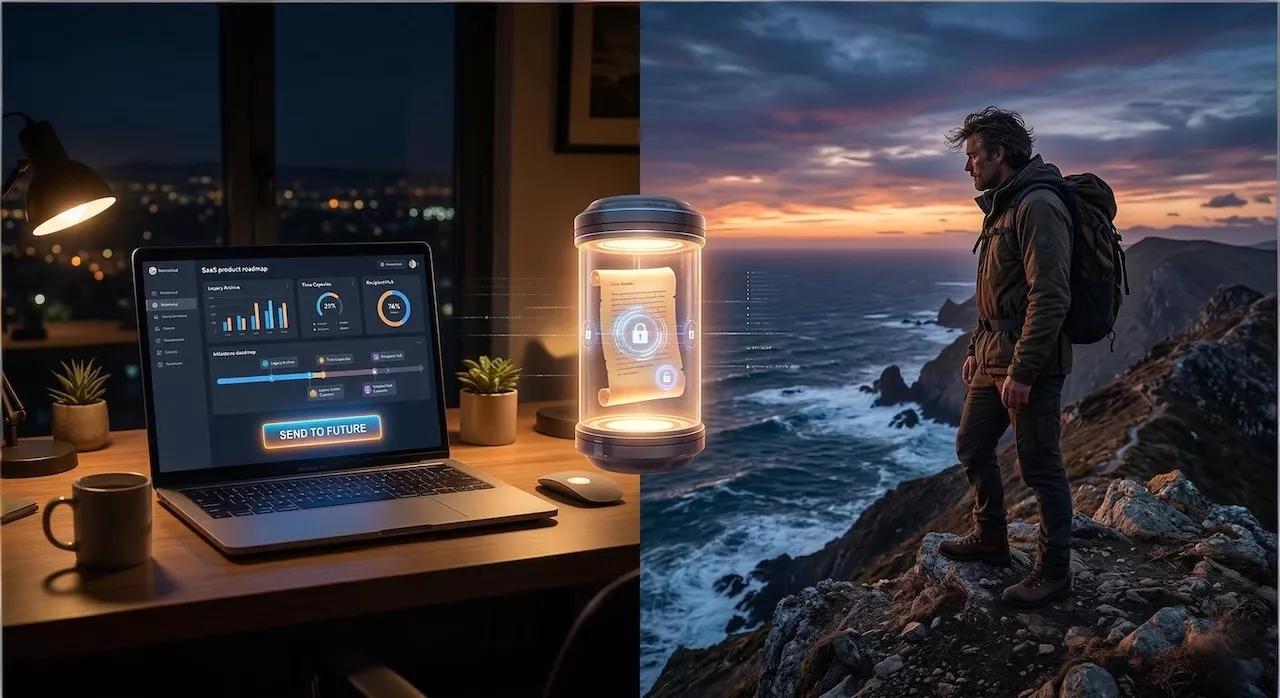
I’m a Product Manager who spends all week optimizing for the "immediate now." But getting lost off the grid on a mountain ridge made me realize I had zero infrastructure for the "forever." Here’s why I stopped worrying about conversion rates for a moment and built EterMail—a secure, tamper-proof digital time capsule for the people I love most.

The Most Radical Letter to Your Future Self Is a Promise to Stay Unfinished
The best letter to your future self isn't a memory—it's a mandate. Learn how writing to the version of you still working with love changes everything.

The Ice Tray at Midnight: On Grief, Domestic Minutiae, and the Quiet Work of Becoming Yourself Again
Why do the smallest habits hurt most after someone leaves? A reflection on grief, domestic minutiae, and the quiet moment healing finally begins.