The Notification That Arrived Like a Death in the Family
The email landed in inboxes with the sterile politeness of a landlord raising rent. "We're sunsetting Sora," OpenAI wrote, as if describing a sunset rather than a demolition. For the creators who had spent months building worlds inside the tool—crafting characters, refining prompts, imagining futures that existed only in latent space—the message was something else entirely. It was erasure dressed in product-management language.
One user on Reddit described scrolling through their project library the night before the shutdown. Seventy-three videos. A visual novel they'd been constructing for their daughter, chapter by chapter, showing her possible futures: what the world might look like when she graduated college, when she turned thirty, when they were both old enough that memory itself would need external support. "I kept thinking someone would save it," they wrote. "I kept thinking my stuff was mine."
But it wasn't. It never had been.
The Illusion of Digital Permanence
We have built our entire emotional infrastructure on a lie so convenient we stopped noticing it. The lie goes like this: upload equals preserve. Save to cloud equals safe forever. Our photos, our drafts, our half-finished predictions about who we might become—all of it floating in server farms we will never visit, maintained by companies whose quarterly earnings have nothing to do with our grandchildren's ability to know us.
The Sora shutdown is not an anomaly. It is a reminder we keep needing and keep ignoring. Google killed Google Reader, orphaning millions of curated information diets. Yahoo erased entire decades of Flickr metadata. MySpace lost twelve years of uploaded music—twelve years of independent artists' distribution history—to a server migration error. Each time, we expressed shock. Each time, we migrated to the next platform, carrying our hope with us like a habit we cannot break.
What makes Sora different is what it represented. This was not a utility. This was imagination as a service. Users weren't storing files; they were storing futures. The videos generated were not endpoints but beginnings—seeds for stories that would unfold across years. When OpenAI pulled the plug, they didn't just delete data. They deleted temporal possibility.
The Psychology of Prediction in Unstable Containers
There is a particular cruelty to losing something you made for your future self. The research on episodic future thinking—our ability to mentally simulate tomorrow—suggests that these simulations are not neutral cognitive exercises. They are emotional anchors. When we write a letter to ourselves five years hence, when we record a message for a child not yet old enough to understand it, we are performing an act of self-continuity. We are saying: I believe I will still exist. I believe the world will still exist. I believe these words will find their target.
Platform instability poisons this belief. The anthropologist Genevieve Bell has written about how digital infrastructure creates "temporal vertigo"—a disorientation about what persists and what evaporates. We experience this as anxiety we cannot name. The background hum of wondering whether our Google Photos will outlive us, whether our Dropbox will survive the next acquisition, whether the app where we store our voice memos will pivot to crypto and delete our archives.
This is not paranoia. This is risk assessment we refuse to perform.
When we make predictions—about our careers, our relationships, our bodies, our planet—we are extending trust outward in time. We trust that the future will be readable. That our present self's attempt to communicate across the years will be received. Platform dependency corrupts this trust at its root. We are trying to build bridges to tomorrow on foundations we do not own.
What We Actually Need to Preserve
The Sora users who lost their projects were not primarily mourning the videos. They were mourning the work of becoming. The iterative process of refining a vision. The accumulated decisions that constituted a creative identity. One prompt engineer described it as "losing my vocabulary"—the specific language she had developed to speak with the model, now useless, now gone.
This suggests something important about digital legacy. We fixate on files when we should fixate on capacity. The ability to think across time. The infrastructure of our own evolving judgment. A prediction is not valuable because it comes true. It is valuable because the act of making it changes the predictor.
When you write to your future self, you are not primarily trying to transmit information. You are trying to preserve the self who cared enough to write. The questions you ask reveal your present preoccupations. The hopes you articulate shape the hopes you will later remember having. This is why sudden platform loss hurts beyond the data itself. It severs the conversation between selves. It makes the past unreachable not by natural forgetting but by artificial amputation.
Building Predictions on Ground We Can Stand On
The alternative is not romantic Luddism. We will not return to parchment and sealing wax, nor should we. The digital offers genuine gifts: searchability, replication, the ability to reach across distance instantly. But we need to be architects of our own persistence, not tenants in someone else's speculation.
This means asking harder questions before we commit our futures to any platform. Not what can this tool do? but what happens when this tool disappears? Not how easy is upload? but how hard is export? The platforms that deserve our predictions are the ones that treat our data as ours, structurally and legally, not merely as a courtesy.
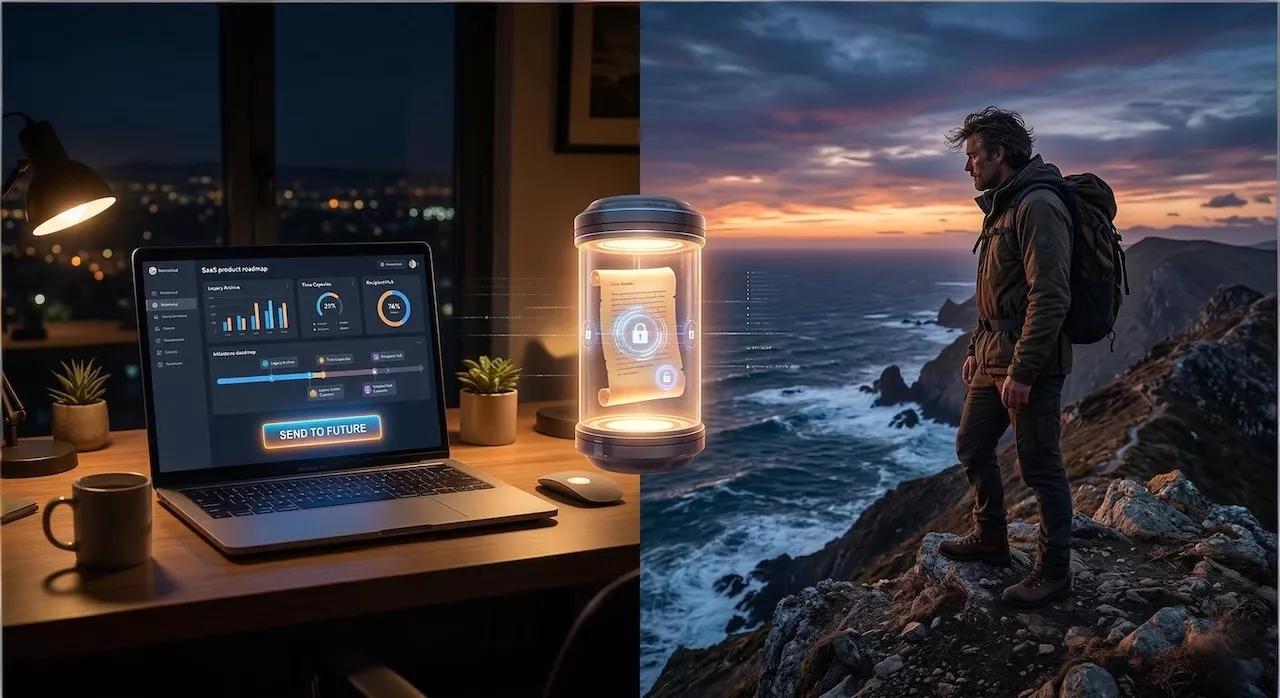
I think about this constantly—both as someone who spends his nights "pair programming" with LLMs until 2 AM, watching architectures take shape in the glow of a screen, and as someone who escapes to mountain trails and ocean waves the moment I step away from the keyboard. That contrast teaches you something. Out in nature, there's no undo button. A wave doesn't care about your autosave. You learn to strip away illusions and cherish what cannot be repeated. The digital world needs that same honesty.
Most importantly, it means reclaiming the act of prediction from the products of prediction. The Sora users who lost their visual novels can still write the stories. The prompts can be reconstructed, the visions reimagined. The platform was a medium, not the memory itself. Our capacity to imagine tomorrow survives any single tool's demise—if we remember that the tool was never the point.
The Deeper Question Sora Forces Us to Ask
There is a question underneath the practical anxiety about data loss. It is this: What does it mean to make a promise to the future when we cannot guarantee the future will receive it?
Every prediction is a promise. Every letter to a future self is a covenant across time. The platforms we use to store these promises have made us careless about the covenant itself. We have outsourced our faith in tomorrow to terms-of-service agreements we never read.
The Sora shutdown is an invitation to become more deliberate. To recognize that preservation is an active practice, not a passive feature. To build our time capsules with the same attention we would give to physical construction—knowing that what we build must withstand forces we cannot fully predict.
This is exactly why I obsessed over end-to-end encryption and extreme server redundancy when building EterMail. Because I know that a letter written to the future needs to be guarded even more fiercely than a bank password. When you're trying to send a piece of your present self across five, ten, twenty years, you cannot afford to trust that promise to a platform that might "sunset" on a Tuesday afternoon. The architecture has to be built for permanence from the ground up—not as a feature, but as the foundation.
Your predictions matter. The questions you ask your future self matter. The evidence you assemble of who you were and who you hoped to become—all of it matters. But it matters only if it survives. And survival, in the digital age, requires choosing foundations we can trust.
The cloud was never infinite. The servers were always someone's property. The only permanence available to us is the permanence we construct with our own hands, our own judgment, our own stubborn insistence that the conversation between who we are and who we will become must not be interrupted.
Write your predictions. Store them carefully. And never forget: the platform is the envelope, not the letter. The letter is yours. Make sure it reaches its destination.
What is EterMail?
EterMail is a revolutionary time capsule service that allows you to send messages, photos, and videos to the future (up to 30 years). Seal your memories and thoughts today, and they'll be delivered when the time is right.
Time Capsule
Send messages up to 30 years in the future
Rich Media
Text, photos, and videos supported
Secure & Private
Your memories are safely encrypted
EterMail Team
We're the team behind EterMail, dedicated to helping you preserve and share timeless messages with your loved ones. Our mission is to make it easy to express your love, share your wisdom, and create lasting connections that transcend time.
Frequently Asked Questions about Future Predictions
How do I protect my digital memories from platform shutdowns?
What should I include in predictions for my future self?
Why does losing digital work feel like losing part of my identity?
Related Articles
Why I Built EterMail: A Time Capsule for the People I Love Most
I’m a Product Manager who spends all week optimizing for the "immediate now." But getting lost off the grid on a mountain ridge made me realize I had zero infrastructure for the "forever." Here’s why I stopped worrying about conversion rates for a moment and built EterMail—a secure, tamper-proof digital time capsule for the people I love most.

The Most Radical Letter to Your Future Self Is a Promise to Stay Unfinished
The best letter to your future self isn't a memory—it's a mandate. Learn how writing to the version of you still working with love changes everything.
The Ice Tray at Midnight: On Grief, Domestic Minutiae, and the Quiet Work of Becoming Yourself Again
Why do the smallest habits hurt most after someone leaves? A reflection on grief, domestic minutiae, and the quiet moment healing finally begins.