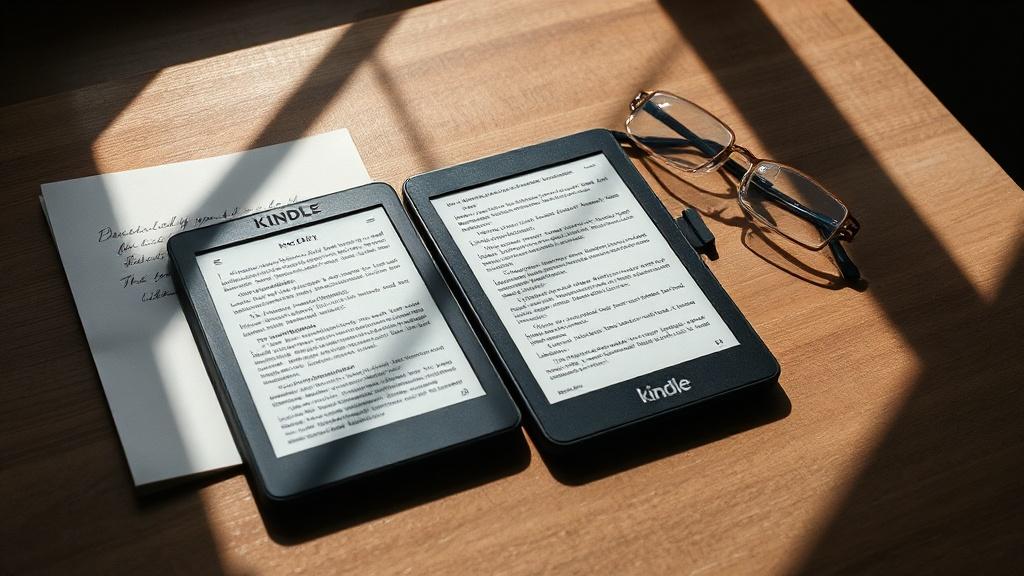
Three nights after the funeral, I finally guessed her password. Not her banking app, not the cloud storage everyone told me to check for "important documents"—her Kindle. The device she'd held through three years of hospice, the one she'd tapped with trembling fingers while I sat beside her showing cat videos I'd already seen, hoping she'd laugh.
She'd highlighted 1,847 passages across 200+ books. Philosophy. Poetry. A surprising number of thrillers. But the notes she'd actually typed? One. A single word beside a paragraph in a memoir I'd never heard of: "yes."
The paragraph was about learning to let go.
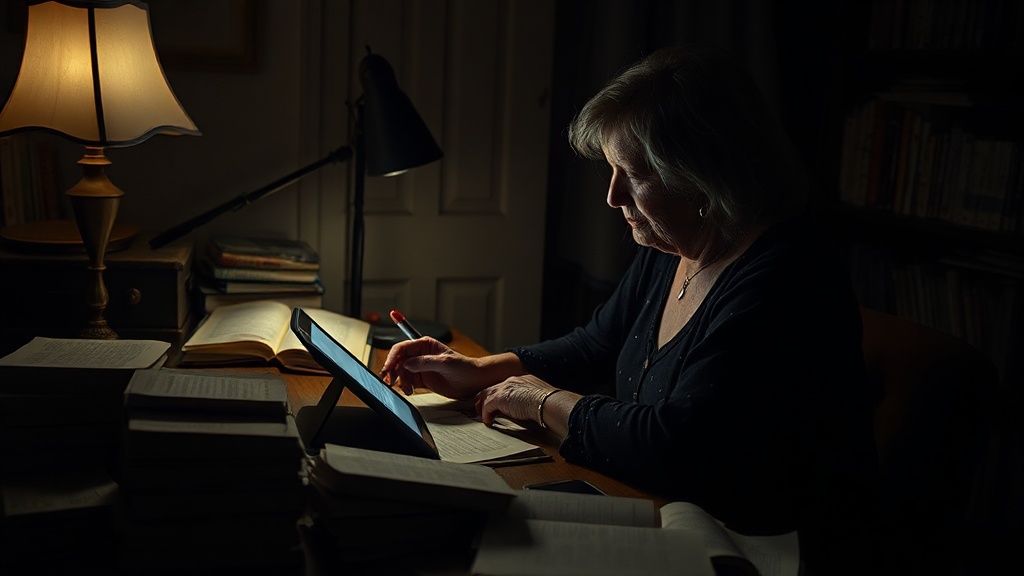
I spent the next seventy-two hours reading every highlighted line in chronological order, reconstructing what she had been trying to believe while I was busy believing she wasn't going anywhere.
The Archaeology of Digital Marginalia
We have always left traces. Marginalia—those handwritten notes in book margins—date back to medieval monks arguing with Aristotle in the white space of illuminated manuscripts. But something shifted when our annotations migrated to screens. The digital highlight feels more intimate than ink because it is so effortless, so unguarded. You don't pause to find a pen. You don't commit to the permanence of graphite. You simply press, hold, release—and move on.
My aunt's highlights traced a topography I never would have found in her spoken words. She was private in that particular way of women born in 1952, trained to deflect with humor, to answer "fine" to every inquiry. But here, in the silent argument with authors she would never meet, she was furious, tender, terrified, and occasionally triumphant.
In The Year of Magical Thinking, she highlighted: "Life changes in the instant. The ordinary instant." No note. But three pages later, another highlight: "I know why we try to keep the dead alive: we do not want them to die." Then, two years later in When Breath Becomes Air: "The fact of death is unsettling. Yet there is no other way to live."
She was building a case. Collecting evidence. A prosecutor preparing closing arguments against her own fear.
The Asymmetry of Digital Intimacy
What undid me was the temporal dislocation. While I was sending her videos of cats falling off sofas in 2019, she was highlighting The Denial of Death in 2017. While I was complaining about my commute in 2020, she was underlining Mary Oliver's "Doesn't everything die at last, and too soon?" in 2018. Our conversations existed in parallel frequencies that never intersected. I was performing life for her; she was preparing for its absence without telling me the show was closing.
This is the particular cruelty of digital legacy. The data survives, timestamped and searchable, but the context evaporates. I cannot ask her why she highlighted a passage about marriage in a novel she'd never discussed with me—whether she was thinking of her first husband, her second, or some version of herself that chose differently. I cannot know if "yes" was acceptance or argument, surrender or defiance.
The digital trace is complete in its data and fragmentary in its meaning. We are left to interpret, to project, to narrate a story that may have nothing to do with the one being lived.
What We Leave Behind vs. What We Mean to Leave
My aunt did not curate her digital legacy. She did not select these 1,847 moments as representative of her essential self. They accumulated, the way sediment accumulates—the unconscious archaeology of attention. This is what distinguishes digital legacy from the intentional time capsule or the carefully composed farewell letter. One is driftwood; the other is a vessel.
I found myself wishing for both. The driftwood taught me things I never knew: that she read Rilke in German, that she returned to certain pages of The Unbearable Lightness of Being seventeen times, that she found something worth marking in a mediocre self-help book at 3:47 AM on a night I now know was sleepless. But I also wanted what she would have chosen to say—to me, specifically, directly, with intention.
The Kindle held her private becoming. It did not hold her love for me, except by inference, except by the space between what she marked and what she didn't.
The Unbearable Intimacy of Posthumous Discovery
There is a specific grief that comes from learning someone after they are gone—not the eulogy version, not the curated stories at the wake, but the unguarded self that existed in the hours you weren't present. I knew my aunt's laugh. I did not know her 2 AM questions. I knew her potato salad recipe. I did not know she underlined, in The Body Keeps the Score, a passage about how trauma lives in the nervous system long after the event.
The digital afterlife exposes these gaps with forensic precision. Every timestamp is a small wound. Every unread book in her library a door never opened. The "yes" she typed—was it in the final month? The final week? The metadata says March, but March of which year? I check and recheck, as if the exact date could tell me whether she had already decided, whether she was already gone in the ways that matter.
This is the paradox of our connected age: we leave more traces than any generation in history, and we leave fewer explanations.
Toward Intentional Digital Legacy
I have started writing letters I will not send immediately. Not because I am dying, though of course I am, though of course we all are, but because I have seen what happens when intention is replaced by inference. When the only message left is a single word beside a paragraph about letting go, and the people who love you spend three nights reconstructing a self you never offered.
There is a difference between the data we accumulate and the meaning we choose to transmit. The Kindle highlights are a map, but they are not a message. They require interpretation, and interpretation is where we lose each other. I read her "yes" as acceptance; she may have meant it as challenge. I see her reading about death as preparation; she may have been seeking distraction. The gap between what we leave and what we mean is where grief becomes its most particular, its most unshareable.
What We Owe the Future
My aunt's Kindle sits in my desk drawer now, the account still active, the highlights still accessible. I have not deleted it. I return to it sometimes, not to discover more—there is nothing more to discover—but to sit with the discomfort of knowing her in a way she did not choose to be known.
This is what I have learned about digital legacy: it is not the same as memory, and it is not the same as love. It is the residue of attention, valuable and insufficient. It teaches us that someone was here, that someone thought and wondered and argued with authors at 2 AM. But it does not teach us what they wanted us to carry forward.
For that, we still need the deliberate act. The composed message. The letter that says: This is what I meant. This is what I want you to remember. This is how I loved you, specifically, particularly, not in the abstract of highlighted philosophy but in the concrete of words I chose for you while I still could.
I know this because I build things. I'm the kind of person who sits alone until 2 or 3 AM, "pair programming" with LLMs, mapping out architectures in the blue glow of a screen, chasing that strange cyber-romantic fantasy of building bridges between the physical and digital worlds. That extreme solitude gives you a particular sensitivity to loneliness—to the weight of words left unsent, to dialogues that never happened across time. I built EterMail because I kept imagining my own future absence, and the people I love staring at fragments, wondering what I meant. The best way to fight forgetting isn't taking another screenshot; it's setting an alarm for the future. By using EterMail to set a delivery date 5 years from now, you completely free yourself from the anxiety of the present. You write the sentence now, while it still feels true, and trust it to arrive when it's needed.
The "yes" my aunt typed remains ambiguous. I have made my peace with never knowing its full meaning. But I have resolved to leave fewer single words where paragraphs are needed, fewer highlights where direct address is possible. The digital trace is a beginning. It should not be the whole conversation.
I still send cat videos to the people I love. But I also write them letters they will find later, with timestamps I choose and words I mean, so that no one has to reconstruct my becoming from the driftwood of my distraction. So that when I am gone, there is something more than a single word beside a paragraph about letting go. So that there is, at minimum, a sentence that says: I knew I was leaving. I wanted you to know I was thinking of you while I was still here.
What is EterMail?
EterMail is a revolutionary time capsule service that allows you to send messages, photos, and videos to the future (up to 30 years). Seal your memories and thoughts today, and they'll be delivered when the time is right.
Time Capsule
Send messages up to 30 years in the future
Rich Media
Text, photos, and videos supported
Secure & Private
Your memories are safely encrypted
EterMail Team
We're the team behind EterMail, dedicated to helping you preserve and share timeless messages with your loved ones. Our mission is to make it easy to express your love, share your wisdom, and create lasting connections that transcend time.
Frequently Asked Questions about Digital Legacy
What should I include in a digital legacy for my family?
How do I preserve my digital memories so they don't get lost?
Is it better to leave a digital legacy or a physical one?
Related Articles
The Last Text on Her Desktop: How Digital Artifacts Become Sacred Monuments to Love
A father resets his late daughter's password and discovers her desktop wallpaper: his last text. The story of how unintended digital artifacts become our most precious monuments.
The 847 Searches She Left Behind: How Digital Footprints Reveal Love's Invisible Labor
What if your digital footprint revealed the love you never spoke? Discover how browser history, late-night searches, and forgotten files become our most intimate legacy.
The 4,327 Games of Solitaire: How Our Most Mindless Digital Rituals Become Our Most Intimate Legacies
When you inherit a loved one's tablet and discover their unbroken solitaire streak, you realize digital legacy isn't about photos—it's about presence.