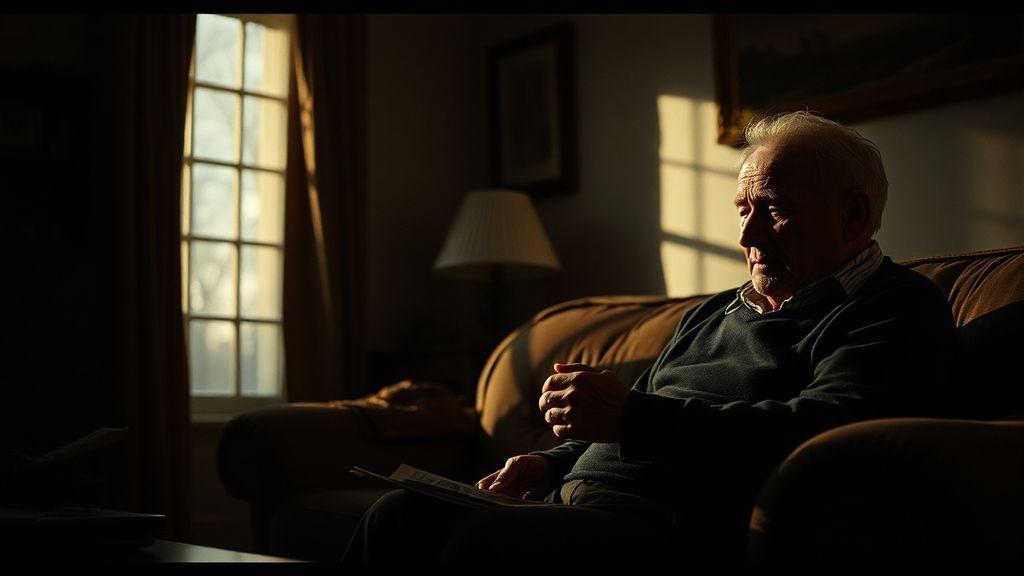
The First Word That Goes Missing
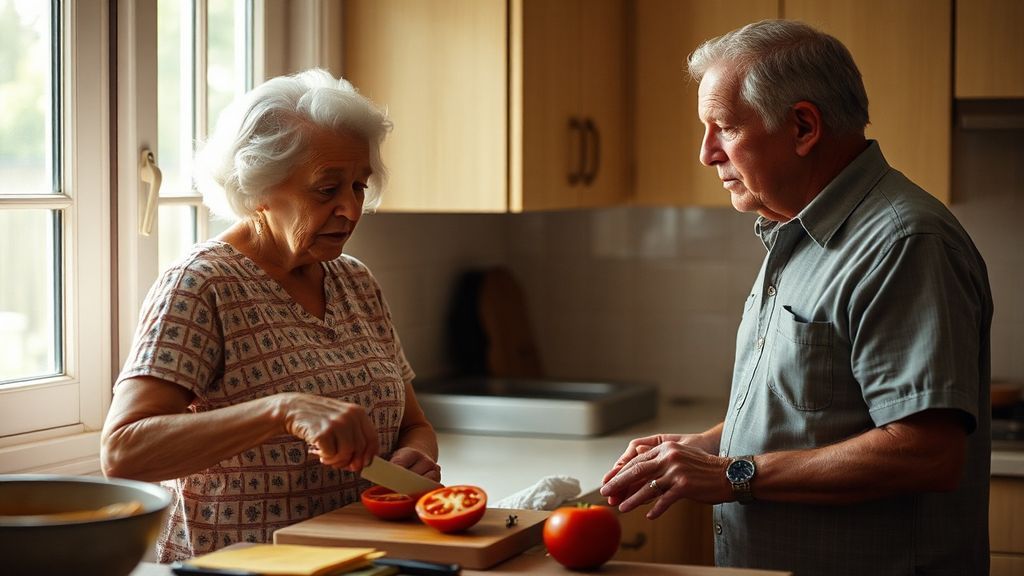
You are standing in the kitchen, afternoon light falling across the counter where she has always sliced tomatoes for sandwiches, and she stops. The knife hovers. Her mouth opens, closes, opens again like a door swinging on a broken hinge. She is looking at the thing in her hand—red, round, familiar—and the word for it has simply walked out of her mind without closing the door behind it.
You wait. You have learned to wait. This is not patience; this is the first lesson in a curriculum no one chooses. The word will come back, or it won't, and either way you are now the keeper of what she cannot hold.
This is how it begins. Not with diagnosis or drama, but with a tomato and a silence that stretches too long, and the sudden, vertiginous realization that you are watching someone you love become partially untranslatable, even to themselves.
The Grammar of Advocacy
There is a moment, usually unmarked, when you cross from being the person who shares their life to the person who must speak it. The doctor asks about symptoms, and you answer. The pharmacist needs insurance information, and your hands move while theirs rest in their lap. You are not replacing them; you are becoming their reliable narrator—the one who holds the thread when the narrative starts to fray.
This is love's most brutal evolution: the shift from witness to advocate. The peak moments of partnership—the weddings, the travels, the bodies young and certain—are not the measure. The measure is the Tuesday morning when you recite their medical history to a stranger in a white coat, when you have memorized their pill schedule better than your own birthday, when you learn to translate their pain into the numerical language of scales from one to ten.
You did not ask for this fluency. You would trade it for their independence in a heartbeat. But here you are, bilingual now in a language you never wanted to learn, speaking for someone who taught you how to speak.
The Ethics of Correction
Perhaps the cruelest calculus arrives without announcement: Do I correct her, or do I live in her version?
She tells the story of how you met, and the details are wrong—the season, the city, the color of the coat you wore. You feel the reflex rise in your throat, the actually, it was autumn, and blue. You swallow it. Or you don't. There is no right answer, only a daily negotiation with truth itself.
Sometimes correction is an act of violence, an insistence on a shared reality that no longer exists for her. Sometimes it is an act of preservation, the last defense against a solitude where even your shared history has become unrecognizable. You learn to read the moment, to feel whether she is waiting to be anchored or whether she has already set sail on waters you cannot follow.
This is not deception. This is hospitality—the offering of a world she can still inhabit, even when it diverges from the one you both built.
The Body Becomes a New Country
You rearranged the kitchen last month. The plates moved lower; the step stool appeared where none had been. You watch her navigate this new topography, her hands finding the familiar shapes in unfamiliar locations. The body she inhabits now is not the one you first loved—the one that danced, that ran, that carried children up stairs without thought. You are learning to love a geography that keeps changing its borders.
This is not the love of aspiration, of mutual becoming. This is the love of accommodation, of constant small adjustments, of finding beauty in limitation rather than possibility. The hand that shakes as it lifts the cup. The voice that repeats the same question three times in an hour, each asking genuine, each answer forgotten before it lands.
You do not love despite these changes. You love through them, which is different—more costly, more strange, more precise.

The Memory That Outlives Recognition
There will come, perhaps, a morning when she does not know your name. This is the fear that wakes you at 3 AM, the future you rehearse like a disaster drill. You have already begun to mourn it, which is its own strange cruelty—to grieve someone still breathing beside you.
But here is what the fear obscures: your presence persists in her body even when it vanishes from her mind. The way you hold a cup to her lips. The particular cadence of your footsteps in the hall. These become her architecture, the walls and floors of a selfhood that no longer requires your name to recognize your necessity.
And you? You carry the story she can no longer hold. You are the archive, the library, the single witness to a marriage that existed in full color, in three dimensions, in time that moved forward with purpose. This is not nothing. This is, perhaps, everything—the final form of devotion, to remember for two.
Writing What She Cannot Yet Read
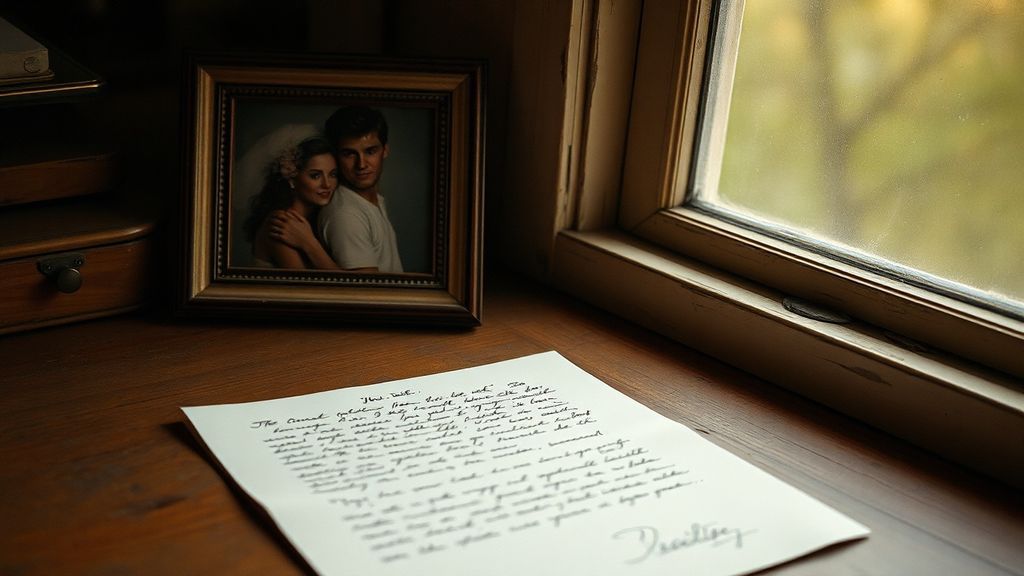
In the quiet hours, you find yourself composing. Not to her present self, who may not follow the thread, but to some future version—or perhaps to no one, perhaps only to the act of witness itself. You write the story of the tomato in the kitchen, the coat that was blue, the body that danced. You write because memory is not only what we retrieve but what we record, what we entrust to paper and pixel and time.
There is a particular loneliness in loving someone whose memory is becoming unreliable. You hold experiences they cannot verify, emotions they may not reciprocate in recognizable form. Writing becomes a form of fidelity—not to accuracy alone, but to the felt truth of what you shared, what you continue to share in this altered register.
The Courage to Be Remembered Alone
What if the truest measure of devotion is not the peak of health shared but the slow, daily work of becoming their reliable narrator when their own mind begins to falter? What if courage is not the grand gesture but the thousand small choices to show up, to speak, to arrange the kitchen again, to answer the same question with the same gentleness you managed the first time?
You are writing a love story with no guarantee of audience. She may never read these words, may never know the fullness of what you carried for her. This is love stripped of reciprocity, love as pure expenditure, love that asks nothing in return because the beloved is no longer capable of the asking.
And still—you write. Still, you arrange the plates lower. Still, you wait through the silence of the lost word, offering not the word itself but the patience of your attention, the shelter of your presence.
What We Leave in Trust
I build things for a living—SaaS platforms, AI systems, code that ships at 2 AM while I'm alone with a screen, pair-programming with LLMs until the architecture finally holds. My weekends, I chase the opposite: steep trails, ocean swells, the raw fact of gravity and wind. That contrast taught me something I couldn't learn from either world alone. The digital space lets us preserve what the physical cannot keep. The physical reminds me that presence is irreplaceable, unrepeatable, now or never.
Some choose to write letters to futures they may not witness, to record what matters before the recording self dissolves. A digital time capsule, a letter to a future self or a future absence, becomes an act of radical hope—the belief that love persists in inscription even when it falters in memory. The technology matters less than the intention: to leave something reliable in a world of increasing uncertainty, to be someone's narrator even from beyond the narrative's end.
The best way to fight forgetting isn't taking another screenshot; it's setting an alarm for the future. By using EterMail to set a delivery date 5 years from now, you completely free yourself from the anxiety of the present. The letter you write at 3 AM, trembling with everything you cannot yet say aloud—EterMail keeps it sealed, encrypted, waiting. You don't have to remember to remember. The future arrives on its own.
You do not know if she will read what you write. You do not know if anyone will. But the writing itself is the devotion, the proof that you were here, that you saw, that you loved through the unraveling and into whatever comes after.
The tomato waits on the counter. The knife hovers. You name it, gently, and she smiles—not at the word, but at the sound of your voice, still familiar, still home.
Some stories deserve to outlast our ability to tell them. EterMail helps you preserve what matters—letters to future selves, to loved ones who may need your voice when theirs falters, to the versions of ourselves we are still becoming.
What is EterMail?
EterMail is a revolutionary time capsule service that allows you to send messages, photos, and videos to the future (up to 30 years). Seal your memories and thoughts today, and they'll be delivered when the time is right.
Time Capsule
Send messages up to 30 years in the future
Rich Media
Text, photos, and videos supported
Secure & Private
Your memories are safely encrypted
EterMail Team
We're the team behind EterMail, dedicated to helping you preserve and share timeless messages with your loved ones. Our mission is to make it easy to express your love, share your wisdom, and create lasting connections that transcend time.
Frequently Asked Questions about Love & Milestones
How do you write a letter to someone who may not remember reading it?
What should I include in a legacy letter for a loved one with memory loss?
How do caregivers process grief when the person they love is still alive?
Related Articles
The Ghost You Choose to Be: Writing Letters to Those Who Will Outlive You
Discover the profound intimacy of writing letters to people who will read them only after you're gone. A meditation on mortality, memory, and choosing your own hauntings.

Why I Built EterMail: A Time Capsule for the People I Love Most
I’m a Product Manager who spends all week optimizing for the "immediate now." But getting lost off the grid on a mountain ridge made me realize I had zero infrastructure for the "forever." Here’s why I stopped worrying about conversion rates for a moment and built EterMail—a secure, tamper-proof digital time capsule for the people I love most.

The Most Radical Letter to Your Future Self Is a Promise to Stay Unfinished
The best letter to your future self isn't a memory—it's a mandate. Learn how writing to the version of you still working with love changes everything.