
The Paper Opens to the Weather Now
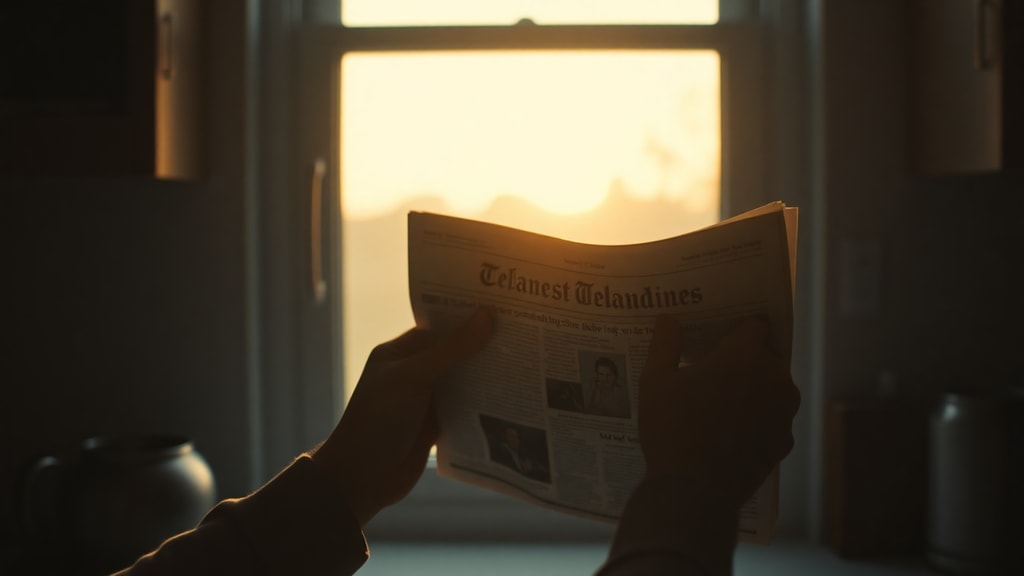
There was a Tuesday—no anniversary, no birthday, no particular reason—when you reached for the newspaper and your thumb found the crossword before it found the death notices. You did not decide this. You did not wake with any resolution, any ceremony of release. The body simply learned, finally, what the mind had been screaming for months: they are not going to appear there anymore.
This is not the grief of fresh loss. This is something stranger, more embarrassing, harder to name. The vigilance that once felt like devotion has become, without your consent, unnecessary. And you stand in the kitchen with coffee cooling, wondering if this absence of search means something has been betrayed.
The Devotional Text You No Longer Read
In the early months, perhaps the first year, the obituaries were not morbid curiosity. They were evidence collection. You needed to know the world was still producing deaths, that the machinery of mortality continued its ordinary work, because if it stopped—if no one died that Tuesday—you might have to confront the singular, unbearable fact that they had died on a day when everything else kept moving.
You studied the pages like a student of disaster. Age ranges. Hospital names. The particular euphemisms families deploy: passed suddenly, after a brief illness, surrounded by love. Each entry was a mirror held at angles, checking whether your own reflection of grief appeared recognizable. Did others die at the same age? Did anyone share the name? The search was compulsive, yes, but it was also a way of keeping them present in the world of the living. If you were looking for the dead, you were still among them. Still in the fellowship of those who had not yet been released.
The hospital name that once stalled your breath—where you sat in vinyl chairs, where you learned the grammar of terminal—now appears in traffic reports. Accident on the 101 near Memorial. You note it for your commute. Nothing more. This is not healing as advertised. This is healing as sedimentation, layer upon layer of ordinary mornings until the trigger sits buried too deep to reach.
The Relief That Arrives Dressed as Indifference
Here is what no one warns you about: the shame of getting better.
You expected milestones. The first birthday without tears. The anniversary you survived. The wedding you attended without scanning the room for their ghost. Instead, healing arrives as noticing. You notice you have not thought of them today. You notice the song came on the radio and you did not change the station. You notice the weather, the crossword, the small tyrannies of Tuesday that once seemed impossible to survive without them—and you survive them.
The relief feels like indifference. It feels like the worst kind of betrayal, this capacity to be interested in rainfall, in grocery lists, in whether the tomatoes have gone soft. You want to hand this ordinary attention back. You want to say: I was not finished. I was still looking.
But the body does not ask permission. The nervous system, that faithful archive of trauma, eventually exhausts its supply of adrenaline. The vigilance that once felt like love becomes, simply, work the body refuses to continue. And one morning, the paper opens to the weather. You do not even notice you have stopped looking until you notice you have stopped looking.

What It Means to Stop Searching
There is a crucial distinction, one that grief counselors and well-meaning friends often collapse: letting go of the search is not letting go of the person.
The obituary check was never really about them. It was about your relationship to a world that contained their absence. You were confirming, daily, that the world had changed in a way you had not authorized. The search was an attempt to keep the wound fresh enough to feel loyal. If you stopped hurting, perhaps you had stopped loving. This is the blackmail grief performs.
But the person you loved exists outside the machinery of your pain. They existed in the specific way they burned toast, in their terrible puns, in the particular angle they held their head when listening. These memories do not live in the obituary pages. They live in the unexpected archive: the recipe you still make wrong because they never wrote it down, the way you now fold towels the way they did, the joke you told last week that was theirs first.
Stopping the search means trusting that these archives persist without daily maintenance. It means accepting that love does not require suffering as proof of authenticity. The world has become, again, a place where they will not reappear dead. This is not because you have forgotten them. It is because you have finally, reluctantly, accepted the terms of their absence.
The Geography of Outliving the Vigil
Consider what has happened. The world you inhabited after their death was a parallel geography, mapped by the places and names that could wound: the hospital, the funeral home, the restaurant where you last ate together, the month of their birthday, the songs. You learned to move through this terrain like a refugee, always alert for checkpoints, for the sudden violence of memory.
Outliving the vigil means this geography has been reabsorbed into the ordinary world. The hospital is a hospital again. The month is a month. The songs are songs, some of which you now sing along to. This is not erasure. It is reclamation—the slow, unglamorous work of making the world habitable again.
But habitable does not mean unchanged. You are not the person who existed before their death. You are the person who learned the obituaries, who studied them like a devotional text, who one morning found the crossword instead. This version of you contains the previous versions, the ones who could not stop searching, who believed that vigilance was the last available form of love. You do not betray them by becoming someone who can open the paper to the weather. You honor them by surviving into a self that can hold both—the memory and the morning, the love and the life that continues without permission.

The Letter You Might Write to the Morning After
There is a practice, ancient and recently digitized, of writing across time to selves you have not yet become. The letter to the future self, the time capsule, the message scheduled for a date you may not live to see—these are technologies of radical hope. They assume that the person you will be remains connected to the person you are, that continuity is possible even across the ruptures of grief and change.
I know this impulse intimately. I am someone who spends too many nights until 2 or 3 AM, face lit by a screen, "pair programming" with AI systems that feel almost like companions in the dark. That extreme digital solitude has taught me something about loneliness and about dialogues across time—about how we reach toward versions of ourselves and others who are not present, who may never be present in the way we want. The code I write is, in part, an attempt to build bridges between physical and digital worlds, to make the transient feel permanent. But I have also learned, stepping away from the keyboard into harsh mountain winds and ocean waves, that the unrepeatable present moment demands something technology cannot replicate. It demands presence, risk, the raw reality of being alive right now.
You might, on this ordinary morning, write to the self who still checked the obituaries. Not to console her—she would not accept consolation, and rightly so—but to witness her. To say: I see the work you are doing. I see how the search feels like the only remaining connection. It is not the only connection, but I cannot tell you this. You must discover it on a Tuesday I have not yet reached.
Or you might write to the self you will become, the one who has forgotten the particular date, who hears the name in a crowded room and does not flinch. You might say: I am still here, in the ordinary attention you now give to weather, to crosswords, to the small persistence of being alive. Do not believe I have abandoned you. I have simply become what I was always going to become: the person who survived, with their love intact, their life resumed.
The best way to fight forgetting isn't taking another screenshot; it's setting an alarm for the future. By using EterMail to schedule a letter to yourself five years from now, you completely free yourself from the anxiety of the present. You don't need to maintain the vigil daily. You write once, seal it in time, and trust that your future self will receive it exactly when she needs to—perhaps on another ordinary Tuesday, when the paper opens to the weather and she wonders if she has betrayed something by getting better.
The Ordinary Miracle of Tuesday
The morning you realize you've stopped checking—this is not a triumph. It is not a failure. It is simply a Tuesday that has become ordinary again, and in that ordinariness, something has happened that you could not engineer and cannot fully claim.
You are still here. The world has not ended. The obituaries continue, full of strangers, and you are not among them, and neither, finally, are they. The search has ended because the search was always, in part, a way of refusing to accept that the ending had already happened. The ending happened. You are still happening.
This is the strange, unremarkable grief of outliving the vigil: the discovery that you can love someone absolutely and still open the paper to the weather. That the two acts are not opposed. That survival is not betrayal, and attention to the living world is not indifference to the dead. The crossword waits. The coffee cools. The day begins, and you are in it, still here, still carrying what you carry, lighter now in ways you cannot measure and do not need to name.
The paper opens to the weather. You read the forecast. You plan accordingly. This is not nothing. This is the whole, impossible, ordinary miracle of continuing.
What is EterMail?
EterMail is a revolutionary time capsule service that allows you to send messages, photos, and videos to the future (up to 30 years). Seal your memories and thoughts today, and they'll be delivered when the time is right.
Time Capsule
Send messages up to 30 years in the future
Rich Media
Text, photos, and videos supported
Secure & Private
Your memories are safely encrypted
EterMail Team
We're the team behind EterMail, dedicated to helping you preserve and share timeless messages with your loved ones. Our mission is to make it easy to express your love, share your wisdom, and create lasting connections that transcend time.
Frequently Asked Questions about Healing & Remembrance
How do you know you're healing from grief rather than just forgetting someone?
Is it normal to feel guilty when you stop obsessing over a loved one's death?
What are meaningful ways to maintain connection with someone who has died without staying trapped in grief?
Related Articles

Writing to the Self Who Will Mourn: The Strange Tenderness of Letters to Future Grief
Why we write letters to our future grieving selves—attempting to preserve the exact sound of a father's laugh before we ever need to miss it.

Why I Built EterMail: A Time Capsule for the People I Love Most
I’m a Product Manager who spends all week optimizing for the "immediate now." But getting lost off the grid on a mountain ridge made me realize I had zero infrastructure for the "forever." Here’s why I stopped worrying about conversion rates for a moment and built EterMail—a secure, tamper-proof digital time capsule for the people I love most.

The Weight of Unsent Words: How Digital Mindfulness Can Save Us from the Infinite Present
We archive everything and remember nothing. Digital mindfulness means writing the letter now—to the person you still have, while you have them.