
The Lightbulb in the Hallway: On Finishing What the Dead Left Undone
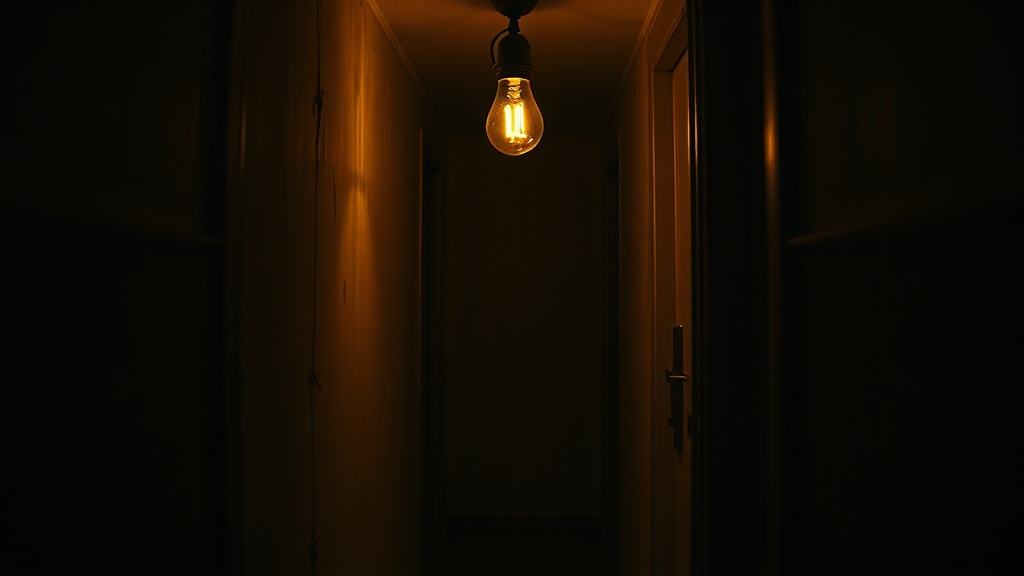
It happens on an ordinary Tuesday. You climb the stepladder they bought at a garage sale, the one with the wobbly left leg you both always meant to replace. The hallway lightbulb—the one that flickered for eleven months, that you navigated by memory and touch, that cast everything in amber and shadow—finally gives out. You twist in the new bulb. The light snaps on, too bright, too honest, too finished. And suddenly you see the scuff marks on the wall, the dust on the baseboard, the precise texture of a life you were still learning to see in the dark.
This is not the grief of fresh loss. This is something stranger, slower. The grief of completion.
The Architecture of Deferred Intention
Every home holds the unfinished intentions of the people who built a life inside it. The shelf brackets still in their plastic sleeve. The garden soil turned but never seeded. The leaky faucet you both learned to ignore, its rhythm becoming as familiar as breathing. These were not failures of will. They were conversations deferred, plans held in the comfortable suspension of "someday, when we have time."
We do not recognize these objects as memorials while the person is alive. They are simply the texture of cohabitation, the benign friction of two lives overlapping. But after death, they transform. The half-painted bedroom becomes sacred ground. The unhung curtains become a last will and testament written in domestic procrastination.
There is a particular cruelty to this: the dead leave behind not just memories, but to-do lists. And for a while, we treat these lists as holy texts. We preserve the flicker. We step carefully around the brackets. We let the faucet sing its single note because to fix it would be to admit that someday has collapsed into never.
The Brightness of Completion
Then comes the evening you finally call the plumber. Or you plant the tomatoes in soil they turned last March. Or you install the shelf alone, measuring twice, cursing once, discovering that some tasks require two sets of hands not for strength but for witness.
The new light reveals what the shadows concealed. This is the paradox of healing: clarity often feels like betrayal. The scuff marks were always there. The wall was never perfect. You were seeing by the gentle lie of insufficiency, and now you must see by the harder truth of enough.
Psychologists who study complicated grief have noted a phenomenon they rarely name in academic literature: the comfort of preserved incompletion. The widower who never moves his late wife's half-knitted scarf. The daughter who leaves her father's workshop exactly as he left it, sawdust and all. These spaces become what we might call active memorials—not static remembrances but ongoing collaborations with absence. To finish the task is to end the conversation.
But here is what the flickering light will not tell you: conversations must end so that new ones can begin. The amber was beautiful, but it was also a kind of holding pattern. And holding patterns, however tender, are not places to live.
The Garden They Turned But Never Seeded
My friend Elena lost her mother to pancreatic cancer in early spring. Her mother had spent the previous autumn turning over the backyard soil, planning a vegetable garden she described in elaborate detail but never planted. "Next year," she said, as people say next year, meaning the future as a general principle rather than a specific season.
Elena left the soil bare through that first summer. She weeded it occasionally, a ritual of maintenance without purpose. The second spring, she stood at the edge with seed packets her mother had bought—heirloom tomatoes, basil, zucchini—and could not open them. The third spring, she planted. "I thought I was desecrating something," she told me. "But the plants grew, and I realized I was continuing something. The soil was the message. The seeds were my reply."
This is the distinction that matters: completion is not erasure. The garden remembers the hands that turned it. The shelf remembers the person who measured the wall. The fixed faucet remembers the drip that marked time. We do not finish their tasks to finish them. We finish their tasks to finish our own paralysis, to step out of the amber and into the day.

The Shadows Not Meant to Be Preserved
The new lightbulb reveals something else, something harder to name. In the flicker, certain shadows moved. Certain shapes suggested themselves. The half-lit hallway was a space of possibility, where the person you lost might still appear around the corner, where the conversation you never finished might still resume.
Brightness forecloses possibility. This is why we resist it. The steady light says: they are not coming. The fixed faucet says: you will do this alone now. The planted garden says: the future belongs to the living, with all its crude and beautiful insistence.
But not all shadows deserve preservation. Some are the shadows of our own fear: fear of forgetting, fear of moving on, fear that to heal is to dishonor. These shadows grow larger in flickering light. They need the clarity of completion to shrink to their proper size.
There is a concept in Japanese aesthetics, wabi-sabi, that finds beauty in imperfection and impermanence. We often misapply it, aestheticizing decay, romanticizing the unfinished. But wabi-sabi is not about preserving the broken. It is about recognizing the broken as part of life's cycle, then continuing the cycle. The cracked teacup is valued not because it leaks, but because it has been repaired with gold, made whole through care, and returned to use.
Writing the Reply
What does it mean to heal when you stop living in the amber of deferred intention? It means becoming, gradually, the person who finishes things. It means discovering that your hands know how to install a shelf, that your body remembers how to turn soil, that you can stand in a hallway too bright and too steady and not look away.
It also means finding ways to continue the conversation on new terms. Some messages need to outlast the moment of sending. This is where the practice of future letters becomes something more than sentimental exercise. Writing to the person you will be in five years, or to the child who will wonder about the grandmother they never met, or to the partner who will sit in this same hallway long after you are gone—these are not replacements for the conversations we could not finish. They are continuations. They are the seeds in turned soil.
I came to this understanding through a strange kind of solitude. For years I've been the person hunched over a screen at 2 AM, "pair programming" with LLMs, mapping architectures while the world sleeps. That extreme digital solitude taught me something about conversations across time—how the most meaningful exchanges often happen asynchronously, with gaps of hours or years between statement and response. The person who sends a message and the person who receives it are never quite the same person. Time is the medium in which meaning crystallizes.
The best way to fight forgetting isn't taking another screenshot; it's setting an alarm for the future. By using EterMail to set a delivery date 5 years from now, you completely free yourself from the anxiety of the present. You write the letter while the soil is still fresh, while the scuff marks still matter, while your hands remember the weight of theirs. Then you let time do what it does. The message waits, encrypted, redundant, patient as a seed in winter. And when it arrives—on a birthday you might have forgotten, on an anniversary when the light feels too bright—you discover that your past self has become a kind collaborator, someone who finished the task of witnessing so your present self doesn't have to do it alone.

The Steady Light
I replaced the hallway lightbulb three years after my father's death. He had been the one who noticed it flickering, who bought the replacement bulb, who left it on the counter in the plastic packaging that gathered dust. I climbed his stepladder. I twisted in the new bulb. The light was terrible, surgical, revealing every flaw in the paint we had chosen together, every mark of a life lived in passage.
I stood there for a long time. Then I walked to the hardware store and bought a dimmer switch. Not to return to the flicker, but to choose the light deliberately, to make it mine, to finish the house he left half-lit and discover that I could live in it after all.
Healing is not a single bright moment. It is the slow installation of dimmers, the gradual adjustment to seeing clearly, the planting of gardens in soil we did not turn alone. The dead leave us their deferred intentions not as burdens but as invitations—to finish, to fail, to try again, to become the people who can stand in steady light and call it home.
The hallway is bright now. The scuff marks are real. And I am still here, learning to see.
What is EterMail?
EterMail is a revolutionary time capsule service that allows you to send messages, photos, and videos to the future (up to 30 years). Seal your memories and thoughts today, and they'll be delivered when the time is right.
Time Capsule
Send messages up to 30 years in the future
Rich Media
Text, photos, and videos supported
Secure & Private
Your memories are safely encrypted
EterMail Team
We're the team behind EterMail, dedicated to helping you preserve and share timeless messages with your loved ones. Our mission is to make it easy to express your love, share your wisdom, and create lasting connections that transcend time.
Frequently Asked Questions about Healing & Remembrance
Why does finishing a deceased loved one's tasks feel like betrayal?
How can I honor someone's memory without keeping everything exactly as they left it?
What are healthy ways to process grief when everyday tasks trigger painful memories?
Related Articles

The Geography of Absence: How Reclaiming Space Becomes Its Own Kind of Healing
What happens when you finally move the couch? Explore how reclaiming physical space after loss creates room for healing and new beginnings.

The Voice They Left Behind: When Healing Sounds Exactly Like Someone You Lost
Discover what it means when a lost loved one's speech patterns, jokes, and verbal tics live on in your own voice—and whether to let them stay.

The Quiet Arithmetic of Moving Forward: When Your Body Learns a Life Measured for One
When grief becomes daily renegotiation: how we learn to inhabit space alone, and why healing happens in the body before the heart.