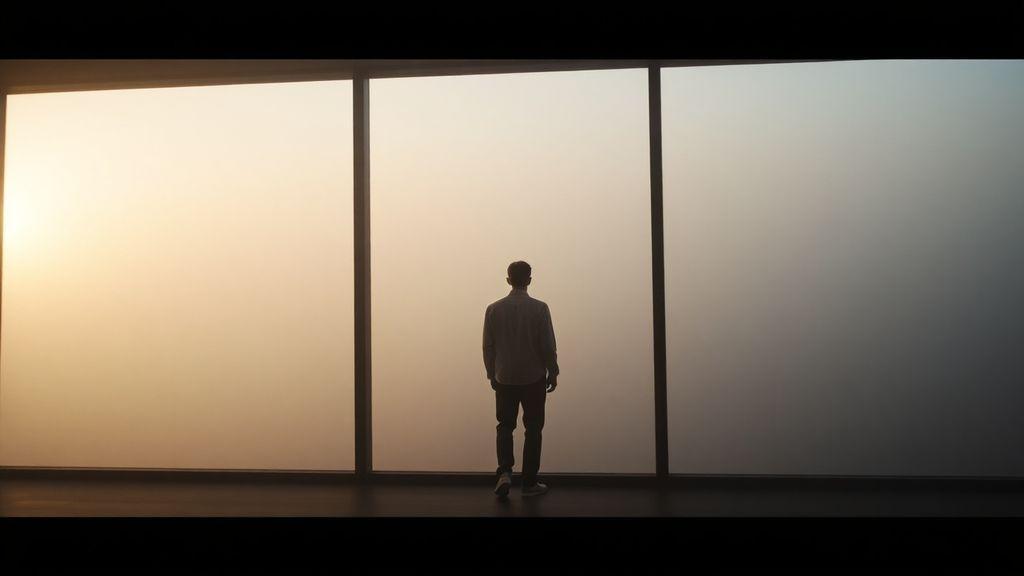
You wake up on a Tuesday in March. The light is wrong for the season, that particular gray that makes the bedroom feel like a held breath. Someone was talking to you. A dog, maybe. The weather. You were complaining about your knee, or they were—something mundane enough to have already evaporated from conscious memory. You reach for the dream as it recedes, and that's when you realize: you cannot remember if they were alive or dead in it. Only that they were there. That you were together in the flat, unremarkable country of ordinary life.
This is the morning you have been dreading and, somehow, waiting for. The morning grief finally stops performing for you.
The Geography of Dreaming Grief
For months, perhaps years, your sleeping mind kept meticulous records. Every dream was a ledger entry, a balance sheet of loss restated nightly. They appeared healthy and you woke sobbing with relief, the dream's cruel contract written in fine print: this is temporary, this is not real, you will pay for this comfort with waking. Or they appeared already gone and you spent the dream's duration in the frantic archaeology of disbelief, digging through the dream-logic for some loophole, some reversal. The worst dreams staged their death fresh each time—different circumstances, same finality, your subconscious apparently unsatisfied with the original version and compelled to produce endless director's cuts.
The body keeps score, but so does the sleeping brain. And for a long while, your brain seemed determined to keep the wound at exact temperature, neither letting it close nor letting it kill you.

The Strange Relief of Boring Dreams
Now this: a conversation about nothing. A dog on the street. The weather, which you cannot even recall as sunny or gray. Your subconscious has stopped keeping score. The dream did not jolt you awake. The morning that followed did not include the weighted hour of readjustment, that terrible recalibration where you must re-learn the fact of their absence as if for the first time, as if the dream's temporary gift of presence were a debt now come due with interest.
There is relief in this, yes. But there is also something else, something harder to name. A kind of loneliness that arrives not from missing them but from missing the intensity of missing them. The dream's ordinariness feels like a betrayal you committed, or they did, or time did on both your behalves. You have been demoted from the epic narrative of grief to the small print of continuing. The sharp edges have eroded. What remains is smooth, and smooth is harder to hold.
What Healing Actually Looks Like
We are given so many inadequate metaphors for healing. Closure, as if grief were a door. Moving on, as if it were a location. Time heals all wounds, which manages to be both true and useless, the kind of sentence that comforts only the person not currently bleeding.
What if healing looks less like resolution and more like diffusion? The grief does not disappear; it simply occupies more space less densely. It seeps into the groundwater of your daily life, present but no longer the main event. You do not stop loving them. You stop needing their death to be the organizing principle of your consciousness.
The ordinary dream is evidence of this diffusion. Your brain no longer requires the dramatic staging. It has integrated their absence sufficiently that they can simply appear, unremarked upon, in the ongoing narrative of your mental life. This is not forgetting. This is, perhaps, the deepest form of remembering: they have become part of the furniture of your mind, no longer requiring special exhibition.
The Guilt of Getting Better
Here is what no one warns you about: the guilt of unremarkable dreams. You may find yourself trying to provoke the old intensity, summoning their image deliberately, testing your own emotional response like a tongue probing a socket where a tooth once was. You want to confirm you still hurt enough, that your love has not been cheapened by its own accommodation to fact.
This is a false audit. The dream's ordinariness is not a measure of your love's diminishment but of its maturation. Early grief is a kind of emergency response, all adrenaline and hypervigilance. Sustained grief is a different organism entirely. It learns to coexist. It makes room. The ordinary dream is not a failure of feeling but evidence that your feeling has found sustainable form.

Writing Toward the Ordinary
There is a practice that can help you recognize and honor this transition: writing letters you do not send, or send only into the future. Not the dramatic farewells or the unreleased anger, but the mundane updates. The letter about the dog on your street, the letter about your knee, the letter about Tuesday's gray light. These are the true substance of relationship, the connective tissue that outlasts crisis.
Some people use digital time capsules for this purpose—secure, scheduled messages that arrive years later, carrying the ordinary voice of your present self to some future iteration who may need to remember who you were, what you noticed, what you loved in the small hours. What matters is the act of recording the unremarkable, of asserting that your daily existence has weight and worth even—especially—when nothing remarkable is occurring.
This practice acknowledges a truth grief often obscures: the relationship was never only its ending. The vast majority of it was ordinary. The dreams are returning you to this proportion, and the letters can help you meet them there.
The Future Self Who Will Grieve Differently
Consider writing to the person you will be in five years, or ten, or twenty. Not with advice or prediction, but with description. The particular quality of this morning's light. The dream you cannot fully recall. The strange, guilty relief of its very unremarkableness. Future you may need to know that healing arrived before they noticed it, that the transition was not a decision but a slow accretion of ordinary mornings.
I know this impulse intimately. I spend my nights building systems, wrestling with code and AI architectures until the hours blur past 2 AM, chasing that strange frontier where human intention meets machine capability. But when I finally step away—hiking steep trails, skiing through whiteout conditions, feeling the ocean's indifferent force against a board—I understand something my screens can't teach me. The present moment is unrepeatable. The gray light of a particular Tuesday, the specific dog on your street, the knee that aches in damp weather: these details are perishable, and their perishability is exactly what makes them sacred. I built EterMail because I kept losing these moments to the assumption that I'd remember, that the important stuff would somehow stick. It doesn't. The future self who receives your words may be grieving someone else by then, or may have forgotten the specific texture of this particular transition. Your record becomes a gift of perspective, a demonstration that they have survived such shifts before and will again.
The best way to fight forgetting isn't taking another screenshot; it's setting an alarm for the future. By using EterMail to set a delivery date 5 years from now, you completely free yourself from the anxiety of the present. The letter about your unremarkable dream, the one you can barely hold onto as coffee brews—that letter can wait, encrypted and protected, for the exact morning when future you needs to remember that healing happened quietly, without announcement.
What We Owe the Dead
The question of obligation haunts every stage of grief. What do we owe the dead? Memory, certainly. But memory of what? The dramatic final days, or the accumulated ordinary days that composed the actual life? The person who existed in crisis, or the person who existed in the flat country of daily existence?
Perhaps we owe them our eventual return to that country. Our willingness to dream them into ordinary contexts, to let them participate again in the mundane texture of our minds. The emergency of grief is not sustainable; it was never meant to be. The ordinary dream is not abandonment. It is invitation. It is the psyche's recognition that the relationship can continue in sustainable form, no longer requiring crisis to justify its existence.

The Continuation of Conversation
You will have other dreams. Some may return to old intensity without warning, triggered by anniversaries or songs or the particular angle of autumn light through kitchen windows. This is not regression. Grief is not linear, and healing is not a destination. The ordinary dreams and the extraordinary dreams can coexist, each true to its moment, each offering its own form of contact.
What changes is your relationship to the dreaming itself. You no longer wake with the same dread of readjustment. The dream's content matters less than its simple occurrence, the ongoing fact of internal conversation. They are still there, in your mind's architecture, available for visitation without requiring dramatic passage.
The Letters We Leave Behind
There is a final consideration, one that the ordinary dream makes newly urgent. If your subconscious has stopped staging their death, has begun instead to stage their simple presence, what record exists of this transition? Dreams evaporate. The morning's gray light, the dog on the street, the conversation about knees or weather—these specifics will not survive the day unless you choose to preserve them.
Digital time capsules offer one form of preservation, but the impulse matters more than the mechanism. The act of recording your ordinary grief, your ordinary healing, your ordinary dreams. The assertion that these states deserve documentation, that the flat country of continuing contains its own forms of meaning. You write not because the future requires instruction but because the present requires witness. You are here, in this unremarkable morning, having survived to a stage of grief you did not know existed and could not have aimed for directly.
The dream will not return on demand. The healing will not announce itself with ceremony. What remains is the choice to notice, to record, to send something forward into the time you cannot see. The ordinary is the only country we truly inhabit. The dead, finally, have joined us there again.
Some mornings you will still reach for the dream and find only absence. Some mornings the dream will return with old intensity, unexpected and unwelcome. This is the nature of the territory. What the ordinary dream offers is not resolution but possibility: the demonstration that your mind has made room for them in sustainable form, that love can persist without requiring perpetual crisis to prove its existence. The letter you write today, scheduled for some future arrival, may be the exact evidence that future self requires to believe this transition ever occurred. The technology is simple. The act is ancient. The need is human, and ongoing.
What is EterMail?
EterMail is a revolutionary time capsule service that allows you to send messages, photos, and videos to the future (up to 30 years). Seal your memories and thoughts today, and they'll be delivered when the time is right.
Time Capsule
Send messages up to 30 years in the future
Rich Media
Text, photos, and videos supported
Secure & Private
Your memories are safely encrypted
EterMail Team
We're the team behind EterMail, dedicated to helping you preserve and share timeless messages with your loved ones. Our mission is to make it easy to express your love, share your wisdom, and create lasting connections that transcend time.
Frequently Asked Questions about Healing & Remembrance
Why do I feel guilty when my dreams about deceased loved ones become ordinary?
How can writing help process the transition from acute to integrated grief?
What should I include in letters to my future self about grief and healing?
Related Articles

Why I Built EterMail: A Time Capsule for the People I Love Most
I’m a Product Manager who spends all week optimizing for the "immediate now." But getting lost off the grid on a mountain ridge made me realize I had zero infrastructure for the "forever." Here’s why I stopped worrying about conversion rates for a moment and built EterMail—a secure, tamper-proof digital time capsule for the people I love most.

The Most Radical Letter to Your Future Self Is a Promise to Stay Unfinished
The best letter to your future self isn't a memory—it's a mandate. Learn how writing to the version of you still working with love changes everything.

The Ice Tray at Midnight: On Grief, Domestic Minutiae, and the Quiet Work of Becoming Yourself Again
Why do the smallest habits hurt most after someone leaves? A reflection on grief, domestic minutiae, and the quiet moment healing finally begins.