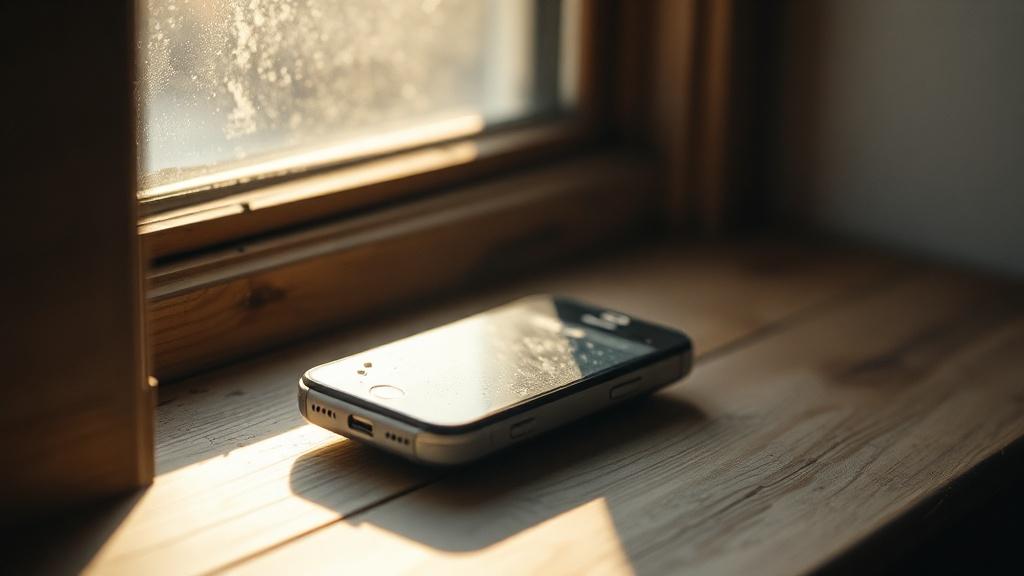
You press play one last time. The audio crackles, familiar as your own heartbeat. "Hey, it's me." A pause. A throat-clearing. Somewhere in the background, a car horn you have come to know by its pitch, its duration, the exact millisecond it blurs their next word. You could recite this message in the dark. You have, in fact, done exactly that—fourteen months of midnight rituals, your phone pressed to your ear like a seashell promising the ocean.
But tonight something shifts. The storage warning that finally prompted this moment was merely an excuse. The truth sits heavier: you no longer need the speaker to hear them. Their voice has migrated somewhere deeper, into the architecture of your own consciousness, and the recording has become something else entirely. A script you perform. A comfort object. Less them than your ritual of pressing play.
This is the strange, unmapped country of contemporary grief—the moment when the technology of remembrance outlives your need for it, and you must learn to carry a voice forward without the crutch of a device pressed to your ear.
The Amber Trap: When Preservation Becomes Performance
We preserve the dead with desperate ingenuity. The voicemail becomes sacred text. The text thread, archived against accidental deletion. The social media profile, left active in a digital mausoleum, friends still posting birthday wishes to a consciousness that will never again scroll, will never feel the particular vibration of notification against palm.
There is profound humanity in this impulse. We are the first generation to possess such granular, reproducible traces of the departed. Our grandparents kept handwritten letters, perhaps a few photographs, the occasional reel-to-reel tape. We inherit terabytes—voice memos, video calls, the accidental documentation of ordinary Tuesday afternoons when someone happened to hit record.
Yet preservation curdles into something else when it outlives its therapeutic function. I knew a woman who played her father's final voicemail every morning for three years, the ritual so fixed she could no longer distinguish between the man and the recording. The "hey, it's me" became a prayer she recited rather than a voice she received. The pauses, once alive with his particular rhythm of thought, became metronomic. She was not listening to him anymore. She was performing her grief, and the voicemail had become its stage.
The question emerges gradually, insidiously: are we preserving them, or preserving our own capacity to feel their loss? The technology offers an illusion of continued relationship. Press play, and they speak again. But relationship requires exchange, and the dead offer only repetition. The same words. The same car horn. The same throat-clearing, looped into eternity.
The Deletion as Rehearsal: Fearing Forgetting

The finger hesitates above delete. The fear arrives in waves, each with its own particular flavor.
First, the superstitious terror: this is the last artifact. The final physical proof that they occupied sound waves, that their larynx shaped air into meaning. Deletion feels like violence, like participation in a second death more complete than the first.
Then, the moral anxiety: what kind of person deletes their dead mother's voice? The internal prosecutor presents evidence of insufficient devotion, of healing too quickly, of a heart that never loved enough to require permanent memorial.
Finally, the existential dread: if I no longer need this, who am I becoming? The grief has defined you. Its rituals have structured your days, given you identity, connected you to a community of fellow mourners. To release the voicemail is to release a version of yourself you have grown accustomed to inhabiting.
But here is what no one tells you: deletion is not forgetting. It is trust.
Trust that memory, that stubborn, imperfect, glorious human faculty, will persist without technological prosthesis. Trust that the voice has already migrated into your dreams, your spontaneous imitations, the way you clear your own throat when nervous. Trust that you have internalized them sufficiently to generate their responses, to know precisely how they would have started this conversation you are now having alone.
The deletion rehearses a larger surrender we must all eventually make: the recognition that we carry the dead not in our devices, but in our ongoing transformation by their presence. They become part of our own voice, our own pauses, our own particular way of saying "hey, it's me" when we call someone we love.
Living Voice: When Memory Becomes Generation

There comes a morning—unexpected, almost embarrassing in its ordinariness—when you realize you have not pressed play in weeks. The realization arrives not with triumph but with subtle grief, a different species of loss. You have been having conversations with them in your head, whole elaborate dialogues, and you have not needed external verification of their voice because you have finally become fluent in their absence.
This is the paradox of deep remembrance: it liberates us from the need to remember.
The technology that once preserved them can now be repurposed. Not as archive, but as bridge. You might record yourself speaking to them, not expecting response but practicing the ongoing articulation of a relationship that death altered but did not terminate. You might write letters they will never read, discovering in the writing that you are really addressing your own future self, the person still becoming through this dialogue with absence.
I spend a lot of nights alone with glowing screens, "pair programming" with AI models until 2 or 3 AM, chasing architectures that dissolve at dawn. That extreme digital solitude has taught me something about voices that outlast their speakers—about the loneliness of building bridges to futures you won't inhabit. When I step away from the keyboard, I head for steep mountain trails or ocean swells, places where control dissolves and raw reality insists. The wind strips away illusions. You learn to cherish unrepeatable moments precisely because they cannot be captured, only carried.
Or you might use tools designed for exactly this temporal complexity—platforms that allow you to compose messages to your own future, to those who will exist after you, to the person you are still becoming who will one day need to hear from who you were. The same impulse that made you press play fourteen hundred times can be redirected toward active creation rather than passive preservation.
The best way to fight forgetting isn't taking another screenshot; it's setting an alarm for the future. By using EterMail to set a delivery date 5 years from now, you completely free yourself from the anxiety of the present. You write to the person you'll become, carrying forward the voices you've internalized, and trust that the bridge will hold until you reach the other side.
The voice you preserved in amber, you are now generating from within. The "hey, it's me" has become your own greeting to the world, inflected with their cadence, their humor, their particular upward lilt at sentence's end. You are not forgetting them. You are finally, fully, incorporating them.
The Speaker Goes Silent: What Remains
The deletion, when it comes, is almost anticlimactic. A confirmation screen. A brief animation. The storage meter retreats, indifferent. You sit with the emptiness, waiting for the anticipated catastrophe, and instead find something quieter: relief, threaded with sorrow, braided with the strange freedom of no longer needing to perform your grief.
You still hear them. In your own laughter, suddenly, unexpectedly. In the phrase you use to greet your child, unconsciously borrowed. In the pause before difficult conversations, their patience become your patience. The speaker has gone silent, but the voice has found a more durable medium: your own living, changing, ongoing self.
This is what it means to heal when technology outlives our need for it. Not the erasure of loss, but its integration. Not the forgetting of voice, but its translation into a new dialect we continue to speak. The voicemail was never really them. It was a moment, captured, partial, already distant even when recorded. They were always larger than any preservation could contain.
The afternoon you finally clear their voicemail, you are not making space on your phone. You are making space in your life for the next form this relationship will take, the form that requires no technology because it has become, finally, fully, part of you.
And when you next say "hey, it's me" to someone you love, you will hear, beneath your own voice, their echo. Not preserved. Not performed. Simply, profoundly, inherited.
What is EterMail?
EterMail is a revolutionary time capsule service that allows you to send messages, photos, and videos to the future (up to 30 years). Seal your memories and thoughts today, and they'll be delivered when the time is right.
Time Capsule
Send messages up to 30 years in the future
Rich Media
Text, photos, and videos supported
Secure & Private
Your memories are safely encrypted
EterMail Team
We're the team behind EterMail, dedicated to helping you preserve and share timeless messages with your loved ones. Our mission is to make it easy to express your love, share your wisdom, and create lasting connections that transcend time.
Frequently Asked Questions about Healing & Remembrance
How do you cope with deleting a deceased loved one's voicemails or messages?
What are healthy ways to preserve memories of someone who has passed away?
Why does deleting a loved one's digital presence feel so emotionally difficult?
Related Articles

Why I Built EterMail: A Time Capsule for the People I Love Most
I’m a Product Manager who spends all week optimizing for the "immediate now." But getting lost off the grid on a mountain ridge made me realize I had zero infrastructure for the "forever." Here’s why I stopped worrying about conversion rates for a moment and built EterMail—a secure, tamper-proof digital time capsule for the people I love most.

The Most Radical Letter to Your Future Self Is a Promise to Stay Unfinished
The best letter to your future self isn't a memory—it's a mandate. Learn how writing to the version of you still working with love changes everything.
The Ice Tray at Midnight: On Grief, Domestic Minutiae, and the Quiet Work of Becoming Yourself Again
Why do the smallest habits hurt most after someone leaves? A reflection on grief, domestic minutiae, and the quiet moment healing finally begins.