The Envelope Addressed to Empty Space
There is a particular loneliness in writing to someone who cannot write back. Not the loneliness of distance, where a reply merely travels slowly, but the deeper solitude of addressing words to a person who may never exist at all.
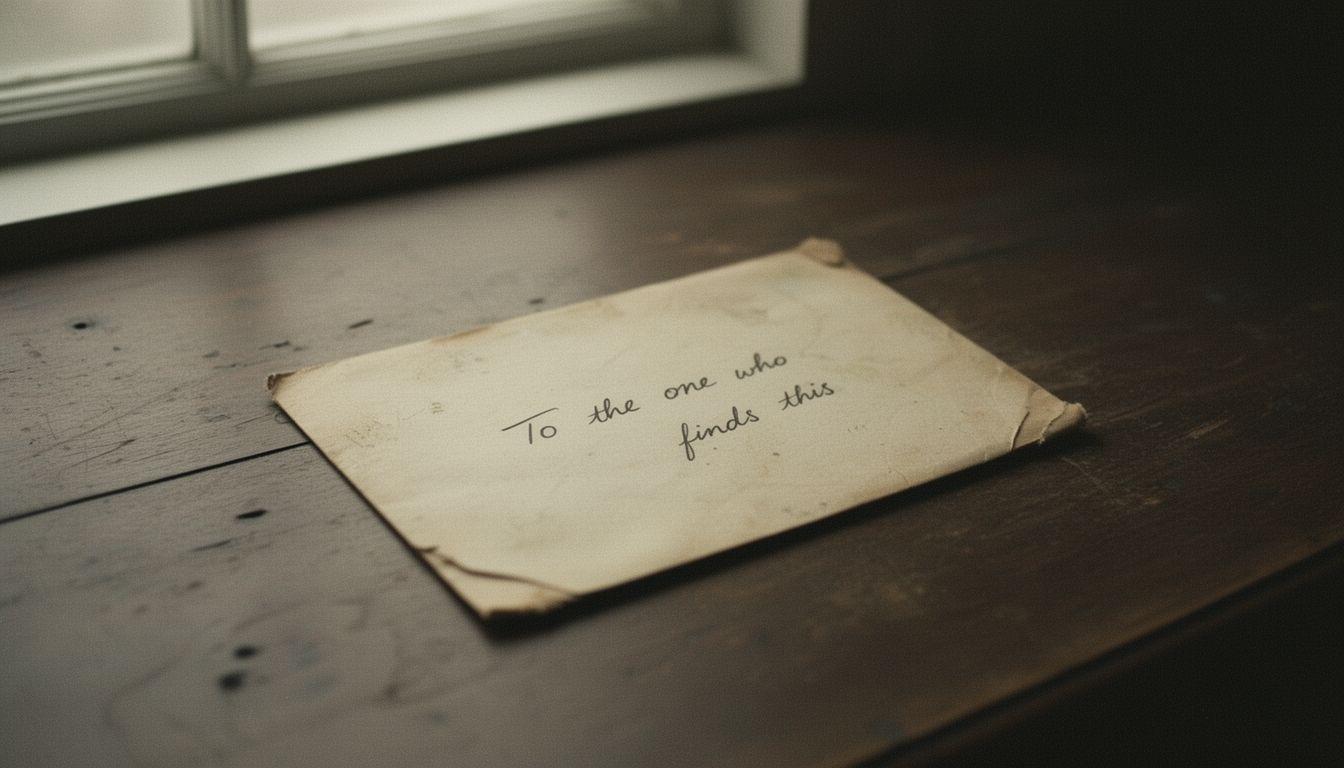
I found one of these letters last spring, buried in my grandmother's cedar chest. The envelope, yellowed at the edges, bore no name—only the words "To the one who finds this." Inside, she had described the smell of her mother's basement in 1954: damp wool, coal dust, the particular green of late afternoon light through ground-level windows. She was twenty-three. She would not have children for another decade. She could not have known who would eventually read her words, or whether anyone would.
This is the paradox at the heart of letters to the future: they are simultaneously acts of profound hope and radical acceptance of oblivion.
We write them anyway.
The Specific Texture of a Tuesday Afternoon
What do we actually want to pass down? Not the milestones. Not the résumé achievements or the accumulated assets. When we sit down to write to someone unformed—an unconceived child, a future spouse we've never encountered, a version of ourselves still decades away—we reach instead for the mundane miracles that constitute a life.
The smell of rain on hot asphalt. The particular way your father laughed when he was truly amused, not merely polite. The color of the walls in your first apartment, the one you could barely afford, where you felt most completely yourself. These details resist inheritance through DNA or estate planning. They cannot be encoded in chromosomes or transferred through legal instruments. They can only be witnessed, and witnessing requires a witness.
I think of this as the witnessing impulse—the fundamental human need not merely to have lived, but to have been seen living. When we describe the texture of a Tuesday afternoon to someone who does not yet exist, we are attempting to solve an impossible problem: how to make the irreducibly subjective experience of consciousness somehow transferable, how to let another person inhabit our sensory world even briefly.
The letter becomes a kind of virtual reality, constructed from language, offering a simulation of being present in a moment that can never be recovered.
Writing to the Unformed
There are particular challenges when your recipient has no fixed identity. A letter to your future self, however distant, at least addresses a known quantity—you have met this person, however changed they may become. But a letter to a child you may never conceive, or to a grandchild not yet imagined, requires a different kind of imaginative labor.
You must construct a recipient without knowing their temperament, their interests, whether they will find your words precious or embarrassing. You write into a void that may remain void. The letter becomes less communication than offering—something left at a shrine, a message in a bottle whose shoreline may not exist.
And yet this uncertainty seems to liberate something in the writing. Freed from the constraints of a known audience, we become more honest, more strange, more specifically ourselves. My grandmother's description of her mother's basement includes details she never shared with anyone living: her fear of the furnace's ignition sound, her secret habit of reading her sister's diary, her conviction that the house was slowly sinking into the earth. These were not stories for her children, who knew a different version of her. They were truths reserved for an unknown witness, someone who could receive them without the complications of shared history.

The Ethics of Unidirectional Intimacy
There is something potentially troubling in this practice. We are, in essence, creating emotional obligations for people who cannot consent to them. A child who discovers a letter written before their conception did not choose to become the repository of their parent's unlived hopes, their unprocessed grief, their need to be understood.
I have heard from people who found such letters and felt burdened by them—the weight of expectations they never agreed to carry, the sense that their own identity was somehow predetermined by these words from the past. The letter to the unformed recipient risks becoming a kind of emotional colonization, claiming territory in a consciousness that does not yet exist.
And yet. And yet.
The alternative is silence. The alternative is that these textures of consciousness—my grandmother's fear of the furnace, her certainty about the sinking house—simply disappear. The alternative is that we live and die without ever having been witnessed, without ever having offered our specific Tuesday afternoon to anyone who might understand what it meant.
Perhaps the ethical practice lies not in refusing to write, but in writing with humility. In acknowledging that our words are gifts that may be unwanted, burdens that may be rejected, truths that may be misunderstood. In leaving space for the recipient to refuse our offering, to read our letter and feel nothing, to cringe at our sentimentality or dismiss our concerns as quaint.
Digital Witnesses, Eternal Archives
The technology of preservation has always shaped what we choose to save. My grandmother's cedar chest imposed its own selection pressures—only objects of certain sizes, certain durability, made the cut. Digital storage promises something different: the preservation of everything, or at least the possibility of it.
But this abundance creates its own problems. A letter buried in a cedar chest carries the weight of intentional curation. A file among thousands in cloud storage may never be found at all. The challenge of digital legacy is not preservation but discovery—how to ensure that our words reach their intended recipients across the noise of infinite content.
This is where intentionality becomes crucial. The platforms we use to store these messages matter. The mechanisms we create for their delivery—time-locked releases, conditional triggers, carefully designated recipients—shape whether our words become meaningful encounters or digital debris.
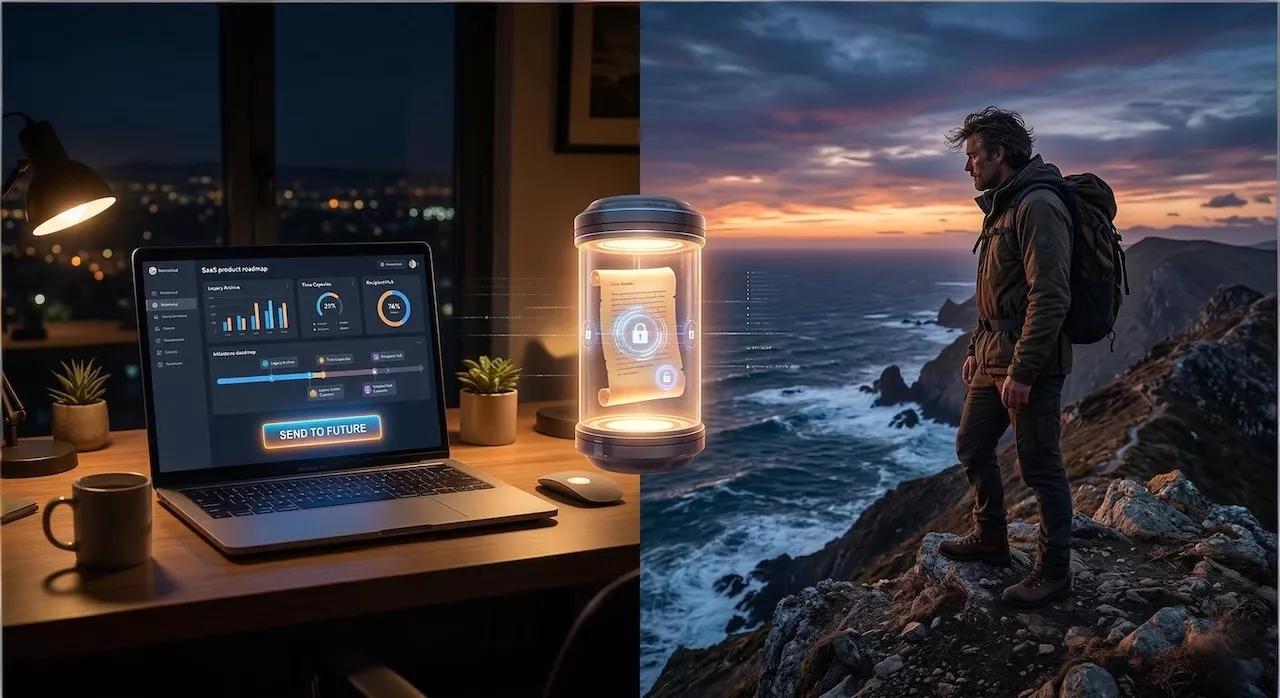
I spend too many nights alone with glowing screens, "pair programming" with LLMs until 2 or 3 AM, mapping architectures for systems that don't yet exist. That extreme digital solitude taught me something about loneliness and about dialogues across time—about building bridges between moments that never overlap. When I step away from the keyboard, I throw myself into steep mountain trails or ocean waves, where the raw reality of wind and water strips away every illusion. Those moments taught me that what matters isn't the perfect system, but the human impulse to reach forward and backward, to insist that consciousness connects across impossible distances.
This is exactly why I obsessed over end-to-end encryption and extreme server redundancy when building EterMail. Because I know that a letter written to the future needs to be guarded even more fiercely than a bank password. The platform treats each letter as a commitment—a promise made across time that the technology itself is obligated to fulfill. When you write to someone who may not exist, you are making a wager against entropy. The infrastructure of that wager matters.
What Survives When Nothing Else Does
I return to my grandmother's letter, to its description of green light through basement windows. What she could not have predicted: I read her words in a basement of my own, in a house I was preparing to sell after her death. The light was wrong—the windows faced north, not west—but the smell was right, that particular underground coolness, and I felt something shift in my understanding of her.
She had been a person who noticed things. Who found significance in the sensory details that most people filter out. Who believed, apparently, that someone someday should know about the green light.
This is what letters to the unformed ultimately offer: not information, but evidence of attention. They prove that someone was here, that someone cared enough to record the specific texture of being alive. They create a chain of witnessing that extends backward and forward in time, connecting consciousnesses that never overlapped in physical space.
The child you haven't conceived may never exist. The future self you address may be unrecognizable to your present understanding. The lover you imagine may never arrive. But the act of writing—of selecting and describing and committing to preservation—remains. It is a way of insisting that your consciousness mattered, that your particular Tuesday afternoon deserved a witness, that the green light through the basement window was worth recording.
We write because we cannot bear the alternative. Because the unwitnessed life feels, in some essential way, incomplete. Because we are creatures who evolved to tell stories, and the story of our own consciousness is the one we are most desperate to share, even with audiences who may never assemble to hear it.
The envelope waits. The cedar chest, or its digital equivalent, stands ready. What will you put inside?
What is EterMail?
EterMail is a revolutionary time capsule service that allows you to send messages, photos, and videos to the future (up to 30 years). Seal your memories and thoughts today, and they'll be delivered when the time is right.
Time Capsule
Send messages up to 30 years in the future
Rich Media
Text, photos, and videos supported
Secure & Private
Your memories are safely encrypted
EterMail Team
We're the team behind EterMail, dedicated to helping you preserve and share timeless messages with your loved ones. Our mission is to make it easy to express your love, share your wisdom, and create lasting connections that transcend time.
Frequently Asked Questions about Letters to Future
What should I write in a letter to my future child?
How do I write a meaningful letter to someone I haven't met yet?
Is it ethical to leave emotional letters for unborn children?
Related Articles
Why I Built EterMail: A Time Capsule for the People I Love Most
I’m a Product Manager who spends all week optimizing for the "immediate now." But getting lost off the grid on a mountain ridge made me realize I had zero infrastructure for the "forever." Here’s why I stopped worrying about conversion rates for a moment and built EterMail—a secure, tamper-proof digital time capsule for the people I love most.

The Most Radical Letter to Your Future Self Is a Promise to Stay Unfinished
The best letter to your future self isn't a memory—it's a mandate. Learn how writing to the version of you still working with love changes everything.

The Ice Tray at Midnight: On Grief, Domestic Minutiae, and the Quiet Work of Becoming Yourself Again
Why do the smallest habits hurt most after someone leaves? A reflection on grief, domestic minutiae, and the quiet moment healing finally begins.