The Letter That Arrived Empty
Three years ago, a woman in Portland opened an email she'd written to herself at twenty-two. She had been drinking, she remembered that much—the subject line read "DON'T FORGET THIS FEELING" in all caps, a digital scream across a decade. But the body contained only abstractions: I was so happy. Everything felt possible. I loved him so much.
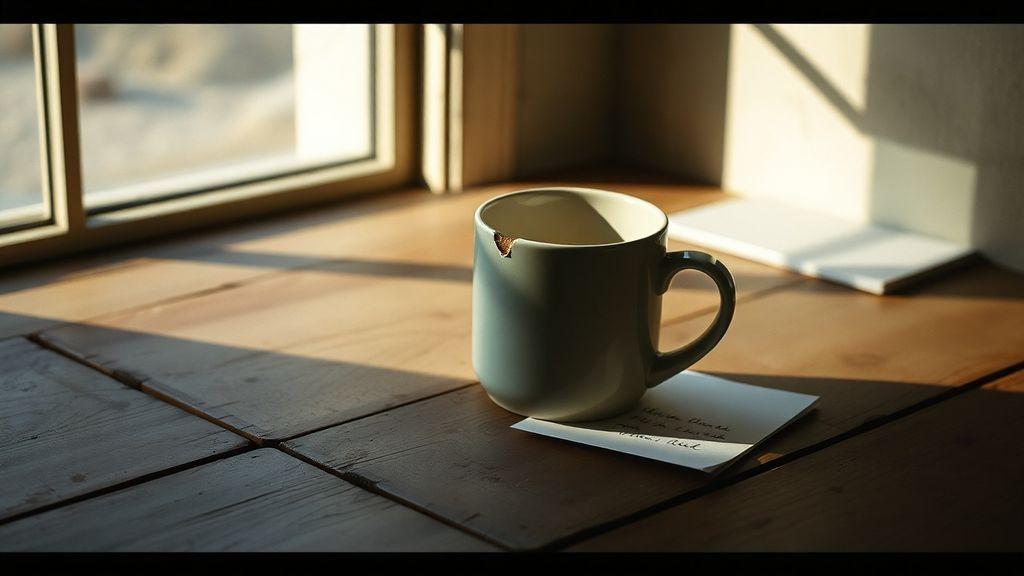
She sat in her kitchen, now thirty-five, divorced, the father of her children living two states away, and felt nothing. Not because the feeling had vanished, but because she had failed to make it grabbable. She had written the emotional equivalent of a weather report—sunny, warm, pleasant—when what she needed was the specific angle of light through her apartment window at 4:47 p.m., the exact chip in the ceramic mug he'd brought her coffee in, the sound of his key turning in the lock that meant he was home, he was hers, this was real.
Mary Oliver, in her ruthless and gorgeous way, once instructed poets to hunt for "verbs of muscle, adjectives of exactitude." She meant it as craft advice, a way to make a line of poetry survive the first reading. But applied to the letters we write to futures we cannot see—to our own older faces, to children not yet born, to lovers we hope will still be beside us—her instruction becomes something else entirely: a technology of immortality, a method for pinning consciousness to the wall before time dissolves it.
The letters that survive are the ones that refuse abstraction. The ones time cannot digest.

The Failure of Emotional Summaries
We have all written them. The birthday card to our future self, the time capsule note, the drunken 2 a.m. email scheduled to arrive in five years: I hope you're happy. I hope you followed your dreams. Remember this moment. These are emotional summaries, and they share the same fatal flaw as all summaries—they assume the reader already knows the story.
Your future self does not know the story. Your future self is, in crucial ways, a stranger. Neuroscience confirms what aging makes viscerally apparent: we do not access memories so much as reconstruct them, each recall a slight betrayal, a smoothing of edges, a substitution of what we wish we'd felt for what we actually did. The self who opens your letter in 2034 will be operating with corrupted source code, a brain that has rewritten your present to serve whatever narrative your future requires.
Against this entropy, abstraction offers no defense. I was so in love tells your future self nothing she can use. But: The way he left his socks balled inside his shoes every single night, and how I would unroll them each morning before the wash, hating it, loving him, the cotton still warm from his sleep—this is a doorway. This is a handhold in the dark of forgetting.
Oliver understood that the physical world is our only shared language across time. Future strangers, including our own estranged older selves, can only be reached through language dense with physical reality. The rust on your mailbox hinge. The particular squeak of your floorboard. The weight—not "heavy," but the exact resistance of your coffee mug when full, the way your wrist adjusts unconsciously—these are the coordinates of being alive, and they do not degrade in transmission.
The Ethics of Precision
There is a tenderness to this kind of writing that borders on the sacred. To record the verb of how your mother's voice cracks when she says your name is to perform an act of preservation against the inevitable. She will not always be here. You will not always remember accurately. The letter becomes a trust, a responsibility to the future reader to deliver not your interpretation of experience, but experience itself, rendered with enough density that it can be re-entered.
This is where most future-letter projects fail. We write to our future selves as if writing to a therapist, processing, interpreting, explaining. We want our older selves to understand why we did what we did. But understanding is perishable; it depends on context that will not survive. The sensory fact—the smell of rain on hot asphalt outside the hospital where your daughter was born—outlasts every justification, every narrative frame.
The letters we neglect to write with such precision are the ones time dissolves first, leaving behind only the vague regret of having once felt something we failed to make permanent.
Writing as Archaeology
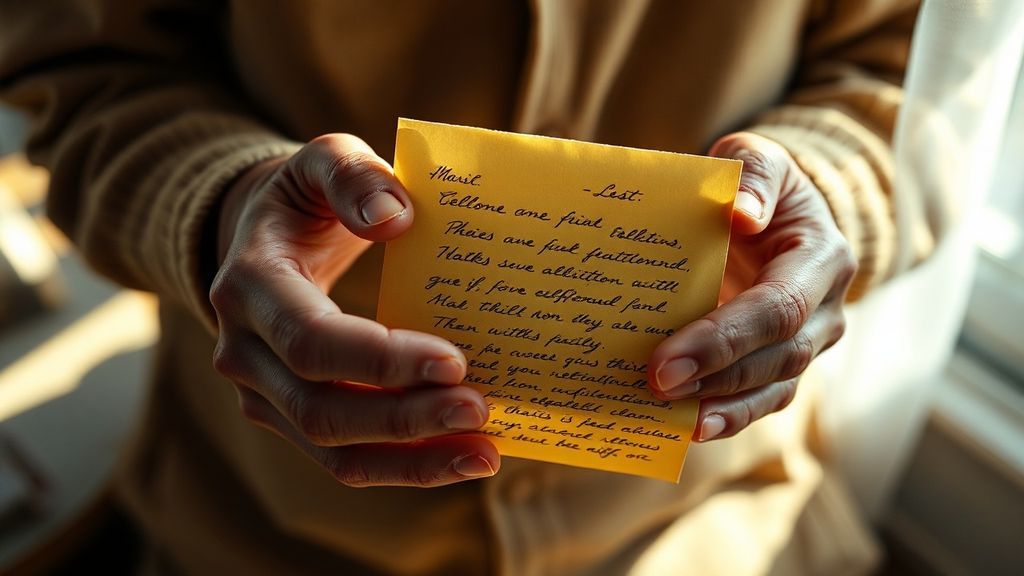
To compose a letter to your future self in the Oliver mode is to practice reverse archaeology. Instead of digging for what remains, you are burying what you hope will be found: not the pottery shard, but the whole vessel, the meal it once held, the hands that shaped the clay.
Begin with inventory. Not of feelings, but of facts that contain feelings:
- The three objects on your nightstand right now, including their precise condition (the water ring on the wood, the frayed charging cable)
- The last thing someone said to you today, rendered with their exact syntax, not your polished version
- The quality of light in the room where you are writing—angle, color temperature, what it does to the shadows
- A single movement your body made recently that you did not choose: the involuntary reach for a hand that wasn't there, the shoulder hunch against a memory
These are verbs of muscle. These are adjectives of exactitude. They require the writer to slow down sufficiently to notice, and in that slowing, something paradoxical happens: the letter becomes not less emotional but more so, because the reader—your future self, your future child, the stranger you cannot yet imagine—will feel their way in through the concrete, will reconstruct the emotion you never named from the particulars you provided.
The Loneliness of Building a Time Machine
I spend most nights alone with a screen, pair-programming with LLMs until 2 or 3 AM, mapping architectures while the world sleeps. That extreme digital solitude taught me something I couldn't have learned any other way: the most profound conversations we have are often with versions of ourselves that don't exist yet. We are all, in some sense, sending signals forward into the dark, hoping someone will be there to receive them.
But here's what haunts me—I've built systems that will outlast me, deployed code to cold servers that will hum in data centers long after I'm gone, yet I know the fragility of it all. Platforms die. Formats rot. The cloud is just someone else's computer, and computers fail. A letter written with painstaking precision, buried in a service that vanishes in an acquisition or a bankruptcy, becomes the same as a letter never written at all.
This is exactly why I obsessed over end-to-end encryption and extreme server redundancy when building EterMail. Because I know that a letter written to the future needs to be guarded even more fiercely than a bank password. The time-locked release, the durable format, the refusal to let algorithms scan your grief or your joy—these aren't features. They're the structural equivalent of verbs of muscle, adjectives of exactitude: the engineering choices that make a digital object as holdable as a chipped ceramic mug.
The letter that survives is the one that is both precisely written and precisely preserved.

The Radical Act of Refusing to Summarize
We live in an age of abstraction acceleration. Our communications trend toward emoji, toward shorthand, toward the efficient transmission of category rather than particular. Vibes. Mood. This. The future-letter, written in Oliver's register, is a small rebellion against this compression. It insists that your specific life matters in its specificity, that the generalization happy is a violence against the irreplaceable complexity of your actual happiness, your actual sorrow.
To write to your future self with verbs of muscle and adjectives of exactitude is to make a bet against time: that the particular will outlast the general, that the physical will outlast the interpretive, that the hand on the mug, the weight, the warmth, the chip—these will reach across years and still be holdable.
The regret that haunts us at midlife, at end of life, is rarely that we failed to feel. It is that we failed to make our feelings permanent in language dense enough to survive us. We felt everything, and recorded almost nothing, or recorded it in summaries so thin that time passed straight through.
Mary Oliver's instruction was never only about poetry. It was about the only immortality available to us: the creation of texts so physically present that future strangers—our own estranged selves among them—can enter them like rooms, can breathe their air, can know, finally, that we were here, that this happened, that it mattered in exactly this way.
The coffee mug waits on your desk. The letter waits to be written. The future waits to receive what you have made too precise to dissolve.
FAQs
What should I include in a letter to my future self to make it emotionally meaningful?
Focus on specific sensory details rather than emotional summaries. Describe the exact objects in your room, the precise quality of light, the particular way someone moves or speaks—these concrete particulars will reconstruct feeling more powerfully than any abstract declaration of happiness or sorrow.
How do I write about my current life without it feeling trivial or boring?
The ordinary is not the enemy of meaning; inattention is. The way your keyboard sounds, the stain on your favorite shirt, the route you walk to buy groceries—these become precious precisely because they will change or disappear. Your future self will read for evidence of having lived, not for drama.
Why do letters to my future self often feel disappointing when I finally read them?
Most disappointment stems from abstraction: you wrote I was so excited instead of the way my hands shook dropping the keys three times before I could unlock the door. The feeling requires its physical container to survive transmission across time.
What is EterMail?
EterMail is a revolutionary time capsule service that allows you to send messages, photos, and videos to the future (up to 30 years). Seal your memories and thoughts today, and they'll be delivered when the time is right.
Time Capsule
Send messages up to 30 years in the future
Rich Media
Text, photos, and videos supported
Secure & Private
Your memories are safely encrypted
EterMail Team
We're the team behind EterMail, dedicated to helping you preserve and share timeless messages with your loved ones. Our mission is to make it easy to express your love, share your wisdom, and create lasting connections that transcend time.
Frequently Asked Questions about Letters to Future
What should I include in a letter to my future self to make it emotionally meaningful?
How do I write about my current life without it feeling trivial or boring?
Why do letters to my future self often feel disappointing when I finally read them?
Related Articles
Why I Built EterMail: A Time Capsule for the People I Love Most
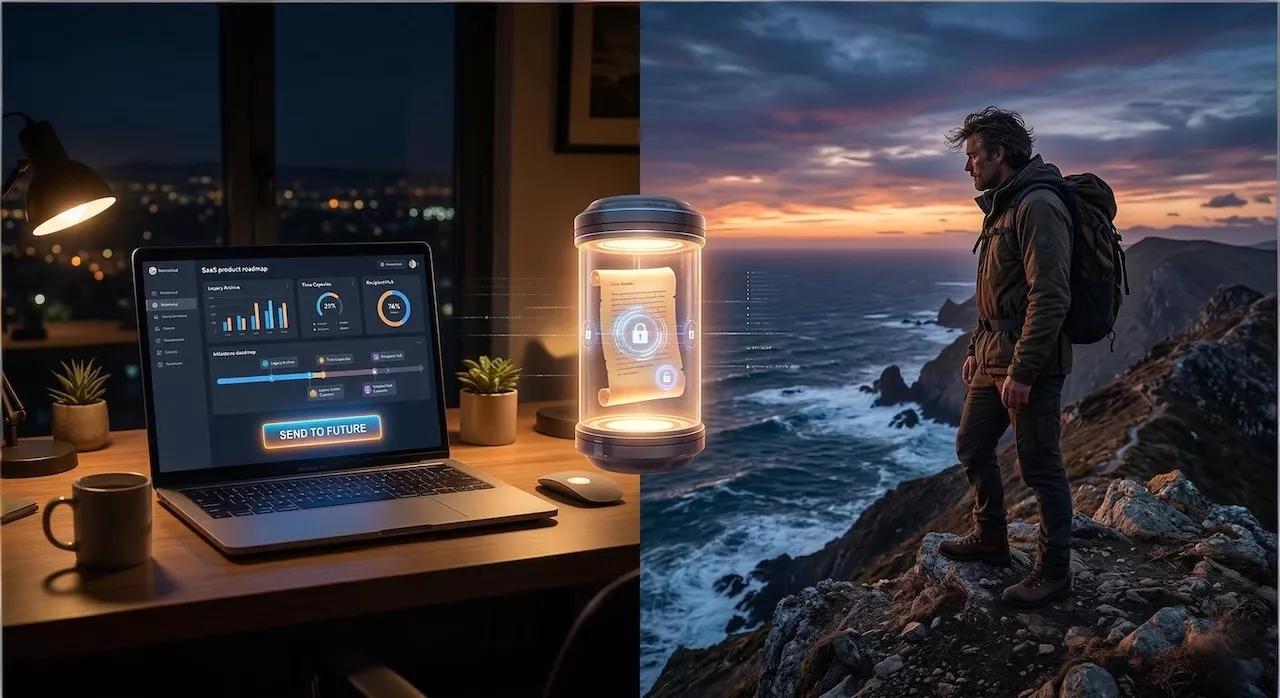
I’m a Product Manager who spends all week optimizing for the "immediate now." But getting lost off the grid on a mountain ridge made me realize I had zero infrastructure for the "forever." Here’s why I stopped worrying about conversion rates for a moment and built EterMail—a secure, tamper-proof digital time capsule for the people I love most.

The Most Radical Letter to Your Future Self Is a Promise to Stay Unfinished
The best letter to your future self isn't a memory—it's a mandate. Learn how writing to the version of you still working with love changes everything.
The Ice Tray at Midnight: On Grief, Domestic Minutiae, and the Quiet Work of Becoming Yourself Again
Why do the smallest habits hurt most after someone leaves? A reflection on grief, domestic minutiae, and the quiet moment healing finally begins.